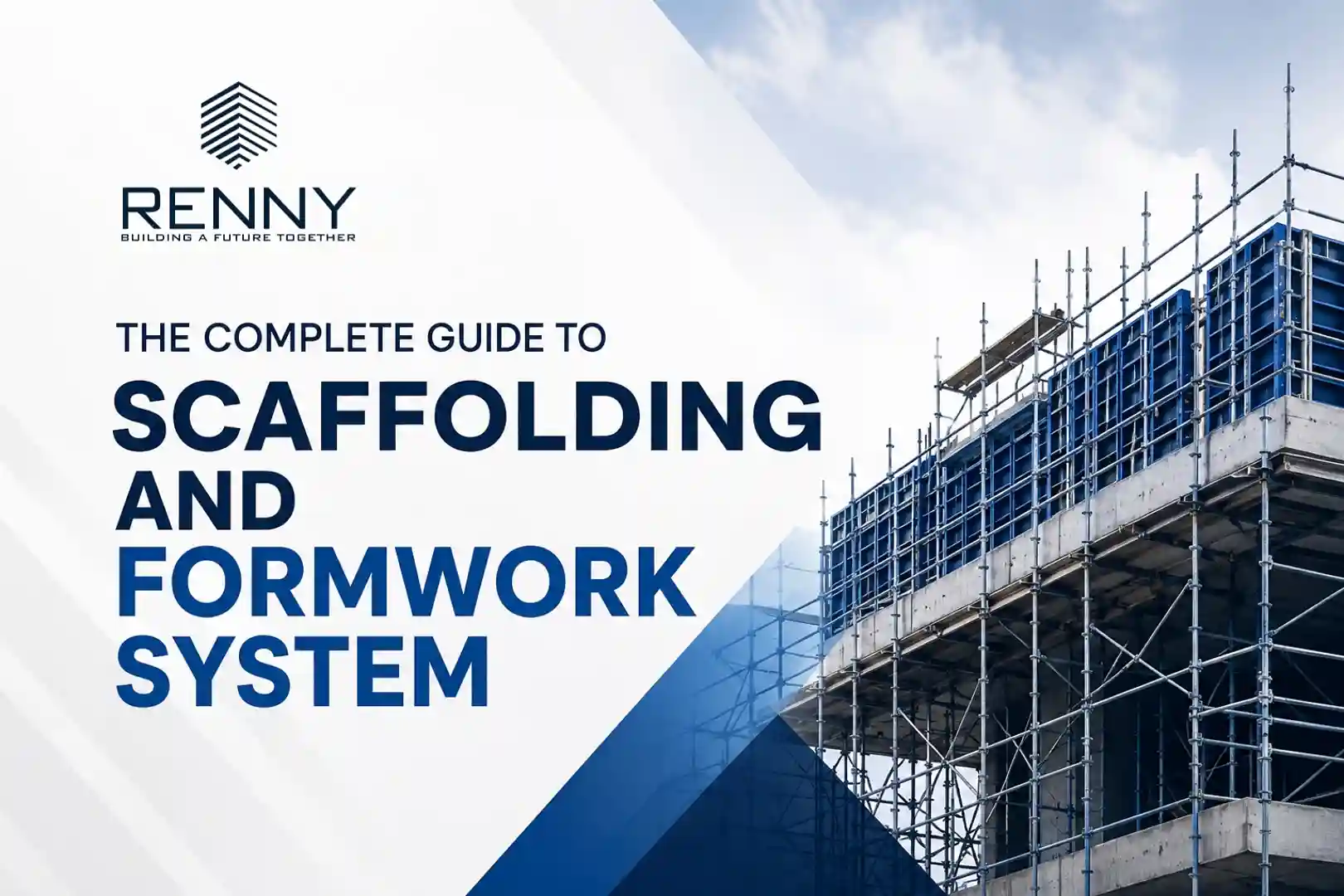
Stand at any active site in Gurgaon, Pune, or Hyderabad. Two things are running at once. Workers are climbing to access finished floor levels, façade panels, and external finishes. Two floors below them, wet concrete is sitting inside aluminum or timber molds, waiting to cure. Those two systems, scaffolding and formwork, operate in parallel on almost every serious build in India. Different equipment. Different failure modes. Same principle: get the temporary structure right so the permanent one can happen. This guide covers both. If you're a contractor, project manager, or procurement head evaluating scaffolding and formwork systems, temporary support systems, or industrial scaffolding for a new project, the decisions here affect your safety record, your cycle time, and your cost per handover. Worth getting right.
What are Scaffolding and Formwork in Construction?
Scaffolding and formwork are essential temporary systems used in construction projects. Scaffolding provides safe elevated platforms and access for workers, tools, and materials during construction, maintenance, and repair work. Formwork, on the other hand, is a temporary mold used to shape and support wet concrete until it gains strength. Together, these systems improve safety, structural accuracy, construction speed, and overall project efficiency while reducing risks, delays, and costly rework on-site.
Difference Between Scaffolding, Formwork, Shuttering, and Shoring
| System | Primary purpose | Supports | Common usage |
|---|---|---|---|
| Scaffolding | Worker access | Workers and tools | Façade work, repairs, inspections |
| Formwork | Shape concrete | Wet concrete | RCC construction, slabs, beams, columns |
| Shuttering | Temporary mold surface | Concrete face | Slabs, beams, columns, walls |
| Shoring | Structural support | Loads temporarily | Excavation support, repair, strengthening |
Scaffolding is for access. Scaffolding and shuttering are different jobs entirely. Formwork and shuttering shape concrete. Shoring provides temporary load support when a structure or excavation needs help carrying weight. Falsework is a broader term that covers any temporary structure supporting another structure during construction, including formwork props and shoring frames.
Why Choosing the Right Scaffolding & Formwork System Matters in Modern Construction
In today’s fast-evolving infrastructure landscape, construction projects demand more than just speed; they require safety, precision, durability, and sustainability. This is where choosing the right Scaffolding & Formwork System becomes critical for ensuring operational efficiency and long-term structural reliability.
At Renny Scaffolding & Formwork System, every solution is engineered to support modern construction requirements while maintaining the highest industry and safety standards.
Engineered for Performance & Safety
Construction environments require dependable systems capable of withstanding heavy operational demands. The various critical components of Scaffolding & Formwork System play a vital role in ensuring worker safety, structural stability, and seamless project execution.
From access platforms and support structures to load-bearing frameworks, every component must deliver exceptional strength and precision. Choosing the right Scaffolding & Formwork System helps improve productivity, reduce downtime, and maintain safer working conditions across construction sites.
Renny Scaffolding & Formwork System is designed for strength, safety, and long-term durability making it the right choice for modern infrastructure projects
Premium Manufacturing Backed by Vertical Integration
One of the strongest advantages of Renny Scaffolding & Formwork System lies in its fully integrated manufacturing ecosystem
Renny produces nearly 90% of its raw materials in-house through its vertically integrated manufacturing infrastructure. This enables strict quality control, consistency in production, and superior product reliability across every stage of manufacturing
The systems are manufactured using premium-grade raw materials and Green Steel recognized by the National Institute of Secondary Steel Technology (NISST), Ministry of Steel, Government of India
This commitment to material excellence ensures that every Renny Scaffolding & Formwork System delivers exceptional structural performance while meeting demanding domestic and global infrastructure requirements
Sustainable Manufacturing for a Better Future
Sustainability is no longer optional in the construction industry; it is essential
Renny’s manufacturing process generates nearly 40% lower emissions compared to conventional industry benchmarks, reinforcing the company’s commitment to responsible industrial practices.
The company also operates a 22 MW solar power plant that contributes nearly 30% of its total energy requirements, making the manufacturing ecosystem significantly more energy efficient and environmentally responsible
This fully integrated production model is strategically aligned with CBAM compliance standards, helping meet evolving international sustainability and export regulations.
By combining advanced manufacturing with eco-friendly operations, Renny Scaffolding & Formwork System stands as the right choice for projects focused on both performance and environmental responsibility.
Built to Meet Global Infrastructure Demands
Modern infrastructure projects require solutions that deliver reliability across diverse applications and challenging environments.
Renny Scaffolding & Formwork System is manufactured to maintain the highest industry standards while supporting the growing needs of commercial, industrial, and infrastructure development projects
Every system is engineered with a focus on:
- Structural stability
- Worker safety
- Operational efficiency
- Long-term durability
- Sustainable construction practices
Designed to meet both domestic and global infrastructure demands, Renny continues to strengthen its position as a future-ready and globally competitive manufacturing brand.
The Right Choice for Modern Construction
Selecting the right Scaffolding & Formwork System directly impacts project timelines, construction quality, safety standards, and long-term performance.
With premium raw materials, vertically integrated manufacture
Scaffolding & Formwork Critical Components
Scaffolding Systems
- Ringlock Systems
Flexible modular scaffolding designed for complex structures and heavy-load applications. The rosette locking mechanism allows multi-directional assembly with high stability.
- Cuplock Systems
Widely used quick-lock scaffolding system featuring self-locking cup joints for faster installation. Suitable for high-rise construction and large infrastructure projects
- Frame Scaffolding
Pre-engineered walk-through and ladder frame systems designed for easy access and quick setup. Ideal for general construction and maintenance work
- Kwikstage Systems
Durable wedge-lock scaffolding system built for medium and heavy-duty applications. Offers rapid assembly along with dependable structural performance
- Access Towers
Mobile and stationary aluminium or steel towers designed to provide safe access at height for inspection, painting, repair, and maintenance activities.
Props and Shoring Systems
Adjustable steel props and robust shoring towers designed to provide temporary vertical support during slab casting and concrete curing. Telescopic mechanisms ensure accurate height adjustment and reliable load-bearing capacity.
Couplers
Swivel, fixed, and sleeve couplers engineered to securely connect scaffold tubes at different angles. Manufactured using drop-forged or pressed steel for enhanced strength and durability.
Nuts
Wing nuts, prop nuts, and tie rod nuts designed for reliable fastening in scaffolding and formwork systems, ensuring secure and stable connections.
Tubes
Scaffold tubes produced using in-house ERW Pipes & Tubes manufacturing facilities. Available in standard 48.3 mm outer diameter along with customised sizes. Hot-dip galvanised finishes are also available for improved corrosion resistance.Learn how GI Pipes achieve long-term corrosion resistance through the galvanization process.
Applications of Scaffolding and Formwork
- High-rise building construction
The pipeline runs across Delhi NCR's Dwarka Expressway corridor, Mumbai's peripheral nodes in Thane and Navi Mumbai, and Bengaluru's Sarjapur and Whitefield belts. Scaffolding for construction supports façade access, finishing, and inspection. Formwork for concrete construction builds every slab, beam, column, and core wall
- Infrastructure and bridge projects
Suspended and Cuplock bridge scaffolding systems go under bridge decks for inspection and repair. Specialized formwork handles piers, abutments, and deck slabs. The metro and expressway expansion across India keeps this segment in high demand.
- Industrial maintenance and refineries
Refineries from Panipat to Jamnagar. Cement plants in Rajasthan and MP. Fertilizer units in Punjab and UP. Thermal stations in Haryana and Chhattisgarh. Annual turnarounds need industrial scaffolding access inside vessels, around pipe racks, under exchangers. Tube and coupler, Ringlock, and suspended systems all see heavy use here.
- Commercial construction projects
Office towers, malls, hotels, and mixed-use developments across every major metro. Modular formwork drives the concrete work. Scaffolding handles the façade finish and cladding installation.
- Residential construction
Frame and H-frame scaffolding for external access. Aluminum or modular formwork for floors and walls. In large housing projects, formwork cycle time directly determines how fast units get handed over.
- Tunnel and metro construction
Access platforms, falsework, and formwork for precast and in-situ tunnel lining. The metro expansion in NCR, Bengaluru, Mumbai, Chennai, and Hyderabad keeps this active year-round
- Event and stage structures
Speaker towers, lighting rigs, temporary grandstands. All scaffold-based. Fast erection and de-rig required.
Scaffolding and Formwork Safety Guidelines
This is where contractors get into trouble.
Key scaffolding & formwork safety standards in India
Indian standards sit under IS 3696 (safety code for scaffolds and ladders) and IS 4014 (code of practice for steel tubular scaffolding). For formwork and falsework, IS 14687 applies. The Building and Other Construction Workers Act, 1996 makes site safety the contractor's legal responsibility. International references including EN 12811 and OSHA 1926.451 apply on export or cross-border projects. [VERIFY current IS revision numbers before specifying]
Scaffolding regulations in India are not optional. Construction safety compliance protects the contractor legally, not just the workers physically.
Daily scaffold & formwork inspection checklist
Scaffolding & formwork should be inspected by a trained, competent person before every shift, after any significant weather event, and after any change or alteration to the structure. The checklist:
- Baseplates and sole boards
- Guardrails and mid-rails
- Couplers and locking points
- Plank condition and gap width (under 25 mm)
- Access ladders and stair units
- Tie-ins and anchoring points
- Bracing and alignment
The supervisors who skip the morning inspection are the ones giving statements to the labour commissioner later.
Common scaffolding & formwork hazards
Falls from height. Overloading a platform beyond its duty class. Inadequate anchoring to the building. Weather: monsoon wind above 40 kmph along the coast, dense North India winter fog that drops visibility below 50 meters, pre-monsoon thunderstorms in central India. Proximity to live overhead cables on congested urban plots.
For formwork specifically: fresh concrete generates enormous lateral pressure on wall forms. That pressure is time-dependent, pour-rate-dependent, and temperature-dependent. Formwork stripped too early or props removed before design strength is reached doesn't just fail. It fails suddenly.
PPE required for scaffold & formwork work
Safety harness, helmet, anti-slip footwear, gloves. Non-negotiable on any platform above 2 meters.
How to Choose the Right Scaffolding and Formwork System
Match the system to the job. Not the cheapest option that sort of fits.
- Based on project type
High-rise towers generally go Ringlock or Cuplock for scaffolding and aluminum or modular for formwork. Residential goes H-frame and aluminum. Industrial sites go tube and coupler or Ringlock. Don't use a light frame system for a 30-storey build. Don't use heavy Ringlock for a school repaint
- Based on height and load capacity
Higher work and heavier materials mean stronger systems, better bracing, and clearer duty ratings. Always check the manufacturer's published load table at the specific bay size you'll actually use, not a generic brochure figure.
- Based on site conditions
Black cotton soil across central India swells and shifts with moisture and can move a screw jack over a single monsoon. Coastal exposure in Mumbai or Chennai accelerates corrosion on unprotected steel. Congested plots in Old Delhi or south Mumbai leave little room for standard base configurations. Site geometry matters as much as height
- Based on budget and reusability
For a one-off job, a cheaper system works. For a contractor running 20 projects a year, the certified galvanized system that lasts 15 years beats the painted system that needs replacing every three. Reusable formwork systems pay back fast on repetitive housing and infrastructure work.
- Based on assembly speed
For repetitive housing or infrastructure work, time saved per cycle compounds. Modular formwork and modular scaffolding beat custom timber and tube-and-coupler on speed once the crew knows the system
Decision table
| Project type | Recommended scaffolding | Recommended formwork |
|---|---|---|
| High-rise towers | Ringlock | Aluminum or modular |
| Residential buildings | H frame | Aluminum |
| Bridge projects | Cuplock | Steel or modular |
| Refineries | Tube and coupler | Steel |
| Fast housing projects | H frame | Aluminum |
What to Check before buying Scaffolding and Formwork
- Material quality and galvanization
Bare or painted steel rusts inside one monsoon. Faster in coastal Mumbai or Chennai than in dry Punjab or Rajasthan. Hot-dip galvanized scaffolding lasts a decade outdoors and beyond. Pay the difference.
- Load capacity certification
Ask for test certificates against the specific standard: IS 4014, BS 1139, AS/NZS 1576, EN 12811. Not a brochure claim. An actual certificate. Local unbranded fabricators usually can't produce one.
- Compatibility with existing systems
If you already run Cuplock from one supplier, frames from another brand may not lock cleanly. Cup spacings differ. Pin diameters differ. Confirm before mixing stock in the yard.
- Manufacturer certifications
Look for ISO certification, BS standards, and EN standards depending on the project requirement. A certified scaffolding manufacturer or industrial scaffolding supplier should be able to produce documentation against whichever standard the project specifies. If they can't, move on.
- Factory manufacturing capabilities
A proper scaffolding manufacturer or formwork manufacturer has automated production lines, consistent welding quality, in-house testing procedures, and repeatable output. Ask to see the production floor. If a vendor refuses a factory audit, that tells you what you need to know.
- After-sales support and availability
Spare parts availability, replacement lead times, technical support, and delivery reliability matter as much as the first-order price. A scaffolding supplier that disappears after the invoice is a liability on a long project.
Scaffolding and formwork cost factors
Material type
| Material | Initial cost | Lifespan | Maintenance |
|---|---|---|---|
| Steel | Medium | High | Low |
| Aluminum | High | High | Low |
| Timber | Low | Low | High |
For a detailed comparison of material properties, costs, durability, and applications, explore our guide Scaffolding & Formwork Materials Compared
- Galvanized vs painted systems
Galvanized systems cost more upfront and outlast painted systems outdoors by years. The math usually favors galvanized scaffolding from the third project onward.
- Labor and installation costs
Fast-assembly systems reduce labor time. A system that's cheap to buy but slow to erect often costs more by day 10 than the more expensive modular alternative.
- Transportation and Storage costs
Heavier and bulkier systems cost more to move and store. Stacking efficiency, yard space, and transport weight all factor into total ownership cost.
- Maintenance and Lifecycle Costs
Systems that are easy to clean, inspect, and repair win over the full lifecycle. A galvanized scaffolding system maintained properly is cheaper per project in year five than a painted system replaced in year two.
Common Mistakes Buyers and Contractors make
- Buying Low-Quality Material
Poor steel, weak welds, and bad coatings create hidden risk and short service life. The savings on day one disappear fast when components fail on site.
- Ignoring Safety Standards
Using unverified equipment creates legal, safety, and insurance exposure. The BOCW Act 1996 and the applicable IS standards exist for a reason.
- Underestimating Quantity Requirements
Buying too little and planning to shift. The plan: erect, strip, move along the elevation. The reality: teardown and rebuild eats crew hours on every cycle. Owning enough to cover the full elevation in one go usually breaks even by the third project
- Mixing Incompatible Systems
Different brands often don't lock properly. Unstable connections, failed inspections, site stoppages.
- Skipping Inspection and Maintenance
Material comes back bent, threads chewed, couplers loose. If nobody checks before the next dispatch, you're sending the damaged kit to the next site. That's how accidents start.
Maintenance Tips for Long-Lasting Scaffolding and Formwork
- Proper Storage Practices
Store in a dry, organized yard. Keep components off wet ground. Separate damaged parts from usable stock immediately on return, before they get mixed back in.
- Cleaning and Rust Prevention
Mud, concrete residue, and rust off the threads, tube ends, and moving parts after every use. Components stored dirty corrode faster and fail sooner.
- Inspection Before Reuse
Inspect every batch before dispatch. Bent tubes, cracked couplers, worn jack threads. Don't send out anything you'd be uncomfortable explaining to a safety officer.
- Replacing Damaged Components
A visibly damaged component reused on the next project is the next accident waiting to happen. Replace, don't patch.
Why Certified Scaffolding and Formwork Systems are worth the Investment
Certified systems reduce accident risk on site. They clear procurement approval faster on regulated infrastructure and government projects. They produce consistent output across repeated deployments. And they survive long enough to pay back the higher upfront cost many times over.
A certified scaffolding manufacturer or formwork manufacturer with documented quality control, ISO certification, and published load ratings is not just safer. It's easier to defend to a client, an insurer, and a labour commissioner. Industrial-grade formwork and high-quality scaffolding systems cost more at purchase. They cost less by year three, and considerably less by year ten.
The math on certified systems isn't complicated. It's just longer than the first invoice.
Conclusion
Scaffolding and formwork are not background items on a construction site. They determine whether the permanent structure goes up safely, accurately, and on schedule. The wrong temporary construction structure costs more in delays, rework, and accidents than the saving on day one ever justified.
Choose certified systems. Maintain them properly. Buy from a scaffolding manufacturer or formwork manufacturer who can prove quality, document load ratings, and show you the factory. That's how you get safer sites, faster cycle times, and lower total cost across the life of the equipment.
Ready to specify the right system for your project?
Explore scaffolding systems, request a quote, download technical specifications, or contact the manufacturing team to discuss your project requirements.
Frequently Asked Questions
What is scaffolding & formwork used for in construction?
Scaffolding gives workers a safe elevated platform for building, repair, painting, inspection, and maintenance work. It also keeps tools and materials within reach at height, which reduces climbing time, improves safety, and speeds up execution. Without it, most work above two floors becomes impractical and unsafe.
What is the difference between scaffolding and formwork?
Scaffolding supports people and materials at height for access and finishing work. Formwork supports wet concrete until it hardens into the required structural shape. Scaffolding is for workers. Formwork is for concrete. They're often on the same site simultaneously but serve completely different functions.
Which scaffolding & formwork system is best for high-rise buildings?
Ringlock and Cuplock are the most common choices for high-rise and complex projects because they're strong, modular, and efficient to assemble at height. Ringlock handles irregular geometry better. Cuplock is faster on straightforward layouts. The right choice depends on the site geometry, load requirement, and build sequence.
Is steel scaffolding better than aluminum scaffolding?
Steel is usually better for heavy-duty construction. Stronger, more widely available, often more economical for large yards. Aluminum is lighter and easier to move, which makes it useful for mobile scaffolding and indoor work where shifting the setup frequently matters more than raw load capacity
What safety standards apply to scaffolding & formwork in India?
IS 3696 and IS 4014 are the primary Indian codes. IS 14687 covers falsework. The Building and Other Construction Workers Act, 1996 governs site safety responsibilities. International projects may require EN 12811 or OSHA 1926.451 compliance. Confirm the exact standard before procurement and installation.
Need Help Choosing the Right Product?
Have questions about pricing, technical details, or bulk orders? Get in touch with our team.