
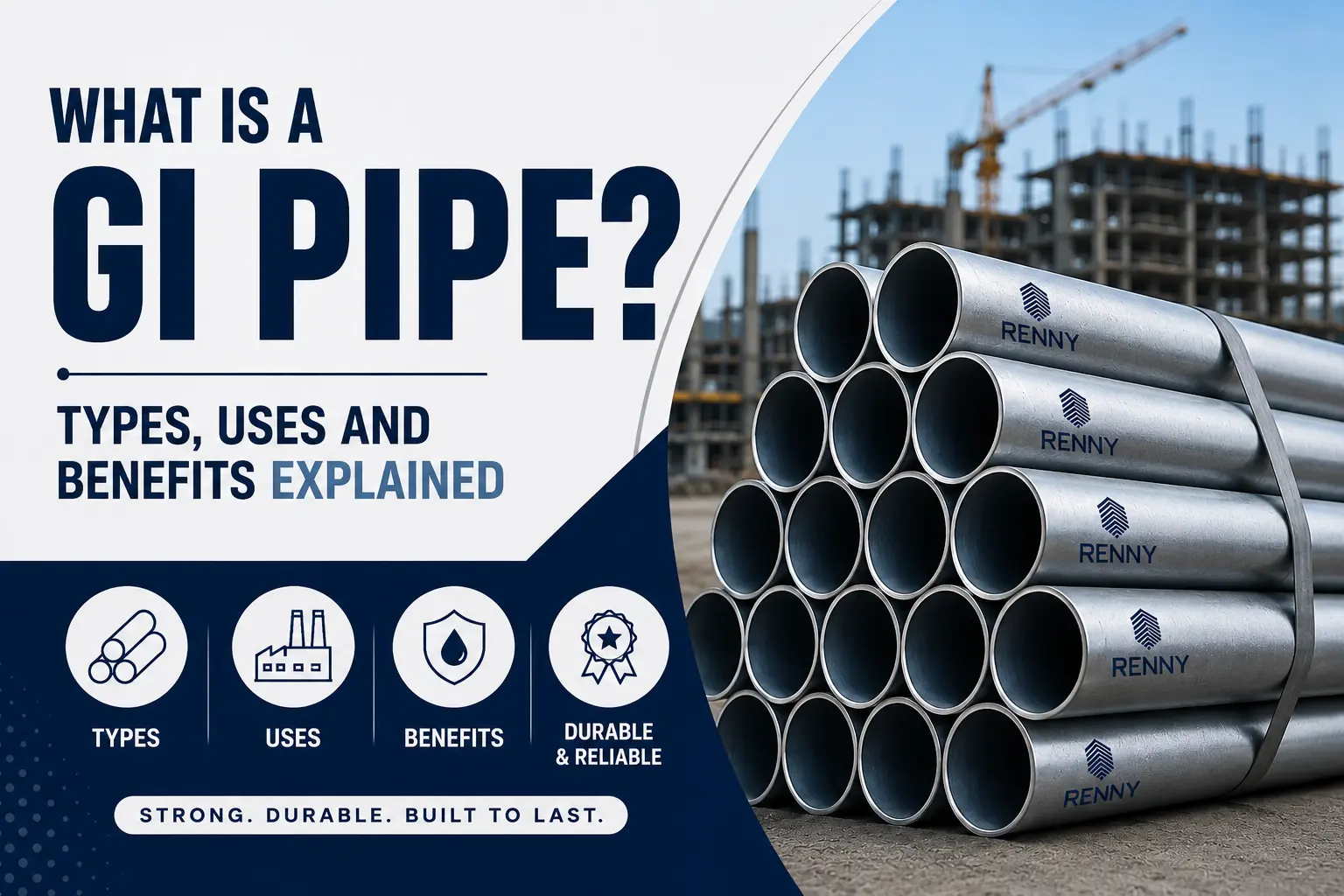
Ask a procurement engineer or a plant manager what holds modern piping infrastructure together, and you'll hear the same answer more often than not: GI pipe. Nobody puts it on a trade show banner. But on construction sites, at water utilities, on farms, in industrial plants, galvanized iron pipe is doing more of the actual work than almost anything else out there.
So if you've ordered GI pipe before and never quite known what you were paying for, what it's made from, how it's put together, where it shines, and where it doesn't hold up, this should clear it up.
What Is a GI Pipe?
Mild steel, coated in zinc through galvanization. That's the pipe in a sentence. The part worth understanding is what that coating actually does: it takes steel that would otherwise rust through fairly quickly and gives it staying power in conditions that would chew up bare steel in months.
Here's the mechanism. Moisture and oxygen hit the surface first, and the zinc reacts before the steel ever does. That's sacrificial protection. Scratch the coating during install, and the surrounding zinc still has your back, continuing to protect the exposed steel underneath. Engineers call this cathodic protection. It's a big reason GI pipe holds up so much better than untreated steel once you're outdoors, underground, or anywhere damp.
Put steel's strength together with zinc's resistance to corrosion, and you get the reason GI pipe shows up everywhere from water distribution to structural work, agriculture, fire protection, and general industrial use. These are places where you can't afford a failure, but you also can't blow the budget.
How GI Pipes Are Manufactured: Step-by-Step Process
Step 1: Steel Coil Selection
The process begins with high-quality steel coils, which are selected and slit to the required width based on the desired pipe diameter. The quality of the finished pipe also depends on the consistency of the
Step 2: Pipe Forming
The steel strip passes through a series of forming rollers that gradually shape it into a cylindrical pipe.
Step 3: Electric Resistance Welding (ERW)
The edges of the steel strip are joined using the Electric Resistance Welding (ERW) process, the same manufacturing technology used to produce high-quality ERW Pipes & Tubes for industrial and infrastructure applications.
Step 4: Surface Cleaning and Pretreatment
Before galvanizing, the pipe is thoroughly cleaned to remove
- Mill scale
- Oil and grease
- Dirt and other contaminants
This ensures proper bonding of the zinc coating.
Step 5: Galvanizing Process
The pipe is then coated with zinc using one of the following methods:
- Hot-Dip Galvanizing
The pipe is immersed in molten zinc to create a thicker, highly durable coating for industrial and structural applications
- Electro-Galvanizing
Zinc is applied through electroplating, producing a thinner and more uniform coating suitable for lighter-duty applications.
Step 6: Quality Inspection and Testing
Before dispatch, the pipes undergo rigorous quality checks, including:
- Dimensional inspection
- Hydrostatic pressure testing
- Weld integrity verification
- Zinc coating thickness measurement
- Compliance testing as per industry standards
Step 7: Packaging and Dispatch
Only pipes that meet the required quality standards and specifications are approved for packaging and shipment to customers.
Types of GI Pipes
Not every job needs the same wall thickness or pressure tolerance.
- Light Class GI pipes
Light Class handles low-pressure work, domestic water supply, internal plumbing, irrigation lines, and temporary structures. Modest load, modest pressure, lowest cost.
- Medium Class GI Pipes
Medium Class thickens the wall up a notch for moderate pressure. This is usually what gets specified for commercial buildings and industrial water lines, the middle ground most projects land on.
- Heavy Class GI Pipes
Heavy Class is the thick-walled option for serious demands: industrial plants, infrastructure, structural work, high-pressure systems, fire protection. When there's zero room for failure, this is the class you reach for.
Why GI Pipe Earns Its Place on the Spec Sheet
Corrosion resistance tops the list; it's the single biggest reason GI pipe wins out over bare steel in anything humid, wet, or outdoors, and most specifiers don't think twice about defaulting to it. Properly installed, it can run for decades, which matters when you're amortizing infrastructure costs over a project's whole lifecycle. Steel's natural strength means it handles structural loads, pressure, and impact without the brittleness (or the price tag) that comes with a lot of corrosion-resistant alternatives.
Compare it to stainless steel, copper, and specialty coatings, and GI pipe tends to win on the cost-to-performance trade, which is really the whole reason it stays the volume choice industry-wide. Maintenance stays low because the zinc layer does most of the protective work by itself. It cuts, threads, and welds with standard tools, so labor and lead times stay predictable for contractors working against the clock. And steel recycles about as well as any material gets, which counts for more every year as procurement teams start weighing environmental impact alongside price
Industries That Use GI Pipes
GI Pipes are used across various industries. Some of the top industries where galvanized pipes are used are as follows:
Construction Industry
GI pipes are widely used for structural frameworks, handrails, fencing, and in conjunction with Scaffolding & Formwork Systems on construction projects.
Water Distribution
One of the most common GI pipe uses is transporting potable water in residential, commercial, and industrial buildings.
Agriculture
Farmers use GI pipes for irrigation systems, borewell connections, pump installations, sprinkler systems, and greenhouse structures.
Industrial Manufacturing
Manufacturing plants rely on GI pipes for utility lines, compressed air systems, cooling water circulation, and general process piping.
Fire Protection Systems
The durability and corrosion resistance of GI pipes make them suitable for sprinkler and firefighting installations.
Infrastructure Projects
Government and private infrastructure projects use GI pipes in bridges, highways, public utilities, railways, airports, and urban development.
Solar Structures
GI pipes are increasingly used in solar mounting systems because they withstand outdoor weather conditions and provide long-term structural stability.
GI Pipe vs. Ordinary Steel Pipe
| Feature | GI Pipe (Galvanized Pipe) | Ordinary Steel Pipe |
|---|---|---|
| Corrosion Resistance | Excellent resistance due to zinc coating | Poor resistance; corrodes quickly when exposed to moisture |
| Protection Mechanism | Zinc coating provides a barrier and cathodic protection, even if scratched | No protective coating; exposed steel rusts immediately |
| Maintenance Requirements | Low maintenance and fewer replacements | Requires regular maintenance and anti-corrosion treatment |
| Durability in Outdoor Conditions | Performs well in outdoor, buried, and humid environments | Deteriorates rapidly in harsh environmental conditions |
| Lifespan | Approximately 30 years or more, depending on conditions | Approximately 10 years in similar conditions |
| Suitability for Moisture-Prone Areas | Highly suitable for water lines, outdoor structures, and high-humidity applications | Not recommended for prolonged exposure to moisture |
| Long-Term Cost | Lower lifecycle cost due to reduced maintenance and longer service life | Higher lifecycle cost because of repairs and frequent replacement |
Factors to Consider Before Buying GI Pipes
Choosing the right GI pipe involves more than just checking the product label. To ensure long-term performance and reliability, consider the following factors before making a purchase:
- Pipe Diameter and Wall Thickness
The pipe's diameter and wall thickness should match the application's load-bearing and pressure requirements. Using the wrong specification can lead to reduced efficiency or premature failure.
- Pressure Rating
Ensure the pipe's pressure rating is suitable for its intended use, whether for water supply, industrial applications, or structural purposes.
- Zinc Coating Quality and Thickness
The effectiveness of a GI pipe largely depends on the quality and thickness of its zinc coating. A thicker, uniform coating provides better corrosion resistance and extends the pipe's lifespan.
- Compliance with Industry Standards
Always verify that the pipes comply with relevant manufacturing standards and certifications, as these ensure quality, safety, and performance consistency.
- Environmental and Corrosion Exposure
Consider the installation environment, including exposure to moisture, chemicals, or harsh weather conditions. Pipes used in corrosive environments may require higher-grade protection.
Application-Specific Requirements
Different applications have different requirements. Confirm that the pipe is suitable for its intended purpose, such as:
- Potable water systems
- Fire protection networks
- Structural and construction applications
- Agricultural and irrigation systems
Manufacturer Reputation and Track Record
One of the most important yet often overlooked factors is the supplier's credibility. Two GI pipes may have identical specifications on paper but perform very differently in real-world conditions due to variations in:
- Weld integrity
- Coating consistency
- Quality control processes
- Testing and inspection standards
Tips for Maintaining GI Pipes
GI pipes are low-maintenance, but a few simple practices can help maximize their lifespan:
- Inspect pipes periodically for scratches, dents, or other mechanical damage.
- Avoid prolonged exposure to corrosive chemicals that can damage the zinc coating.
- Ensure proper drainage in outdoor installations to prevent standing water.
- Replace damaged fittings promptly to avoid leaks and further deterioration.
- Use compatible threaded fittings and protective coatings where required.
- Follow the manufacturer's recommended installation and maintenance guidelines from the start.
Proper care and timely maintenance can significantly extend the service life of GI pipes and ensure reliable long-term performance.
Why Choose Renny’s, GI Pipes
You can't judge GI pipe quality by eyeballing the finished product; it's built in at every stage, starting with the steel strip and ending at final inspection. That's where Renny puts the effort. Built using advanced ERW technology, with strict quality control running through every stage of production, Renny GI Pipes are made for consistent strength, dimensional accuracy, and corrosion resistance you can actually count on.
A fully integrated manufacturing setup, rigorous testing at every step, and a real commitment to sustainable steel production mean every pipe leaving the Renny line meets the bar that modern infrastructure, industrial, and construction work demands. Water distribution, structural framework, engineering installs, whatever the application, Renny GI Pipes deliver reliability built on manufacturing discipline, not just numbers on a spec sheet.
Frequently Asked Questions (FAQs)
What is a GI pipe?
A GI pipe is a galvanized iron or galvanized steel pipe coated with zinc to protect it from rust and corrosion.
What does GI stand for in pipe?
GI stands for Galvanized Iron, referring to the zinc coating applied to the pipe's surface.
Is GI pipe a steel pipe?
Yes. Modern GI pipes are typically made from mild steel and then galvanized with zinc for enhanced corrosion resistance.
Why is GI pipe used?
GI pipes are widely used because they offer excellent durability, corrosion resistance, and a long service life in demanding environments.
What are GI pipes used for?
GI pipes are used in water supply systems, plumbing, construction, scaffolding, irrigation, fencing, fire protection, and various industrial applications.
How long do GI pipes last?
With proper installation and maintenance, GI pipes can last for 20 to 30 years or more, depending on the operating environment.
Is GI pipe stronger than PVC?
Yes. GI pipes are generally stronger and more impact-resistant than PVC pipes, making them suitable for high-pressure and structural applications.
Which pipe is better, GI or PVC?
The choice depends on the application. GI pipes are preferred for strength and durability, while PVC pipes are ideal for lightweight, corrosion-free plumbing systems
Conclusion
GI pipe didn't become a default spec by accident. It delivers what buyers actually need: strength, corrosion resistance, a price that makes sense, and a service life that holds up over decades. As more industries push toward durable, sustainable materials, GI pipe's footprint in water systems, structural builds, and industrial operations keeps growing instead of shrinking. The real question for most projects isn't whether to use GI pipe anymore. It's whose quality control you trust enough to build on.
Ready to source reliable GI pipes for your next project? Get in touch with our team today to discuss your requirements and explore high-quality galvanized piping solutions designed for strength, corrosion resistance, and long-term performance.
Need Help Choosing the Right Product?
Have questions about pricing, technical details, or bulk orders? Get in touch with our team.