
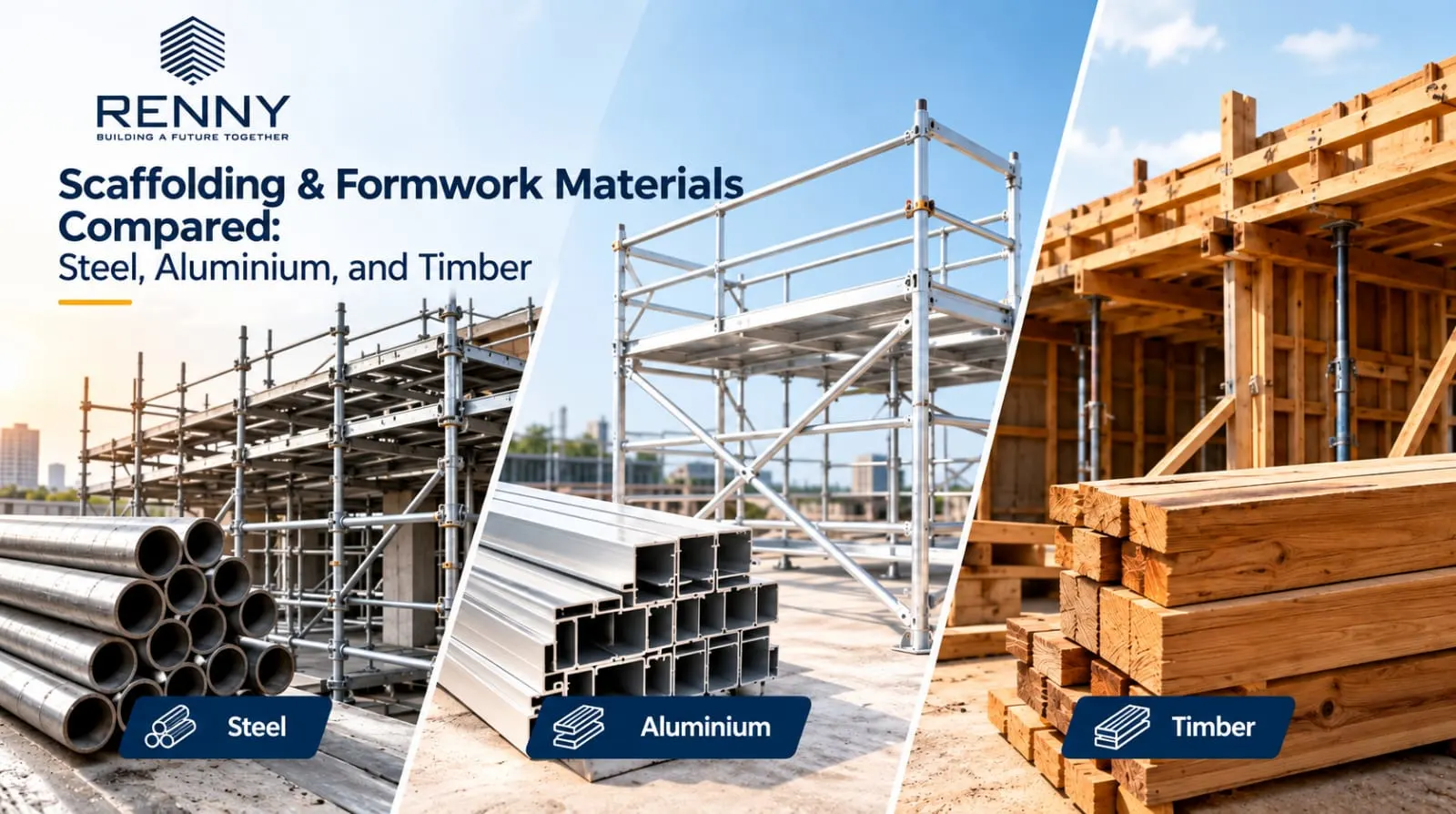
Steel, aluminium, and timber are the three materials most scaffolding and formwork projects choose between. As a quick rule: steel handles the heaviest loads and tallest structures, aluminium is the lightest and fastest to move, and timber survives today mainly as planking and formwork rather than as a load-bearing frame. The right pick still depends on the specific system, the site, and what the job actually needs — this guide walks through why.
Scaffolding and formwork do different jobs on a construction site, but the materials behind them work the same way either way. The material shapes everything downstream: how much weight the structure can carry, how fast a crew can put it up and take it down, how long it lasts, and what it costs over the life of a project.
This guide compares scaffolding materials types side by side, shows where each one earns its place, and gives you a simple way to figure out the best material for scaffolding on your specific project.
What Are Scaffolding & Formwork Materials?
Scaffolding and formwork materials are the raw materials — steel, aluminium, timber, and a few others — used to build the scaffolding components : standards, ledgers, frames, and platforms for scaffolding; panels, props, and ties for formwork. Steel and aluminium now dominate most professional projects, while timber holds a smaller but still useful role, mainly for planks and boards.
Scaffolding gives workers a safe platform to stand and work on, and it often carries some of the load itself. Formwork does something different — it holds and shapes wet concrete until the concrete is strong enough to support its own weight. Both jobs can be built from the same handful of materials, which is why comparing scaffolding materials side by side is useful whichever one you're specifying.
For a broader look at how the two systems fit together — applications, safety, and buying tips — see our complete guide to scaffolding and formwork systems.
Steel Scaffolding & Formwork: Built for Strength and Rigidity
Steel is still the default choice for heavy-duty scaffolding and formwork, and for good reason. It's strong, it holds its shape under load, it lasts with basic care, and it can be cut, shaped, and welded into almost any configuration a project needs.
But the grade of steel alone doesn't tell the whole story. How thick the tubes are, how the pieces connect, how the bracing is arranged, and what the ground beneath the structure can support all decide how much a system can really carry. That's why the manufacturer behind the steel matters just as much as the steel itself.
Key Advantages of Steel
- Carries more weight than aluminium or timber, which is why it's the default for demanding jobs
- Holds its shape and stays stable at height when the system is designed correctly
- Lasts for years and can be reused across many projects, as long as it's coated and inspected regularly
- Easy to cut, shape, and weld into custom parts
- Works for almost anything — industrial sites, infrastructure, and complex formwork jobs
Limitations of Steel
The trade-off is weight. Steel components are heavier to move, which slows down setup and can mean bringing in machinery on bigger jobs. Steel also rusts if it isn't protected — galvanizing, coatings, and regular inspection are what keep it performing for its full lifespan instead of wearing out early.
Renny's Approach to Steel
Not all steel carries the same environmental cost, and for export buyers and ESG-conscious clients, that's becoming part of the buying decision rather than a nice-to-have extra. Renny Strips Ltd. is recognised as a 5-Star Green Steel manufacturer by NISST (Ministry of Steel, Government of India), and produces a low-emission Green Line range backed by a 22MW solar-powered plant. For international buyers navigating the EU's carbon border rules (CBAM), Renny's emissions dashboard gives shipment-level data on request — so proving your supply chain is clean doesn't have to mean extra paperwork.
Where Steel Is Most Suitable
- High structural capacity and rigidity requirements
- Heavy-duty, repeated, or long-term use
- Industrial and infrastructure construction
- Complex or customised fabricated configurations
- Projects where CBAM or ESG documentation is part of the procurement criteria
Aluminium Scaffolding & Formwork: Lightweight and Easy to Handle
When weight and speed matter more than maximum load capacity, aluminium is usually the better scaffolding material. It's substantially lighter than steel, which means faster transport, quicker setup and take-down, and fewer people needed to move it.
Key Advantages of Aluminium
- Low weight — the core advantage over steel systems
- Easier to handle by hand, cutting down labour and time on relocation-heavy jobs
- Highly mobile — well suited to systems that move often between work areas
- Naturally resists rust — a thin oxide layer forms on the surface and protects it, so no galvanizing needed
Limitations of Aluminium
Light doesn't mean weak, but it does mean less headroom. Depending on the alloy and design, aluminium usually carries less weight and flexes more than a steel system built for the same job. It can also cost more upfront per component — though lower transport and labour costs often even that out over the life of a project.
Where Aluminium Is Most Suitable
- Mobile scaffolding towers and maintenance work
- Interior and fit-out applications
- Jobs requiring frequent relocation
- Sites where minimising manual handling is a priority
Timber Scaffolding & Formwork: Flexible for Selected Applications
Timber's role as the primary structural material for professional scaffolding has narrowed as standardised metal systems took over, but it hasn't disappeared. It still shows up in planks, decking, temporary platforms, walkways, and formwork and shuttering — anywhere flexibility and easy on-site modification matter more than a standardised load rating.
Advantages of Timber Scaffolding Materials
Timber is easy to cut and adapt on site, familiar to most crews, and often the most affordable option for limited-use, irregular, or site-specific jobs.
Limitations of Timber Scaffolding Materials
Unlike steel or aluminium, timber isn't standardised. Its strength varies by species, grade, moisture level, age, and condition, so each piece needs to be checked rather than assumed to perform like the last one. Moisture exposure in particular can cause swelling, warping, or decay over time.
Scaffolding Material Comparison: Steel vs Aluminium vs Timber
| Metric | Steel | Aluminium | Timber |
|---|---|---|---|
| Strength & Rigidity | High when properly engineered | Good strength-to-weight ratio; depends on application | Varies by grade and condition |
| Weight | Heaviest | Lightest | Light, varies by species |
| Handling | Needs more effort, sometimes machinery | Easy to move by hand | Easy to cut and adapt on site |
| Durability | High with coating and maintenance | Good natural rust resistance | Sensitive to moisture and pests |
| Reusability | High | High | Lower, depends on application |
| Mobility | Moderate | High | Suitable for select uses |
| Relative Cost | Moderate material cost, higher labour to move | Higher material cost, lower labour cost | Lowest overall cost |
| Heavy-Duty Use | Well suited | Depends on application | Limited |
| Typical Applications | Heavy-duty scaffolding, infrastructure, industrial formwork | Mobile towers, maintenance, lightweight work | Planks, decking, formwork, temporary structures |
Actual performance always depends on the specific product, material spec, system design, load, and the manufacturer's technical data — treat this table as a starting point, not a substitute for engineering sign-off.
What Determines Scaffolding Material Performance
Two systems built from the same material can perform very differently. What actually determines capacity and stability is the complete engineering picture:
- Material grade
the exact spec behind the steel, aluminium, or timber used
- Component size
tube width, wall thickness, and frame dimensions
- Connections
how couplers, joints, welds, and locking mechanisms transfer weight through the structure
- Bracing
how standards, ledgers, transoms, and ties work together for stability
- Rated load
what the system is actually built to carry
- Site conditions
the ground, height, wind exposure, and nearby structures
Always choose, build, and use scaffolding according to its rated capacity and the manufacturer's instructions — not a general assumption about what steel or aluminium 'should' be able to handle.
What About Formwork?
Formwork has one extra job that scaffolding doesn't: holding and shaping wet concrete until it sets. That adds a few more things to think about — how much pressure the wet concrete puts on the panels, how fast it's poured, how the props are arranged, how much a panel can bend under load, the finish you need on the concrete surface, and how soon you can strip the formwork away. All of that comes on top of everything scaffolding already has to satisfy. For projects that repeat the same pour again and again, a reusable formwork system built around your actual cycle time is worth more than one picked on price alone.
Best Material for Scaffolding: How to Choose
So what is the best material for scaffolding on your project? It depends on what you need most. Steel fits when carrying capacity, stiffness, and repeated heavy-duty use come first — and increasingly, when a project needs proof of low-emission sourcing for CBAM or ESG requirements.
Aluminium fits when low weight, frequent relocation, and reduced manual handling drive the decision — mobile towers, maintenance, and fit-out work.
Timber fits for planks, decking, and formwork jobs where site-specific modification matters more than a standardised load rating.
In the end, the decision should come down to the full system — design, expected loads, site conditions, and the manufacturer's own specifications — not just the material's name
Working through a scaffolding or formwork decision for an upcoming project? Talk to Renny Strips Ltd. about your load requirements, timeline, and any CBAM or ESG documentation your buyers need.
How to Select the Right Scaffolding Materials for Your Project
- Load Requirements
what the system needs to support: workers, tools, materials, and equipment.
- Height and Configuration
as height and complexity increase, stability, bracing, ties, and wind effects matter more.
- Handling and Relocation
frequent movement favours lightweight scaffolding materials.
- Site Environment
humidity, coastal exposure, chemicals, and temperature all affect material choice and the protection it needs.
- Total Lifecycle Cost
purchase price is only one input. Transport, labour, erection, dismantling, maintenance, storage, and reuse over the project's duration often matter more than the sticker price.
Can Different Scaffolding Materials Be Combined?
Yes — but not just because two parts happen to fit together. A steel or aluminium scaffold can reasonably use timber decking, for example, but only after checking the whole setup against dimensions, connections, load ratings, and the manufacturer's requirements. Mixing parts from different systems or manufacturers should only happen once you've confirmed they're actually compatible — not assumed.
Why Engineering and Manufacturing Quality Matter
Material is only one piece of the puzzle. How components are designed, welded, machined, inspected, and finished decides whether a system performs consistently on site. This matters even more for custom components or unusual dimensions — the gap between what's on the design spec and what actually shows up on site gets closed by careful manufacturing, not material choice alone.
Renny Strips Ltd.: Engineered Steel, Backed by Data
Renny Strips Ltd. brings together material expertise, precision manufacturing, and in-house engineering to support scaffolding and formwork applications that need more than a standard catalogue part. That means:
- 5-Star Green Steel recognition from NISST, Ministry of Steel, Government of India
- Green Line — a low-emission product range built for ESG-conscious and export buyers
- A 22MW solar-powered manufacturing base, cutting the carbon footprint behind everything we produce
- A live emissions dashboard giving buyers real-time, checkable data — built for CBAM compliance without the paperwork
- Engineering support for structural analysis, custom component design, and application-specific configurations
This applies across our steel, aluminium, and timber-compatible systems, not just the raw steel itself. For construction professionals evaluating scaffolding and formwork for export-facing projects, ESG reporting, or simply demanding structural loads, that combination — engineered strength plus verifiable sustainability data — is the difference between buying steel and buying a supply chain you can defend to your own buyers.
Conclusion: Choosing the Best Material for Scaffolding
Steel, aluminium, and timber each earn their place in construction. Steel wins on strength and stiffness, aluminium wins on weight and mobility, and timber holds on for planks, decking, and site-specific formwork.
But the material is only the starting point. Design, loading, connections, bracing, site conditions, manufacturing quality, and total cost over the project's life are what actually decide whether a scaffolding or formwork system performs — and increasingly, so does the emissions data behind the material itself.
Have a scaffolding or formwork requirement? Talk to Renny Strips Ltd. about your project and application.
Frequently Asked Questions
What is the best material for scaffolding?
There's no single best material for every job. Steel suits heavy-duty, engineered scaffolding; aluminium suits mobile, weight-sensitive work; timber suits planks and short-term setups. The right choice depends on system design, loading, height, and applicable standards.
Is steel or aluminium scaffolding stronger?
Steel generally offers greater load capacity and rigidity, but actual performance depends on the complete system — material spec, component dimensions, connections, and bracing.
Is aluminium scaffolding suitable for high-rise construction?
It can be, for specific elevated applications where lightweight handling matters — but suitability depends on the engineered system, height, and stability requirements, not weight alone.
Why is steel widely used for scaffolding?
Its combination of strength, rigidity, durability, and reusability suits a broad range of heavy-duty and engineered applications, from infrastructure to industrial formwork.
Is timber still used for scaffolding?
Yes, but in a narrower role — planks, decking, temporary platforms, and formwork rather than the primary structural frame.
Which scaffolding material is easiest to transport?
Aluminium is the easiest to transport and handle, since it's substantially lighter than steel and rarely needs machinery to move on site. Timber is also light but less durable for repeated transport and reuse.
What is the best material for a scaffold tower?
Aluminium is usually the best material for a scaffold tower, thanks to its low weight, quick assembly, and natural rust resistance — ideal for towers that get moved often between work areas.
Can steel and timber be used together?
Yes, once their compatibility and the complete arrangement have been checked against load, connection, and safety requirements.
What should contractors consider when selecting scaffolding?
Load requirements, height, configuration, site conditions, how often it needs to move, corrosion exposure, reuse, and total lifecycle cost — including manufacturer support and, increasingly, emissions documentation for export-facing projects.
What should be considered when selecting formwork?
Concrete pressure, pour rate, panel design, prop arrangement, how much the panel can bend under load, the finish needed on the concrete surface, dimensional accuracy, stripping time, and intended reuse.
Need Help Choosing the Right Product?
Have questions about pricing, technical details, or bulk orders? Get in touch with our team.