
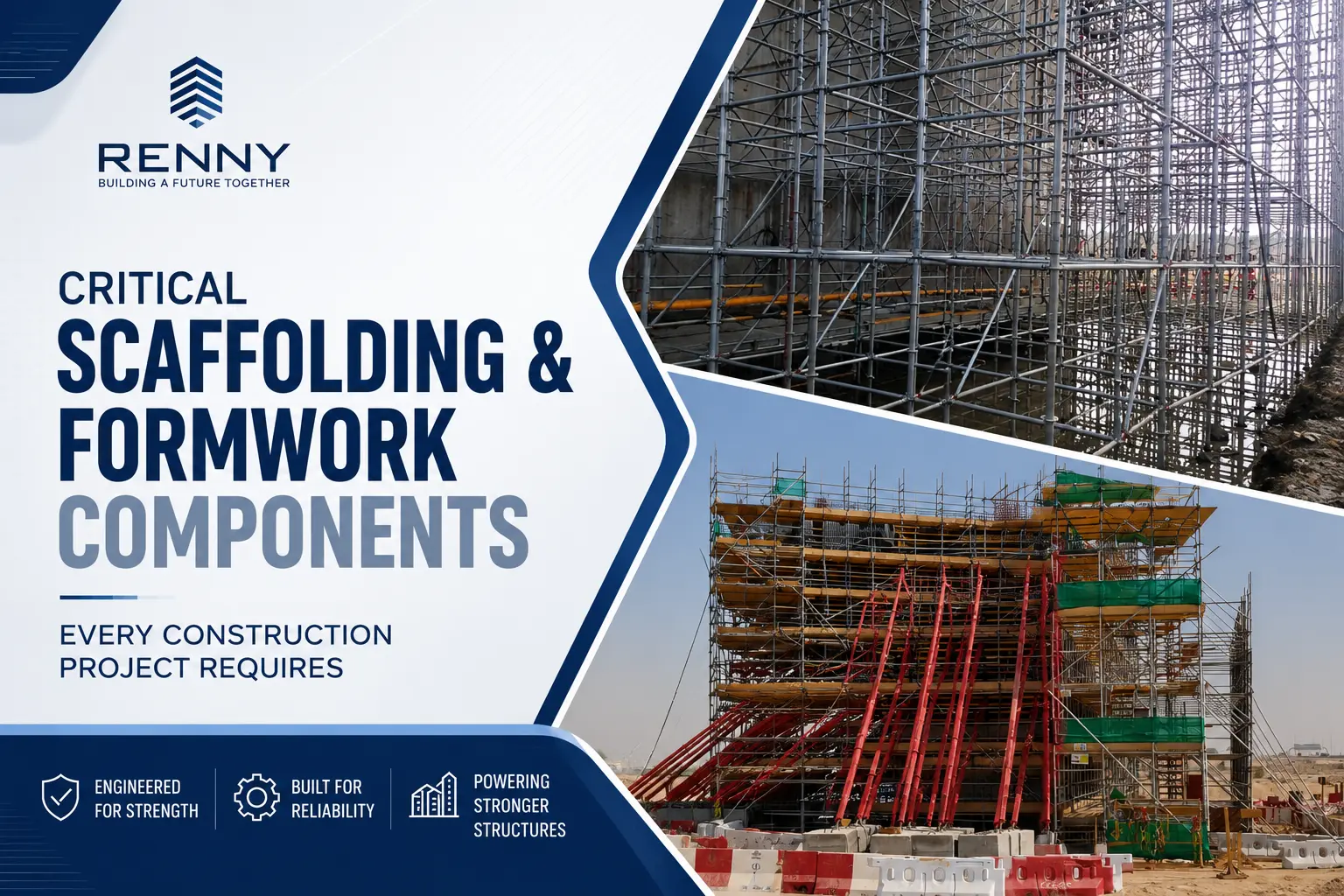
Walk onto any active construction site, and you'll notice something: nothing moves without scaffolding and formwork doing their job first. These systems don't get much glory, but strip them out and the whole project stalls. Residential blocks, commercial towers, industrial plants, highway bridges- doesn't matter what's being built; the same basic rule applies. Vertical standards, ledgers, adjustable props, tie rods. Each one is doing something specific, and if even one part is wrong, the rest of the system feels it.
So it pays to actually understand what these components do, not just buy whatever's cheapest or most available. Components that are engineered well spread load more evenly; they cut delays, they keep the crew safer, and honestly, they make it a lot easier to stay on the right side of international standards when inspection time comes. Below, we've broken down the components you'll run into on almost every job site what they're for, why they matter, and a few things worth thinking about before you place an order.
12 Critical Scaffolding & Formwork Components Every Construction Project Requires
- Standards (Vertical Posts)
Everything rests on the standards. Literally, they're the vertical members carrying load from the structure straight down into the foundation. Made from high-strength steel, because there's no room for flex here.
- Ledgers
Run horizontally, tie the standards together, and suddenly the whole frame has some rigidity to it. Ledgers also give transoms and platforms something to rest on, spreading the load out instead of letting it pile up in one spot.
- Transoms
Sit perpendicular to the ledgers and hold up the planks and platforms workers actually stand on. Get the transoms wrong, and everything above them becomes shaky not somewhere you want a crew working.
- Diagonal Braces
Wind pushes, loads shift, and a scaffold without bracing will sway. Diagonal braces stop that lateral movement cold. A properly cross-braced structure just feels different to stand on more solid, less give.
- Base Plates & Adjustable Base Jacks
Nothing above is stable if the ground-level connection isn't right. Base plates spread the load across the surface; adjustable jacks pick up the slack when the ground isn't level, which let's be honest, it rarely is.
- Steel Planks & Working Platforms
This is where people actually stand. Galvanised steel has mostly replaced older materials here, and for good reason: it doesn't slip easily, holds up under fire exposure, and lasts through repeated use.
- Guard Rails & Toe Boards
Simple idea, huge impact on safety. Guard rails keep people from going over the edge; toe boards keep tools and debris from falling on whoever's below. Two small components, outsized role.
- Couplers & Connectors
The joints that hold everything together. Sounds minor until you realize a poorly made coupler is often where failures start. Good ones speed up assembly and just feel tighter when you're building.
- Adjustable Props
Temporary support for slabs and beams while concrete cures; nothing fancy, but essential. Because they adjust, one prop can cover a range of heights instead of needing a custom part for every job.
- U-Heads
Sit on top of the props, hold the beams and timber steady during casting, and make sure loads transfer where they're supposed to instead of drifting off-center.
- Tie Rods & Wing Nuts
Keep formwork panels from spreading apart under the sheer pressure that wet concrete puts on them. Not glamorous, but skip these, and you'll see it in the finished wall.
- Soldiers & Walers
Add stiffness to bigger formwork jobs and spread pressure across the panels evenly. You'll see these on bridges, retaining walls, and industrial foundations, anywhere the pour is big enough that pressure really adds up.
Benefits of High-Quality Scaffolding & Formwork Components
It's tempting to cut corners on components to save a bit upfront. Don't. Good ones pay for themselves fast, and here's how.
Improved Worker Safety
A stable, well-built framework simply fails less often. Fewer collapses, fewer falls, fewer near-misses on site- that's the direct payoff of components rated to actually handle the loads they'll see.
Faster Installation and Dismantling
Precision manufacturing means parts go together (and come apart) without a fight. Less labour time, quicker turnarounds, less standing around waiting for something to fit.
Enhanced Structural Stability
Load spreads the way it's supposed to when the engineering behind the components is sound. The result: less deformation, fewer surprises mid-project.
Reduced Maintenance and Lifecycle Costs
Durable parts break down less. That means fewer repairs, fewer replacements, and a lower total cost across the life of the equipment not just the purchase price. Material selection also affects scaffolding and formwork cost, durability, and maintenance. Explore our comparison of Scaffolding & Formwork Materials
Durable parts break down less. That means fewer repairs, fewer replacements, and a lower total cost across the life of the equipment not just the purchase price.
Improved Construction Productivity
Reliable equipment keeps the work moving. Every breakdown or maintenance stoppage is time lost, so components that don't fail often are components that keep schedules intact.
Superior Concrete Finishes
Formwork that holds its shape and alignment gives you smoother, more consistent surfaces once the concrete cures and a lot less rework afterward.
Longer Service Life
Built from premium materials with real engineering behind them, these components take a beating and keep performing, project after project.
Compliance with International Standards
Certified components give contractors something to point to when regulators or clients ask questions. It's not just a checkbox; it's proof the equipment actually meets the bar.
International Standards for Scaffolding & Formwork
None of this matters much without a benchmark to hold it against. That's what these standards are for:
- EN 12811
Temporary Works Equipment – Performance Requirements and General Design
- EN 1090
Execution of Steel Structures and CE Marking
- ISO 9001
Quality Management Systems
- ISO 14001
Environmental Management Systems
- ISO 45001
Occupational Health and Safety Management Systems
- ISO 3834-2
Quality Requirements for Fusion Welding of Metallic Materials
Go with certified systems, and you're not just buying equipment; you're buying assurance that it'll hold up to the standards global infrastructure projects actually demand.
Why Renny Strips Ltd. is the Preferred Partner for Scaffolding & Formwork Components
Who makes the components matters as much as the components themselves. Renny Strips Ltd. is one of India's leading integrated manufacturers, producing Ringlock Systems, Cuplock Systems, Kwikstage Systems, Adjustable Props, Base Jacks, U-Heads, Steel Planks, Walk Boards, and more. Premium-grade steel, robotic welding, and precision engineering that combination is what gives their products the strength and durability contractors actually need on site.
Advanced Manufacturing with Sustainable Practices
Renny Strips runs vertically integrated manufacturing paired with modern technology, which keeps quality consistent batch after batch. The company has built its production around the Carbon Border Adjustment Mechanism (CBAM) framework and uses an AI-monitored Emission Dashboard to keep tabs on carbon output across the plant. Around 30% of energy needs come from captive solar, which helps bring emissions in at roughly 40% below the industry average.
Internationally Certified Quality
EN 1090 (Execution Class 2), ISO 9001, ISO 14001, ISO 45001, ISO 3834-2: Renny Strips holds all of them, and it shows in the components they ship. Pairing solid engineering with genuinely sustainable manufacturing means contractors get equipment that's safer, stronger, and built with the environment in mind.
Conclusion
Modern construction needs more than something to prop things up temporarily. It needs engineered systems that deliver on safety, precision, efficiency, and sustainability all at once. High-quality Scaffolding & Formwork Systems are what infrastructure projects actually rest on, protecting workers, keeping schedules realistic, and holding the finished structure to a real standard.
Choose certified components made from proper materials, and contractors end up more productive, spend less over the equipment's lifecycle, and stay compliant without extra headaches. As construction leans further into smarter, more sustainable practices, working with a manufacturer who's already ahead of that curve stops being optional; it becomes a real advantage.
Integrated manufacturing, internationally recognised certifications, a genuine commitment to sustainable steel, and a clear eye on where low-carbon manufacturing is headed that's what makes Renny Strips Ltd. a trusted partner for Scaffolding & Formwork Systems worldwide. Landmark infrastructure, industrial builds, commercial projects Renny delivers equipment built to hold up over the long run.
Frequently Asked Questions (FAQs)
What are Scaffolding & Formwork Components?
They're the individual structural pieces that make up a scaffolding or formwork system, working together to provide stability, load-bearing support, worker safety, and accurate concrete shaping.
What are the main Scaffolding & Formwork Components?
Standards (Vertical Posts), Ledgers, Transoms, Diagonal Braces, Base Plates & Adjustable Base Jacks, Steel Planks & Working Platforms, Guard Rails & Toe Boards, Couplers & Connectors, Adjustable Props, U-Heads, Tie Rods & Wing Nuts, and Soldiers & Walers. Each has its own job, and together they keep the whole system strong.
Why are high-quality Scaffolding & Formwork Components important?
Because they hold up better, keep workers safer, spread load more efficiently, and need less upkeep. Projects finish faster and cost less over time when the components are actually good.
Which Scaffolding & Formwork Components are essential for worker safety?
Rails, Toe Boards, Steel Planks, Diagonal Braces, and Base Plates are the ones doing the direct safety work, stopping falls, adding stability, and keeping access secure at height.
What international standards apply to Scaffolding & Formwork Components?
EN 12811, EN 1090, ISO 9001, ISO 14001, ISO 45001, and ISO 3834-2 are the main ones. Meeting them means the components are held to globally recognised benchmarks for quality and safety.
How do I choose the right Scaffolding & Formwork Components?
Check load-bearing capacity, durability, corrosion resistance, how well it fits your existing system, compliance with international standards, and, just as important, the manufacturer's actual certifications.
How do certified Scaffolding & Formwork Components benefit construction projects?
Consistent quality, reliable performance, easier compliance with regulations. On top of that, lower maintenance costs and fewer disruptions across the project's lifespan.
Why choose Renny Strips Ltd. for Scaffolding & Formwork Components?
Because they manufacture a full range of components using premium-grade steel, advanced engineering, and robotic welding backed by vertically integrated manufacturing, real certifications, and a genuine commitment to sustainable steel production.
Need Help Choosing the Right Product?
Have questions about pricing, technical details, or bulk orders? Get in touch with our team.