
The global manufacturing and construction landscapes are undergoing a profound paradigm shift. For decades, industrial procurement decisions were governed strictly by a classical triad: quality, cost, and delivery lead times.
Today, a critical fourth dimension has permanently altered the calculus of international trade the carbon footprint of raw materials. Driven by unprecedented regulatory mandates, evolving capital markets, and a systemic push toward corporate sustainability, international buyers are aggressively auditing their supply chains. The primary target of this scrutiny is steel, an essential backbone of global infrastructure that historically accounts for approximately 7% to 9% of global greenhouse gas emissions.
Manufacturers investing in sustainable steel manufacturing are becoming preferred partners for buyers seeking environmentally responsible and export-ready steel solutions.
As multinational corporations commit to aggressive Science Based Targets (SBTi) and net-zero roadmaps, purchasing traditional, emission-heavy steel is increasingly viewed as a commercial and financial risk. To remain competitive in standard-bearing markets like the European Union, North America, and developed parts of Asia, industrial buyers are seeking partnerships with agile, technologically advanced, low-carbon steel manufacturers.
This comprehensive analysis explores the macroeconomic and technical drivers behind these shifts, examines the operational criteria driving procurement decisions, and highlights how forward-thinking manufacturers like Renny Strips Ltd. are setting new benchmarks for sustainable industrial production.
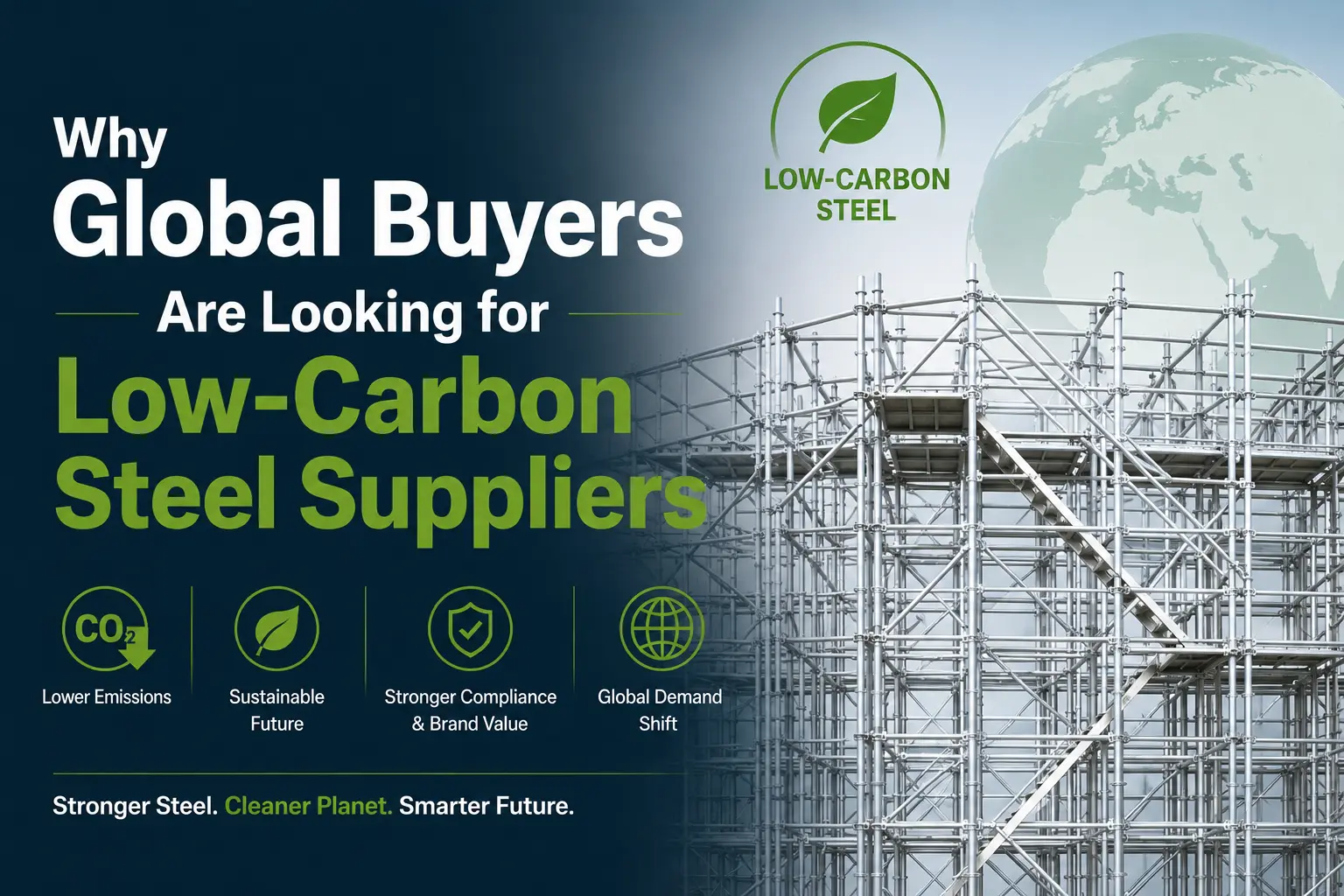
Why Low-Carbon Steel Has Become a Procurement Priority
Sourcing negotiations used to be decided almost entirely on two figures: landed cost and lead time. That calculus no longer holds. Emissions have moved from a footnote in a sustainability report to a legitimate financial risk; a quote that looks competitive on paper can end up costing more once border levies and compliance overhead are factored in.
Several forces are converging here. Buyers now treat carbon exposure as a cost risk to be underwritten, not an environmental side issue. Demand for verifiably sustainable steel is rising well beyond the brands that market themselves as green; plenty of conventional manufacturers need supplier emissions data simply to complete their own disclosures. Regulatory pressure, investor scrutiny, and internal sustainability targets are landing on procurement desks at the same time, and sourcing decisions increasingly have to be defended on emissions with the same rigor they've always been defended on price.
Key Factors Driving Demand for Low-Carbon Steel Suppliers
CBAM and the Future of Steel Exports
Ask any buyer why emissions data now shows up before pricing discussions, and the answer traces back to one policy: the EU's Carbon Border Adjustment Mechanism. CBAM puts a carbon price on imported steel and other carbon-intensive goods, closing the gap between what importers pay and what EU producers already absorb under the Emissions Trading System.
Ask any buyer why emissions data now shows up before pricing discussions, and the answer traces back to one policy: the EU's Carbon Border Adjustment Mechanism. CBAM puts a carbon price on imported steel and other carbon-intensive goods, closing the gap between what importers pay and what EU producers already absorb under the Emissions Trading System.
The impact on exporters is immediate and unambiguous. A competitive quote built on a high-emission production route stops being competitive the moment CBAM applies, no matter how attractive the headline number was. Carbon intensity isn't a compliance footnote anymore; it's a sourcing criterion EU buyers are pricing in from day one.
And this isn't just a European story. The US, UK, and Canada are all developing their own versions of a carbon border mechanism. None has passed into law yet, but smart suppliers aren't waiting for the ink to dry. Forward-looking buyers are already restructuring supplier relationships around carbon performance, well ahead of any regulatory deadline. The message for producers is simple: get your emissions data in order now, or risk explaining it later, after the deal's already gone to someone who did
Scope 3 Emissions and Net-Zero Commitments
Net-zero commitments are now table stakes for large manufacturers, but for many, the hardest number on the balance sheet isn't the one they control directly. Purchased steel typically represents the largest single share of Scope 3 emissions: the indirect footprint embedded in a company's supply chain rather than its own four walls.
That's where the real exposure lives. A manufacturer can retrofit every facility with LED lighting and electrify its entire fleet, and still barely move the needle if the steel going into its products comes from a high-carbon process. Operational efficiency only gets you so far when the bulk of your carbon liability sits upstream, in someone else's mill.
The market has responded accordingly. Scope 3 has evolved from a reporting obligation into a procurement filter, and an increasingly strict one. Buyers aren't just asking about price and lead time anymore; they want verifiable emissions data before a contract gets signed. Low-carbon steel isn't a nice-to-have or a marketing angle; it's becoming a prerequisite for suppliers looking to compete for business from companies with targets validated under frameworks like the Science Based Targets initiative.
For steel producers, the message is clear: emissions performance is no longer a sustainability side conversation. It's a competitive differentiator, and increasingly, a condition of doing business at all.
Growing Preference for Sustainable Supply Chains
There's also a quieter force at work, one operating well outside any regulatory mandate. Institutional investors are asking harder questions about where carbon risk actually sits within a company's supply chain, and they expect answers with substance, not sustainability boilerplate.
Buyers across construction and infrastructure are demanding proof that project materials were sourced responsibly, not simply procured at the lowest bid. And traceability has moved from nice-to-have to non-negotiable: today's buyers want to verify where their steel came from, backed by data, not take a supplier's word for it.
How Steel Manufacturers Are Reducing Carbon Emissions
Cutting carbon out of steel production isn't a matter of a few efficiency tweaks. It requires rethinking how a plant sources its power, how components are engineered, and how emissions are tracked from the shop floor upward.
Energy is the biggest lever available to most manufacturers. Steel processing is energy-intensive, so the source of that power matters as much as anything else in the process. Captive solar generation allows a plant to offset a meaningful share of grid dependence with clean energy rather than drawing entirely from a fossil-heavy grid. Paired with tighter thermal management across rolling and processing mills, this trims energy waste out of the process itself, not just the power source behind it.
Design and automation carry nearly as much weight. AI-assisted product design enables generative modeling and stress simulation, letting engineers reduce the raw material a component requires without compromising performance, a practice known in the industry as lightweighting. Robotic welding adds precision on top, reducing spallation, rework, and rejected batches, which in turn cuts wasted material and energy per finished part.
None of this delivers full value without measurement. Digital carbon monitoring lets a manufacturer track emissions as they occur rather than estimate them after the fact, and manufacturers with greater control over their own raw material production typically achieve better traceability, since less of the supply chain is left unaccounted for upstream.
What Global Buyers Look for in a Low-Carbon Steel Supplier
Procurement teams evaluating steel suppliers today tend to work through a consistent checklist:
| Procurement Criteria | Why It Matters |
|---|---|
| Low carbon footprint | Easier compliance with global regulations |
| Renewable energy usage | Reduced production emissions |
| Carbon reporting | Supports CBAM and ESG reporting |
| Product quality | Consistent performance |
| Supply chain transparency | Better traceability |
| Export readiness | Smooth international trade |
| Manufacturing capability | Reliable production and delivery |
Manufacturers with integrated production capabilities can supply a wide range of steel products, from ERW Pipes & Tubes for infrastructure and industrial projects to Narrow Width HR Coils used in automotive and engineering applications.
How Renny Strips Ltd. Supports Sustainable Steel Procurement
As global buyers scour the international market for compliant partners, Renny Strips Ltd. has emerged as a premier choice, successfully synthesizing deep decarbonization with superior mechanical engineering. Renny Strips Ltd. has transitioned from a traditional manufacturing paradigm to an advanced, data-driven circular production model, systematically addressing the key pain points of global procurement managers.
Captive Solar Energy and Deep Emission Cuts:
At the center of Renny Strips Ltd.’s sustainable manufacturing process is its state-of-the-art captive solar power plant. This facility provides 30% of the entire plant’s operational energy requirements, directly replacing carbon-dense grid electricity with clean, zero-emission solar power.
This major shift in energy inputs, combined with optimized thermal management in their processing mills, enables Renny Strips Ltd. to operate with 40% fewer emissions than current global industry standards. Far from settling for this milestone, the company has launched a capital expenditure roadmap targeting a 50% absolute reduction in emissions in the near term, positioning it well ahead of the decarbonization curve mandated by international regulators.
The One-Click AI Emission Dashboard:
Auditing Redefined. For modern compliance officers, simply claiming a low-carbon footprint is insufficient; environmental data must be empirical, traceable, and ready for third-party auditing. Renny Strips Ltd. resolves this challenge through its cutting-edge AI-based emission dashboard. This digital infrastructure continuously captures data from energy meters, raw material logs, and shop-floor machines to calculate the real-time carbon intensity of every production batch.
For international buyers, this transparency shifts compliance from an administrative hurdle into a seamless operational advantage. With a single click, tracking and validation of the product’s carbon lifecycle can be executed. This instantly generates verifiable carbon accounting metrics suitable for CBAM customs declarations, ESG reports, and internal Scope 3 audits. By removing the administrative friction of environmental reporting, Renny Strips Ltd. saves procurement teams hundreds of hours in compliance overhead.
How Renny Strips Ltd. Supports Sustainable Structural Steel Export
Global steel procurement is no longer driven solely by price and production capacity. Buyers also evaluate whether suppliers can consistently deliver engineered products like Scaffolding & Formwork Systems that meet international quality and sustainability expectations. Today’s buyers assess suppliers through a broader lens carbon performance, regulatory readiness, data transparency, and long-term reliability.
As sustainability regulations continue to reshape international trade, procurement leaders are increasingly selecting export partners whose credibility is supported by measurable performance rather than marketing claims.
Building Sustainability into Every Ton of Exported Steel
A truly sustainable steel exporter embeds environmental responsibility into its production and logistics processes, rather than treating it as an afterthought.
At Renny Strips Ltd., this approach is reflected in a manufacturing ecosystem designed to minimize environmental impact while maintaining export-grade engineering excellence.
A 22 MW captive solar power plant currently supplies nearly 30% of the facility’s total energy needs, replacing conventional grid electricity with clean, renewable energy. Alongside this, advanced process optimization and the integration of AI-driven technologies such as robotic welding systems and CNC automation ensure precision manufacturing while reducing waste and energy consumption.
These intelligent systems continuously adapt to production conditions, improving efficiency and lowering carbon emissions to approximately 40% below prevailing industry benchmarks.The company continues to advance with a clear roadmap aimed at achieving a 50% reduction in emissions, reinforcing its commitment to future-ready export manufacturing.
Transparency is the New Competitive Advantage in Global Trade
For international buyers, sustainability is no longer about declarations it is about verifiable data.Whether complying with Carbon Border Adjustment Mechanism (CBAM) requirements, ESG disclosures, or Scope 3 reporting, procurement teams increasingly demand accurate and traceable environmental information from their export suppliers.
To meet this need, Renny Strips Ltd. has implemented an AI-powered emission monitoring dashboard that continuously captures data from production equipment, energy systems, and raw material inputs. The platform calculates real-time carbon intensity across production batches and enables single-click tracking and validation of emissions, creating an auditable digital record throughout the manufacturing and export process.
Instead of spending weeks compiling environmental data manually, buyers gain access to reliable carbon information that supports compliance reporting and sustainability assessments with significantly reduced administrative effort.
Trust is Earned Through Data, Not Branding
In today’s global procurement landscape, supplier credibility is established long before commercial discussions begin.
It is built through operational transparency, consistent product quality, certified export-ready manufacturing practices, and the ability to provide dependable environmental data whenever required.
The strongest export-oriented manufacturing brands are not recognized simply because their logos are widely visible. They become preferred partners because every shipment meets international standards, every document withstands scrutiny, and every sustainability claim can be verified.
That is the foundation of long-term global business relationships.
Why Global Buyers Choose Sustainable Export Partners
Modern procurement teams seek suppliers who reduce risk while supporting their sustainability objectives across borders.
A manufacturing partner that combines engineering capability with measurable environmental performance offers more than steel it delivers confidence across the entire export supply chain.By investing in renewable energy, AI-driven manufacturing technologies, digital carbon intelligence, transparent production processes, and continuous operational improvement, Renny Strips Ltd. enables customers to procure structural steel with greater assurance, lower compliance complexity, and stronger long-term value.
In an industry where every specification is measured, credibility has become the most valuable specification of all.
Conclusion
The transition toward low-carbon procurement is a permanent realignment of global trade. The buyers who successfully secure green supply chains today will be the market leaders of tomorrow, possessing insulated margins, fully compliant logistics, and resilient corporate reputations. Partnering with a supplier that combines deep ecological responsibility with cutting-edge automation is no longer just a defensive risk-management move; it is a decisive competitive strategy.
Renny Strips Ltd. stands at the intersection of this industrial transformation. By pairing a 30% solar-powered infrastructure and a 40% reduction in emissions with advanced AI analytics and robust in-house manufacturing, the company answers the dual call for sustainability and performance. For global buyers navigating the complexities of the modern industrial landscape, Renny Strips Ltd. provides a clear path forward, proving that heavy industry can be innovative, cost-effective, and profoundly sustainable.
Frequently Asked Questions
What is low-carbon steel?
Steel is produced with significantly lower greenhouse gas emissions than conventional methods, typically achieved through cleaner energy sources, more efficient processing, and tighter control across the production chain.
Why are global buyers choosing low-carbon steel suppliers?
Regulatory pressure such as CBAM, Scope 3 reporting obligations, and investor expectations has turned emissions from a nice-to-have into an actual procurement requirement.
How does CBAM affect steel exports?
CBAM applies a carbon levy to steel and other carbon-intensive goods entering the EU, matching roughly what European producers already pay under the EU's Emissions Trading System. Exporters running higher-emission production end up paying more at the border.
What is the difference between green steel and sustainable steel?
Green steel typically refers narrowly to steel made with significantly reduced or near-zero direct emissions, often through renewable energy or alternative production routes. Sustainable steel is the broader term, covering resource efficiency, supply chain transparency, and long-term environmental practice on top of emissions alone.
What are Scope 3 emissions in steel manufacturing?
Indirect emissions are generated outside a company's own operations but within its value chain. For a manufacturer buying steel, this includes the emissions generated during the production of that steel.
How can steel manufacturers reduce carbon emissions?
Common approaches include shifting to renewable energy such as captive solar, tightening energy efficiency across processing, using AI-driven design to reduce material use, automating production to cut waste, and tracking emissions digitally rather than estimating them after the fact.
What should buyers consider when selecting a sustainable steel supplier?
Carbon footprint, renewable energy use, whether emissions reporting is genuinely verifiable, product quality, supply chain transparency, and overall manufacturing and export capability.
How does renewable energy support sustainable steel production?
Steel processing is energy-intensive, so shifting even part of that demand to renewable sources like captive solar directly lowers the carbon footprint of every ton produced.
Need Help Choosing the Right Product?
Have questions about pricing, technical details, or bulk orders? Get in touch with our team.