
Structural steel used in buildings, bridges, industrial facilities and infrastructure begins as iron ore, recycled scrap or semi-finished steel. Turning that raw material into certified, project-ready steel involves several controlled stages, including steelmaking, casting, hot rolling, cutting, fabrication, testing and dispatch.
This guide explains how structural steel is manufactured in India, what standards such as IS 2062 mean in practical terms, the major product categories buyers may encounter, the factors that influence pricing, and the checks that can help when selecting a reliable manufacturer.
What Is Structural Steel?
Structural steel is carbon steel manufactured to meet defined strength, dimensional, and quality requirements for load-bearing applications. Its strong strength-to-weight ratio makes it useful when projects need reliable load capacity without adding unnecessary material weight.
You'll find structural steel in:
- High-rise commercial and residential buildings
- Bridges and flyovers
- Pre-engineered buildings, warehouses and factory sheds
- Transmission and telecom towers
- Industrial plants, refineries and process structures
How Structural Steel Is Manufactured in India
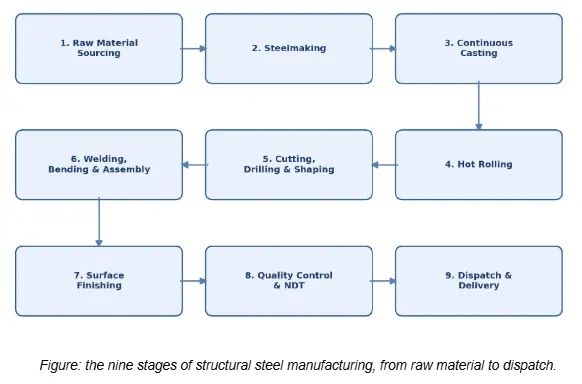
- Raw Material Sourcing The starting material has a direct effect on the quality and consistency of the finished product. Integrated mills may use iron ore, while Electric Arc Furnace and induction furnace operations commonly use recycled scrap. Some manufacturers purchase billets and roll them into finished products. In every route, controlling raw material chemistry and quality is essential, and reputable manufacturers document the source and grade of incoming material as part of their supplier qualification process.
- Steel Making The selected raw material is converted into liquid steel through processes such as the Basic Oxygen Furnace, Electric Arc Furnace, or Induction Furnace route. During this stage, the chemistry is adjusted and monitored so the steel meets the requirements of the specified grade.
- Continuous Casting Once the molten steel reaches the required specification, it is continuously cast into semi-finished forms such as billets, blooms, or slabs. Continuous casting supports consistent production and helps reduce internal defects compared with older casting approaches.
- Hot Rolling Billets and blooms are reheated and passed through a sequence of rolling stands. Each pass progressively changes the material into the required structural profile. Dimensions, surface quality and mechanical properties are closely controlled during this stage.
- Cutting, Drilling & Shaping Finished profiles can be cut to specified lengths using saws, shears or CNC plasma equipment. Where required, drilling, punching and end preparation are carried out according to fabrication drawings and project specifications.
- Welding, Bending & Assembly Some orders require further fabrication before delivery. Steel may be welded, bent or bolted into frames, trusses and other fabricated assemblies. Approved procedures, skilled fabrication and inspection are important because connection quality directly affects the performance of the completed structure.
- Surface Finishing The required surface protection depends on the application and exposure conditions. Hot-dip galvanizing is commonly used for exposed environments, while zinc primers and epoxy systems are used for many industrial applications. Fire-resistant or intumescent coatings may be specified where additional fire protection is required.
- Quality Control & Non-Destructive Testing Before dispatch, manufacturers check dimensions, chemical composition, tensile strength and yield strength. Depending on the product and project requirements, structural steel testing methods such as ultrasonic testing, radiographic testing or dye-penetrant testing can be used to identify defects that may not be visible during a standard inspection. Reliable suppliers document testing frequency and keep records that can be traced back to the original batch.
- Dispatch, Traceability & Delivery Each production batch should have traceability through a heat number or batch reference. A Mill Test Certificate records key chemical and mechanical properties. Reliable loading, transport and dispatch planning are equally important because delivery delays can affect the entire construction schedule.
Types of Structural Steel Products Manufactured in India
Structural steel is available in several product categories, with each product serving specific requirements based on load, span, structural design, fabrication method, and project environment.
Rolled Structural Sections
They are widely used for primary framing, columns, beams, and other load-bearing applications. Their dimensions and section properties are selected according to structural design requirements.
ERW Pipes and Tubes
ERW Pipes and Tubes are manufactured by forming steel strip and joining the edges through electric resistance welding. They are used in structural frameworks, construction, infrastructure, fencing, furniture, and various industrial applications, depending on their grade, size, and specifications.
Steel Hollow Sections
These include square and rectangular hollow sections, which are commonly used in columns, frames, trusses, canopies, and architectural applications where strength, efficient material usage, and a clean appearance are important
Steel Plates
They are used for base plates, connection plates, gusset plates, fabricated structural members, and other applications requiring flat steel products.
MS Billets
MS billets are semi-finished steel products that serve as an important input material for manufacturing various downstream steel products. They are produced through processes such as steel melting and continuous casting and are subsequently processed into products such as bars, rods, and other rolled sections.
Narrow-Width HR Coils
HR Coils are produced by hot rolling steel into relatively narrower strip widths. They are used as raw material for applications such as pipe and tube manufacturing, fabrication, and other downstream steel products, depending on the required grade, thickness, and dimensions.
Wire Rods
Wire rods are continuously rolled steel products with a round cross-section and are used as raw material for manufacturing wire, mesh, fasteners, nails, welding products, and other downstream applications. Their grade and diameter are selected according to the intended end use.
Scaffolding and Formwork Systems
They are widely used in construction for providing temporary support, access, and working platforms, as well as for supporting concrete structures during construction. These systems are designed according to project requirements, load conditions, and applicable safety standards.
C and Z Purlins
They are commonly used in pre-engineered buildings to support roof and wall cladding. Their lightweight design and structural efficiency make them suitable for a range of industrial and commercial building applications.
Structural Steel Grades & Standards in India
IS 2062 Grades: E250 to E650
The "E" stands for elastic limit; the number is the minimum yield strength in MPa.
| Grade | Minimum Yield Strength (MPa) | Typical Use Case |
|---|---|---|
| E250 | 250 | General structural applications, low- and mid-rise buildings |
| E300 | 300 | General fabrication, medium-load structures |
| E350 | 350 | Higher-load buildings, bridges, pre-engineered buildings |
| E410 | 410 | Heavy structural members, bridges, transmission towers |
| E450 | 450 | High-rise buildings, heavy industrial structures |
| E550 | 550 | High-strength applications where reduced section weight matters |
| E650 | 650 | Specialized heavy-duty, high-strength applications |
Picking the Right Grade
Load requirements should be the starting point when selecting a steel grade. Higher static or dynamic loads may require higher-strength grades. The environment also matters: moisture, coastal exposure, and chemical conditions can influence the required corrosion protection. Cost should be considered on a total-project basis. A higher-strength grade may have a higher price per tonne, but the design may require less total steel. The selected material must also comply with the applicable project and design standards, including IS 800 where relevant in India. Understanding how IS grades compare with international specifications can also help when selecting materials for projects involving different standards. Our guide to Structural Steel Grades covers these differences in detail.
Structural Steel Design Principles Every Buyer Should Understand
Load Conditions
Structural design must account for several load conditions, including dead load, live load, wind load, seismic load, and snow load where applicable.
Stability
Stability is as important as material strength. Slender members subjected to compression can buckle, which is why structural systems use appropriate bracing and moment-resisting arrangements to maintain overall stability.
Connections
- Bolted connections can be quick to install and relatively easy to inspect or replace.
- Welded connections can provide continuous load transfer and are widely used in fabricated structural systems.
- Riveted connections are now uncommon in new construction but remain present in some older structures.
Applicable Standards
Indian projects are generally designed in accordance with IS 800 along with other applicable standards. Projects in other regions may follow frameworks such as AISC 360 or Eurocode 3.
How to Choose a Reliable Structural Steel Manufacturer in India
Start with the Mill Test Certificate. Ask for documentation covering chemical composition and mechanical properties, with traceability to a specific heat or batch. It is also useful to verify relevant BIS, ISO and project-specific certifications.
The difference between an integrated manufacturer and a trader or re-roller is worth understanding. Integrated manufacturers can control raw material, production, testing and traceability across more stages of the supply chain. A trader or re-roller can still be suitable, but buyers should know where the material was produced and how quality was verified.
Ask how quality inspections are recorded and whether each batch can be traced. This becomes especially important if a quality issue arises during a project and the affected material needs to be identified.
Delivery capability matters alongside metallurgy. A technically compliant product that arrives weeks late can still disrupt a project. Review production capacity, stock availability, dispatch systems and transportation arrangements against the project schedule.
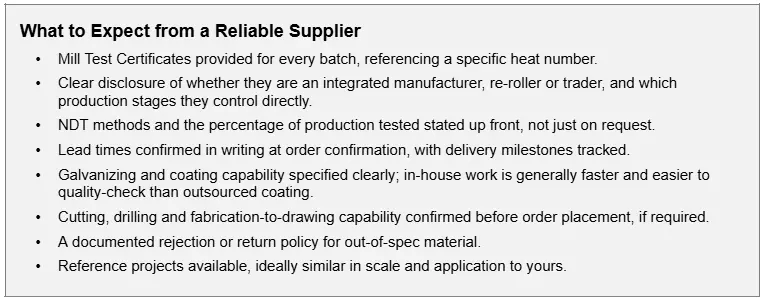
Questions worth asking a supplier
- Can you share a sample Mill Test Certificate for the grade I need?
- Are you an integrated manufacturer, or a trader/re-roller?
- What NDT methods do you use, and on what percentage of production?
- What is your typical lead time from order to dispatch?
- Do you handle galvanizing or coating in-house, or is it outsourced?
- Can you cut, drill, or fabricate to drawing?
- What is your rejection/return policy for out-of-spec material?
- Can you provide references from projects similar in scale to mine?

Applications of Structural Steel in Construction & Industry
- High-rise & Commercial Buildings:
Structural steel enables large, open floor areas with fewer supporting columns, while off-site fabrication can help accelerate construction.
- Bridges & Transport Infrastructure:
Fabricated steel members and truss systems are widely used where long spans, efficient load transfer and structural strength are required.
- Pre-Engineered Buildings & Industrial Sheds:
Steel components can be manufactured, fabricated and prepared off-site before being transported to the project location, reducing on-site construction time.
- Renewable Energy Projects:
Galvanized steel is commonly used for solar mounting structures because of its durability and resistance to outdoor environmental conditions.
- Marine & Shipbuilding Applications:
Structural steel is used in marine environments where materials need to withstand demanding operating and environmental conditions.
Structural Steel vs Other Building Materials
| Factor | Structural Steel | Reinforced Concrete | Timber |
|---|---|---|---|
| Strength-to-weight ratio | Strong | Lower | Lower |
| Construction speed | Fast with prefabrication | Moderate | Fast for small/low-rise |
| Fire resistance (inherent) | Requires protection | Inherent advantage | Requires protection |
| Cost consideration | Depends on design & prefab savings | Often favourable on availability | Favourable for smaller projects |
| Best-fit use case | Long spans, high-rise, fast build | Availability-driven, fire-sensitive builds | Small or low-rise, appearance/renewable priorities |
Compared with reinforced concrete, structural steel generally offers a strong strength-to-weight ratio and can support faster construction when prefabrication is used. Concrete can offer advantages in availability and inherent fire resistance. The right choice depends on design, schedule, site conditions and total project cost.
Compared with timber, steel generally provides higher load capacity and can accommodate longer spans. Timber can still be a practical choice for smaller or low-rise projects where appearance, cost or renewable material considerations are priorities.
Sustainability & Green Steel Manufacturing in India
- Lower-carbon production: Scrap-based Electric Arc Furnaces, hydrogen-based direct reduced iron, and renewable-powered operations are increasingly supporting lower-carbon steel production .
- Recyclability: Steel is highly recyclable — material recovered from older buildings and infrastructure can become feedstock for new production, supporting circular-economy practices.
- Procurement relevance: For EPC contractors and infrastructure developers, embodied carbon is becoming an increasingly important procurement consideration, with green building frameworks such as IGBC and LEED placing greater emphasis on material selection and carbon performance.
For buyers with sustainability targets, it is useful to work with manufacturers that measure emissions and can provide credible information about their production footprint.
Conclusion
From raw material to a certified, delivered product, structural steel passes through multiple controlled stages: steelmaking, casting, rolling, fabrication, finishing and testing. Standards such as IS 2062 help establish the requirements the finished material must meet.
The lowest quotation does not always represent the lowest overall project cost. Grade, quality, certifications, traceability, manufacturing process and delivery reliability should all be considered alongside the price per tonne.

Frequently Asked Questions
What is structural steel used for?
Structural steel is used in load-bearing frameworks for buildings, bridges, pre-engineered buildings, towers and industrial facilities where strength and stability are essential.
What is the difference between structural steel and mild steel?
Structural steel is manufactured and tested against defined standards such as IS 2062. "Mild steel" is a broader term generally used for low-carbon steel and does not automatically confirm compliance with structural certification requirements.
Which IS grade is used for structural steel in India?
IS 2062 is widely used. E250 is commonly selected for general structural applications, while higher grades are considered when the design requires greater strength.
What affects structural steel prices in India?
Key factors include raw material costs, energy prices, steel grade, profile dimensions, coating requirements, order volume, transportation, and broader market conditions.
Hot rolled vs. cold rolled — what's the difference?
Hot rolled steel is shaped at elevated temperatures and is widely used for large structural profiles. Cold rolled steel is formed at room temperature and is generally selected when tighter dimensional tolerances and a smoother finish are required.
How do I choose a reliable manufacturer?
Review Mill Test Certificates, quality-control procedures, certifications, manufacturing capabilities, traceability, production capacity and delivery performance. Ask for evidence of projects similar to yours.
Is structural steel more expensive than reinforced concrete?
The material price is often higher, but faster fabrication and erection can help balance overall project costs. The final comparison depends on design, quantity, labour, transport and schedule.
Is structural steel manufacturing sustainable?
Steel has strong recycling potential, and approaches such as scrap-based Electric Arc Furnaces and renewable-powered operations can reduce production emissions. The sustainability of a specific product depends on how and where it was manufactured.
Need Help Choosing the Right Product?
Have questions about pricing, technical details, or bulk orders? Get in touch with our team.