
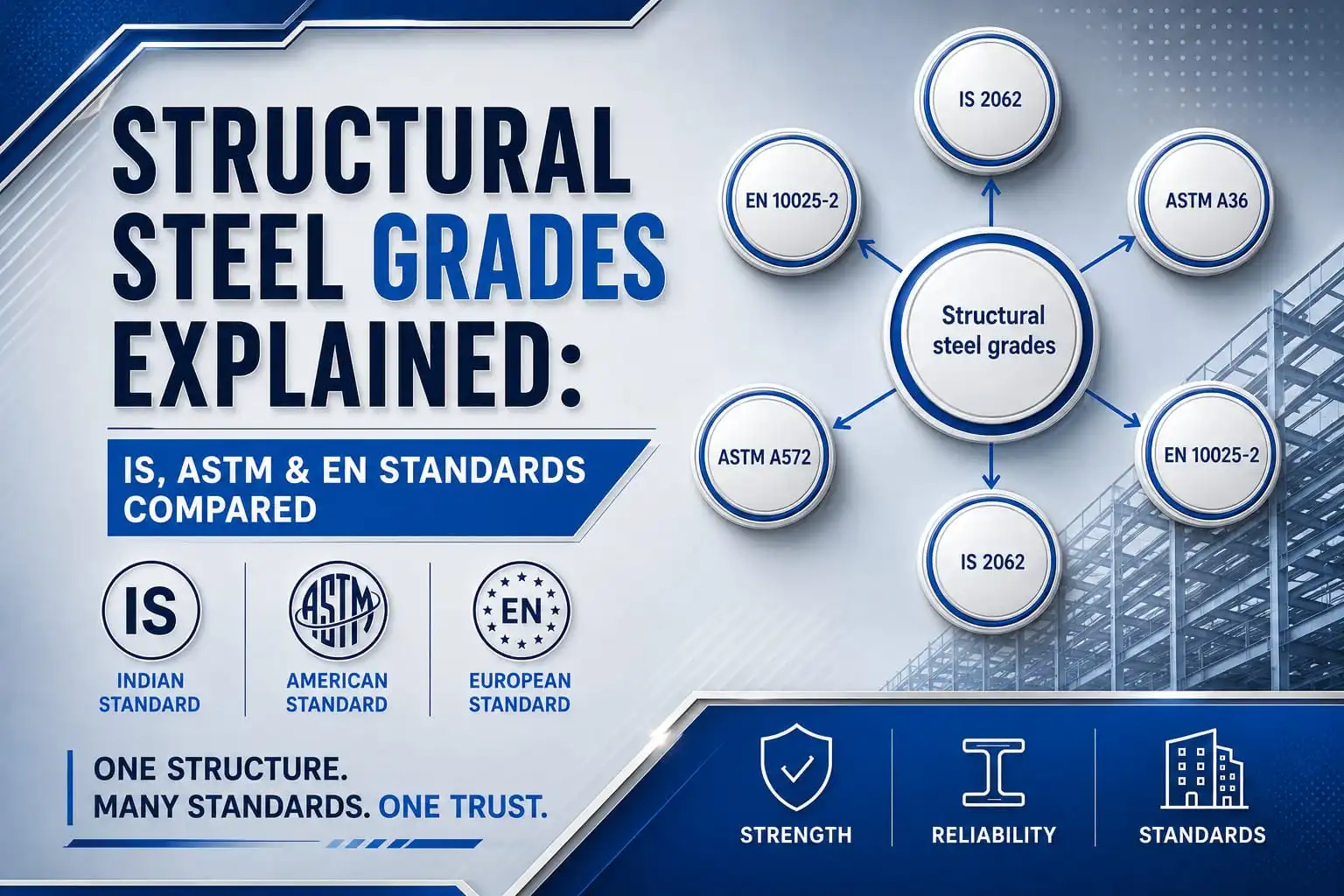
"Structural steel" without a grade isn't a paperwork gap. It's a structural risk. A structural steel grade is a standardized classification based on chemical composition and mechanical properties yield strength, tensile strength, weldability, impact toughness. It tells an engineer, a fabricator, or a buyer exactly how a piece of steel will behave under load, in a weld, or in a corrosive environment. Three systems dominate structural specifications worldwide India's IS 2062, America's ASTM grades, and Europe's EN 1 0025 series and while they often cover similar strength ranges, they are not the same standard wearing different labels. This guide breaks down what each grade actually promises, how the three systems compare, and what changed in 2026 that you need to know before your next purchase order goes out.
What Is a Structural Steel Grade?
Every grade designation is shorthand for three specific guarantees the mill has committed to: Strength class the minimum yield and tensile strength the material will hit, which determines how much load a given section can carry. Deoxidation and impact quality whether the steel is semi-killed or fully killed, and whether toughness has been tested at low temperature. Intended use general fabrication, high-load structures, corrosive environments, or specialty applications like pressure vessels and transmission towers.
Get any one of these wrong, and you're not dealing with a documentation error you're dealing with how the structure performs in the field.
Why So Many Structural Steel Grades Exist
Strength, weldability, corrosion resistance, and fire performance pull against each other. A grade optimized for maximum yield strength is often harder to weld on-site. A grade suited to coastal, corrosive environments usually costs more than an inland warehouse needs. There's no single "best" grade only the grade correctly matched to four factors:
- Load path
dead, live, wind, and seismic loads determine how much strength a section actually needs.
- Service environment
coastal, industrial, or high-temperature exposure changes which grade holds up long-term
- Fabrication process
process field welding, bolting, or riveting each favor different chemistry and toughness.
- Applicable code
the governing standard, IS, ASTM, or EN, narrows the field before strength even enters the conversation.
IS 2062 Structural Steel Grades Explained (Indian Standard)
What Is IS 2062?
IS 2062 is the Bureau of Indian Standards specification for hot-rolled medium and high tensile structural steel plates, strips, shapes, sections, flats, and bars. It appears on the overwhelming majority of structural steel drawings issued in India, from mezzanine floors and pre-engineered buildings to bridges and heavy industrial frames. Understanding how these structural steel products are manufactured also helps explain how processing, rolling, grading, and testing affect their final properties. Learn more about the structural steel manufacturing in India.
Standard update: BIS has notified IS 2062 (Part 1):2025, Eighth Revision, effective 29 December, 2025. The prior IS 2062:2011 (Seventh Revision) reached its formal withdrawal date of 29 June 2026. If your drawings, purchase orders, or supplier contracts still cite "IS 2062:2011 ," confirm with your supplier and design consultant that the current edition and any amendment status are reflected in your specification. The grade structure itself — E250 through E650, with the A/BR/BO/C sub-quality system — has carried forward in industry use, but always verify figures against the current standard and your mill test certificate rather than an older printed copy.
IS 2062 Grades: E250 to E650
The "E" stands for elastic limit the number that follows is the minimum yield strength in MPa.
| Grade | Min. Yield (MPa) | Min. Tensile (MPa) | Typical Use |
|---|---|---|---|
| E250 | 250 | 410 | General fabrication, mezzanine floors, sheds |
| E300 | 300 | 440 | Transitional grade for medium-strength members |
| E350 | 350 | 490 | Industrial buildings, moderate-span structures, PEBs |
| E410 | 410 | 540 | Large-span industrial structures, heavy fabrication |
| E450 | 450 | 570 | Bridges, heavy industrial structures, long-span warehouses |
| E550 | 550 | ~600* | Transmission towers, crane girders |
| E600 | 600 | ~650* | Specialized high-load structural applications |
| E650 | 650 | ~700* | Pressure vessels, specialized heavy engineering |
*E550, E600, and E650 entered via a later amendment. Confirm tensile figures against the current standard and your mill test certificate.
Understanding IS 2062 Sub-Qualities (A, BR, BO, C)
Every grade from E250 to E410 splits further by sub-quality governing deoxidation practice and impact testing, not base strength:
- A
No impact test required. Fine for non-critical work in a moderate climate.
- BR
Impact test at room temperature. Usually optional or buyer-specified.
- BO
Impact test mandatory at 0°C. For structures that may see cooler service temperatures or higher-stakes welding.
- C
Impact test mandatory at −20°C. The toughest requirement critical welded structures, cold-climate service.
Weldability generally improves as you move from A toward C, since carbon equivalent limits tighten at each step. E450 and above is usually offered only as A or BR.
IS 2062 Chemical Composition Limits
Chemical composition is where the grade's mechanical promises actually come from. As strength requirements rise, IS 2062 tightens carbon and carbon-equivalent (CE) limits for the higher grades even as manganese and other alloying elements increase specifically to preserve weldability. A mill that pushes yield strength up without controlling CE is producing steel that meets the number on paper but behaves unpredictably in the field. This is exactly why the mill test certificate, not just the grade stamp, matters (more on this below).
How IS 2062 Steel Is Tested (Tensile, Bend & Impact Tests)
Structural steel undergoes several tests to verify its mechanical properties, ductility and suitability for the specified grade. Structural steel testing methods help buyers understand how the material is evaluated before it is supplied.
- Tensile Test (IS 1 608):
Yield strength, tensile strength, and elongation run for every heat.
- Bend Test (IS 1 599):
80° bend; checks ductility and surface defects.
- Charpy V-Notch Impact:
Mandatory for BO and C sub-qualities, run at 0°C and −20°C respectively.
- Y-Groove Crackability:
Required for E250 Quality C plates 1 2mm and above a dedicated weldability check.
Unit Conversion & Dimensional Tolerance Quick Reference
Cross-referencing specs across IS, ASTM, and EN paperwork usually means converting MPa to ksi or kgf/mm² by hand. Here's the quick version:
| MPa | ksi | kgf/mm² |
|---|---|---|
| 235 | ~34.1 | ~24.0 |
| 250 | ~36.3 | ~25.5 |
| 275 | ~39.9 | ~28.0 |
| 345 | ~50.0 | ~35.2 |
| 355 | ~51.5 | ~36.2 |
| 410 | ~59.5 | ~41.8 |
| 450 | ~65.3 | ~45.9 |
| 550 | ~79.8 | ~56.1 |
(1 MPa≈ 0.1 45 ksi≈ 0.1 02 kgf/mm²)
Dimensional and thickness tolerances are governed separately from strength grade IS 1852 for Indian hot-rolled sections and plates, ASTM A6 for US plates, shapes, and bars, and EN 10029 for European hot-rolled plate. A grade match on strength doesn't guarantee a tolerance match — check both if you're substituting a section sourced against a different standard.
ASTM Structural Steel Grades Explained (US Standard)
Common ASTM Structural Steel Grades
The three grades that come up most often in US-influenced structural specifications:
| Grade | Yield / Tensile | Typical Use |
|---|---|---|
| A36 | 250 MPa / 400–550 MPa | General-purpose fabrication, easiest to weld |
| A572 Grade 50 | 345 MPa / ~450 MPa | High-strength low-alloy, lighter sections |
| A992 | 345–450 MPa / ~450 MPa | Wide-flange beams and columns, seismic work |
A36 vs A572 vs A992 — What's the Difference?
A36 is general-purpose, low-carbon steel — the easiest of the three to weld, and the default choice unless the design specifically calls for more strength.
A572 Grade 50 is a high-strength low-alloy (HSLA) steel. It hits the same 345 MPa yield class as A992, which means engineers can specify lighter, leaner sections for the same load — a real cost and weight advantage on large jobs.
A992 adds tighter chemistry control and a capped yield-to-tensile ratio on top of the same strength class. It's the standard choice for wide-flange beams and columns specifically because that capped ratio makes its behavior more predictable in seismic design.
These three are not interchangeable without project engineer approval — even where the strength numbers appear to match on paper.
EN (European) Structural Steel Grades Explained
S235, S275 & S355 — The Core EN Structural Grades
EN 10025-2 keeps the naming logic simple: the number in the grade name is the minimum yield strength in MPa.
- S235JR
235 MPa yield, 360–51 0 MPa tensile. Entry-level, general construction, good weldability and formability.
- S275JR
275 MPa yield, 370–530 MPa tensile. A step up for medium-load designs, columns, platforms.
- S355JR / S355J2
355 MPa yield, 470–630 MPa tensile. The high-strength option for cranes, bridges, and dynamically loaded or cold-climate structures. The "J2" suffix means Charpy impact tested at −20°C.
IS vs ASTM vs EN: Structural Steel Standards Comparison Table
| Standard | Grade | Approx. Min. Yield |
|---|---|---|
| IS 2062 (BIS · India) | E250 | 250 MPa |
| ASTM A36 (US) | A36 | 250 MPa |
| EN 10025-2 (CEN · Europe) | S235JR | 235 MPa |
| IS 2062 (BIS · India) | E350 | 350 MPa |
| ASTM A572 (US) | A572 Grade 50 | 345 MPa |
| EN 10025-2 (CEN · Europe) | S355JR / J2 | 355 MPa |
Roughly the same strength band does not mean interchangeable. Chemistry limits, impact-test regimes, and certification requirements differ across all three systems — the same rule that applies to mixing bolt standards applies here too. Don't substitute grades from different standards on a live project without engineering sign-off.
CBAM & Export Compliance: What EN and IS Buyers Need to Know
If you're exporting IS 2062 material or supplying EN-grade structural steel into the European Union, the compliance picture changed materially in 2026. The EU's Carbon Border Adjustment Mechanism (CBAM) moved from its reporting-only transitional phase (October 2023–December 2025) into its definitive, financially binding regime on 1 January 2026. Iron and steel — including structural sections, plates, and their listed precursors — sit squarely in scope.
Here's what that means in practice for a structural steel buyer or exporter:
- EU importers above a 50-tonne annual threshold of covered goods must hold "Authorised CBAM Declarant" status to bring in CBAM goods, including structural steel.
- No certificate purchases fall due in 2026 itself — but 2026 imports still create certificate cost exposure. The first annual declaration and certificate surrender deadline is 30 September 2027, covering the full 2026 import year, with certificates priced against EU ETS carbon allowance rates.
- Emissions data must be installation-level and verified. A generic industry-average figure won't satisfy an EU importer's declarant obligations — exporters need actual embedded-emissions data from their specific production route.
- A 50-tonne de minimis exemption now excludes very small importers entirely, but most structural steel shipments will clear that threshold easily.
For an EU-facing buyer, this means the supplier relationship now includes a carbon-data relationship, not just a grade and an MTC. A manufacturer that can already hand over installation-level emissions data alongside the mill test certificate removes a real compliance burden from the buyer's side — increasingly a deciding factor in EU-bound tenders, alongside the grade itself.
Structural Steel Grade Properties That Actually Matter for Buyers
- Yield Strength & Tensile Strength
Yield strength drives section sizing. A higher-yield grade means a lighter section can carry the same load — which cascades into lower transport weight, smaller connections, and often a real cost saving even at a higher per-tonne price.
- Weldability
Poor weldability isn't a footnote — it's a cost center. It means preheating, controlled interpass temperatures, and special electrodes, all of which slow down the shop floor and raise fabrication cost.
- Corrosion Resistance
A weathering grade (such as ASTM A588) or a properly specified coating system matters more for lifecycle cost than the steel's sticker price, especially in coastal or industrial-corrosive environments.
- Ductility & Elongation
Ductility — how much a material deforms before it fractures — is a real safety margin, not just a certificate number. It matters most in seismic zones and any structure carrying dynamic, repeated loading.
How to Choose the Right Structural Steel Grade for Your Project
Five factors, in the order engineers typically resolve them:
- Load requirements
dead, live, wind, seismic. Nail these down first; the grade follows the load case.
- Environment
corrosive, coastal, or high-temperature service may push toward a weathering steel or an upgraded coating system.
- Weldability and fabrication
match carbon equivalent to what your shop can actually handle and how critical the joints are.
- Applicable code
export jobs, EPC contracts, and government tenders often name IS, ASTM, or EN outright, which settles the standard before strength does.
- Availability and lead time
a marginally better grade sitting on a six-week import wait can wreck a schedule that a ready domestic equivalent wouldn't.
That fifth factor deserves a closer look. India versus imported material is a real trade-off, not just a cost line. Imported ASTM or EN material into India requires BIS mandatory registration compliance on top of applicable import duty, and lead times of four to eight weeks are common even before customs clearance. A domestically rolled IS 2062 grade — or an Indian mill's EN- or ASTM-equivalent product — usually clears in days, not weeks, with full traceability from a known cast. Unless a project genuinely requires an imported chemistry or certification an Indian mill can't supply, the domestic equivalent is very often the better call on both cost and schedule.
If your specification also calls for corrosion protection, it's worth checking whether a pre-galvanized or coated variant of the same base grade fits the application better than a bare section plus a separate coating step.
Can You Substitute One Structural Steel Grade for Another?
Not without engineering approval. Grades that look chemically and visually similar can still differ in intended purpose, connection compatibility, and certified test requirements. Swapping grades on-site "to keep things moving" risks both safety and code compliance — and can void the certification the entire project relies on.
If a specified grade isn't available: flag it to the design engineer and get a documented substitution approved. Don't make that call on the yard floor.
Verifying Structural Steel Grade & Supplier Certification
What Is a Mill Test Certificate (MTC)?
A Mill Test Certificate is the manufacturer's document certifying chemical composition and mechanical test results — yield, tensile, elongation, impact — for a specific batch or heat. It's the only document that actually ties the material sitting in your yard to the grade written on your purchase order.
BIS Certification & the Standard Mark for IS 2062 Steel
Only manufacturers licensed under the Bureau of Indian Standards Act, 1986 can legally use the BIS Standard Mark. Check the license number against BIS records directly — the mark on a delivery note isn't a substitute for verification, and it doesn't replace the MTC either.
Questions to Ask Your Structural Steel Supplier
- Can you provide an MTC for this specific batch or heat?
- Is the grade BIS-, ASTM-, or EN-certified? Show me the license or certification number.
- What sub-quality or impact-test rating applies here?
- Are you an integrated producer, or a trader reselling third-party material?
- What's your cast-and-heat traceability process?
- Will the MTC match the heat number stamped on the delivered material?
Conclusion: Choosing a Certified Structural Steel Grade You Can Trust
IS, ASTM, and EN each pack decades of engineering experience into a handful of numbers and letters that describe exactly what a piece of steel will do under load. Start with the load case and environment, respect whichever standard governs your project, and don't assume a grade from one system drops in for a grade from another without engineering sign-off — and in 2026, don't assume your IS 2062 reference is still citing the current edition either.
Renny Strips manufactures IS 2062-certified structural steel with full Mill Test Certificate traceability on every batch. Learn more about Renny Strips and its integrated steel manufacturing capabilities, or talk to a Renny Strips engineer about your specification and request a quote backed by full batch documentation
Frequently Asked Questions
Is IS 2062:2011 still valid?
No. BIS notified IS 2062 (Part 1):2025, Eighth Revision, effective 29 December 2025, and the 201 1 edition's formal withdrawal date of 29 June 2026 has now passed. Confirm your supplier and drawings reference the current edition.
What does the "E" in E250, E350, and E410 mean?
It stands for elastic limit. The number that follows is the minimum yield strength in MPa — E250 guarantees a minimum yield of 250 MPa, and so on.
Is ASTM A36 the same as IS 2062 E250?
They're close — both have a 250 MPa minimum yield— but they're governed by different chemistry limits, testing regimes, and certification systems. Treat them as roughly equivalent for preliminary estimating, never as a drop-in substitute without engineering sign-off.
What's the difference between A572 Grade 50 and A992?
Both hit a 345 MPa yield class. A992 adds tighter chemistry control and a capped yield-to-tensile ratio, which is why it's the standard for wide-flange beams and columns in seismic-sensitive design.
Does CBAM apply to Indian structural steel exported to the EU?
Yes, if the shipment falls under the iron and steel CBAM scope and the EU importer brings in more than 50 tonnes of covered goods annually. The importer needs Authorised CBAM Declarant status and installation-level embedded-emissions data from the exporting mill.
What is a Mill Test Certificate, and why does it matter more than the grade stamp?
An MTC is the batch-specific document certifying the actual chemical and mechanical test results for the heat your material came from. A grade stamp tells you what was ordered; the MTC tells you what you actually received.
Can I substitute EN S355 for IS 2062 E350 on the same project?
Not without documented engineering approval, even though both sit in a similar strength band. Differing impact-test regimes and chemistry limits mean the substitution needs sign-off, not assumption
Need Help Choosing the Right Product?
Have questions about pricing, technical details, or bulk orders? Get in touch with our team.