
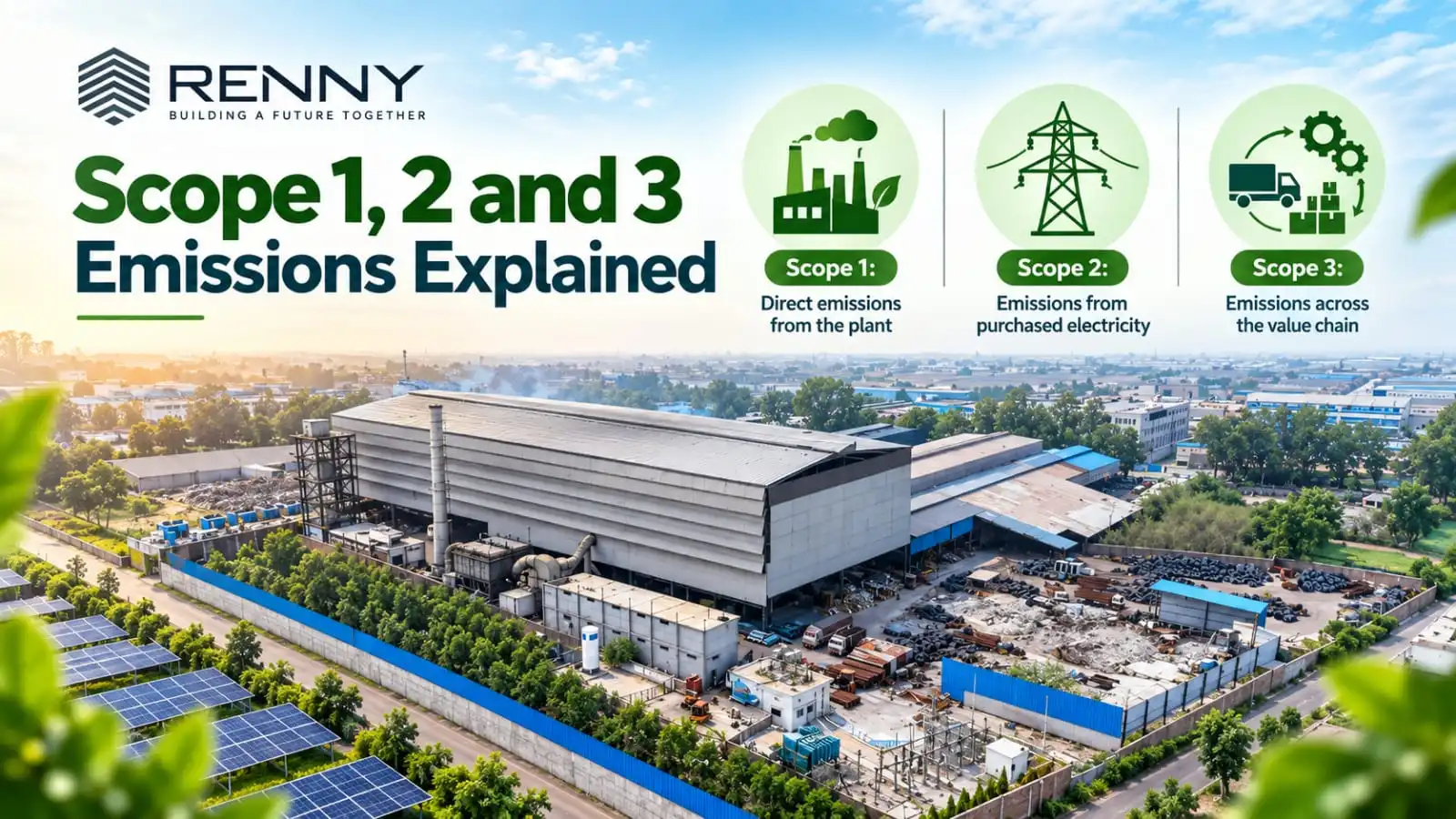
Explore how Scope 1, 2 and 3 emissions impact steel manufacturing, where these emissions originate, and how steel producers can measure and reduce their carbon footprint.
Not long ago, a steel buyer asked three questions: grade, price and delivery date. Today, almost every enquiry from Europe, the Gulf and large Indian infrastructure buyers adds a fourth: what is the carbon footprint of this steel?
Since the EU's Carbon Border Adjustment Mechanism (CBAM) moved into its paid phase in 2026, that question carries a real price. Indian exporters who can prove low emissions save their buyers money. Those who can't risk being charged as if their steel were among the dirtiest on the market.
Every credible answer starts with one framework: Scope 1, 2 and 3 emissions. This guide explains what the three scopes mean for steel, how they connect to CBAM and India's carbon market, and how Renny Strips Ltd is turning low-carbon structural steel into a measurable advantage for its customers.
Why Steel Emissions Now Carry a Price
Steel is one of the most carbon-intensive materials in the world, and India starts from a difficult position. In 2023-24, Indian crude steel averaged about 2.54 tonnes of CO₂ per tonne produced, compared with a global average of around 1.9 tonnes.
That gap matters because carbon is now priced at the border, through CBAM, and at home, through India's Carbon Credit Trading Scheme. For Indian steelmakers, accurate emissions accounting is no longer a sustainability-report exercise. It decides export competitiveness.
[Visual 1: Bar chart, "Emission intensity of crude steel: India vs global average (tCO₂/t)." India 2.54, Global 1.9. Source: Down To Earth.]
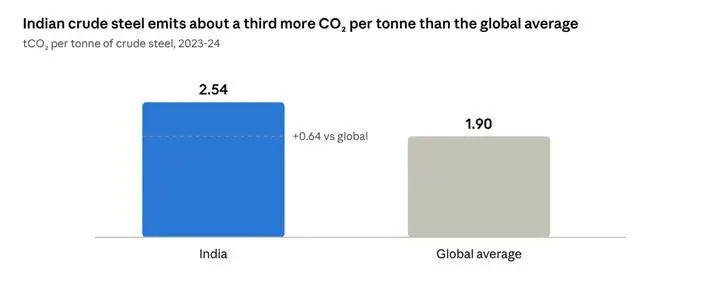
Down To Earth, India 2.54 vs global 1.9 tCO₂ per tonne of crude steel, 2023-24
What Are Scope 1, 2 and 3 Emissions in Steel?
The scope framework comes from the Greenhouse Gas Protocol. It sorts emissions by where they come from and how much control a company has over them.
[Visual 2: Diagram, "Scope 1, 2 and 3 emissions across a steel value chain." Left: mines, suppliers and inbound transport (Scope 3). Centre: steel plant with furnaces and captive power (Scope 1), connected to the grid (Scope 2). Right: outbound transport, fabrication and end of life (Scope 3).]
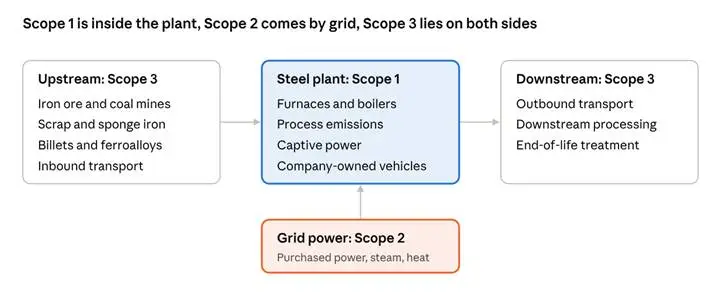
Scope 1, 2 and 3 across a steel value chain · 3 columns and the grid
Scope 1: Direct emissions from the plant
These come from sources the company owns or controls:
Fuel burned in furnaces, reheating furnaces and boilers
Process emissions from reducing iron ore and making steel
Captive power generated from coal or gas
Company-owned vehicles and material-handling equipment Company-owned vehicles and material-handling equipment Company-owned vehicles and material-handling equipment
Scope 2: Emissions from purchased electricity
These are created wherever the electricity, steam or heat a plant buys is generated. India's grid still depends heavily on coal, so a rolling mill or electric arc furnace running on grid power carries a large Scope 2 load. Captive solar is one of the most direct ways to reduce it.
Scope 3: Emissions across the value chain
Usually the largest and hardest category to measure, Scope 3 covers:
- Purchased raw materials such as iron ore, coal, ferroalloys, scrap, sponge iron and billets
Inbound and outbound transport
Business travel and employee commuting
Downstream processing and end-of-life treatment of the steel
An easy way to remember it: Scope 1 is what we burn, Scope 2 is what we buy, and Scope 3 is what others in our chain emit on our behalf.
Why vertical integration helps
When a steelmaker produces its own inputs, emissions that would otherwise sit in a supplier's Scope 3 move into its own Scope 1; on paper, this can look like higher direct emissions. In practice it is an advantage: the company can meter those emissions at source, control them and reduce them, instead of relying on supplier estimates. Under CBAM, where precursor emissions must be documented, this control is especially valuable.
Scope 1, 2 and 3 emissions by steel route: BF-BOF, scrap EAF and Scope 1, 2 and 3 emissions by steel route: BF-BOF, scrap EAF and coal-based DRI
The route decides which scope dominates. About 72% of the world's steel comes from blast furnace–basic oxygen furnaces (BF-BOF), 21% from scrap-based electric arc furnaces (EAF) and 7% from gas-based DRI-EAF plants.
| Route | Largest scope | India note |
|---|---|---|
| BF-BOF | Scope 1 | Over 90% of route emissions come from the blast furnace and converter |
| Scrap EAF | Scope 2 | The grid factor decides the result |
| Coal-based DRI with induction or electric furnace | Scope 1 and 2 | Mining adds only about 4% to the route total |
Scope 2 for Indian steel plants: location-based or market-based
The GHG Protocol counts purchased power two ways. The location-based method applies the average grid factor; the market-based method reflects contracts such as a solar power purchase agreement, and companies with such contracts report both. India's Central Electricity Authority publishes the grid factor in its CO₂ Baseline Database. The 2023-24 weighted average, adjusted for renewables, was reported at about 0.727 tCO₂ per MWh.
Where Scope 1, 2 and 3 Steel Boundaries Differ
Each framework counts differently, so its figures are not interchangeable.
| Framework | What it counts | Unit |
|---|---|---|
| Worldsteel | CO₂ only; Scope 1, 2 and defined upstream items, mining excluded | Tonne of crude steel |
| CBAM, iron and steel | CO₂; direct emissions plus precursors | Tonne of product, by CN code |
| India's Green Steel Taxonomy | CO₂e; Scope 1, 2 and limited Scope 3 up to finished steel | Tonne of finished steel |
How ISO 14064 Reporting Makes Scope 1, 2 and 3 Steel How ISO 14064 Reporting Makes Scope 1, 2 and 3 Steel Emissions Data Credible
Calculating emissions is one task. Proving them is another. ISO 14064 provides the structure for the second. It has three parts:
ISO 14064-1 sets out how an organisation builds and reports its greenhouse gas inventory. Its emission categories (direct, imported energy, transport, purchased products and more) map closely onto Scopes 1, 2 and 3.
ISO 14064-2 covers emission-reduction projects such as solar installations or fuel switching.
ISO 14064-3 sets the rules for third-party validation and verification.
For a steel plant, an ISO 14064-aligned system means a clearly defined boundary, consistent calculation methods, traceable data from meters, invoices and production logs, and independent verification. It does not replace CBAM's product-level calculations, but it builds the audit trail that makes those calculations defensible when a verifier comes calling.
ISO 14064 reporting for a steel plant, step by step
ISO 14064-1 uses six categories: category 1 is Scope 1, category 2 is Scope 2, and categories 3 to 6 split the Scope 3 items.
Set the organisational boundary and reporting year.
List every source by unit, from the melt shop to captive power and vehicles.
Collect activity data and record the source and version of each emission factor.
Fix a base year, with a rule for recalculating when capacity is added.
Publish the report and obtain verification under ISO 14064-3.
ISO 14064 versus CBAM verification
An ISO 14064 statement does not satisfy CBAM alone. CBAM needs installation-level data for each product and CN code, checked by a CBAM-accredited verifier.
Scope 1, 2 and 3 Steel Compliance Requirements for Indian Manufacturers
1. EU CBAM: verified data or costly defaults
CBAM's definitive regime has applied since 1 January 2026; unlike the earlier transitional period, it requires verified emissions, an annual declaration and the surrender of certificates. Three points matter most for Indian exporters:
- The importer pays, the exporter proves.
- The legal obligation sits with the EU importer, but the commercial responsibility for supplying auditable emissions data falls on Indian exporters.
- Missing data triggers default values.
- From 2026, when an exporter can't provide reliable, verified data, the EU importer must use default values. These are set conservatively, so a clean mill without proof can be charged like a high-emitting one.
- The cost rises every year.
- The payable share is 2.5 percent in 2026, and as EU free allocation is withdrawn between 2026 and 2034, CBAM will cover 100 percent of embedded emissions by 2034.
Verification under CBAM runs through an accreditation framework built on existing EU ETS systems, and EU importers are expected to increasingly require pre-verified emissions data before engaging suppliers. Accurate Scope 1 data, and reliable data from upstream suppliers, therefore decide what a buyer ultimately pays.
Related reading:Renny Strips Ltd CBAM complaince
CBAM dates for steel exporters
| Date | What happens |
|---|---|
| 1 January 2026 | Definitive regime starts; importers under 50 tonnes a year are exempt, others need authorised declarant status |
| 7 April 2026 | First certificate price: €75.36 per tonne of CO₂ for Q1 2026 |
| 1 February 2027 | Certificate sales open for 2026 imports; holdings must cover 50% of embedded emissions at each quarter end |
| 30 September 2027 | First declaration and surrender, covering 2026 imports |
What CBAM counts for steel
For iron and steel products, the Commission's guidance generally counts direct emissions plus those of the precursors used. Electricity is excluded from crude steel, though sintered ore carries its electricity-related emissions into downstream products. So captive solar lowers Scope 2, BRSR and CCTS figures but moves most CBAM product figures far less; confirm each CN code with your verifier.
Default values: the 10%, 20% and 30% mark-up
For iron and steel, defaults carry a mark-up of 10% in 2026, 20% in 2027 and 30% from 2028.
2. India's Carbon Credit Trading Scheme (CCTS)
At home, steel is entering India's compliance carbon market. Draft emission-intensity targets have been notified for 255 iron and steel units, making steel the largest sector under the scheme, with compliance starting in FY 2026-27. Each covered plant receives a baseline emission intensity based on its 2023-24 performance, along with targets it must meet during the compliance years. Plants that beat their targets can earn tradable credits; plants that miss them will have to buy credits. Measured, verified emission intensity is becoming a financial asset.
3. Buyer disclosure under BRSR
SEBI's Business Responsibility and Sustainability Reporting (BRSR) framework asks large listed companies to disclose their Scope 1 and 2 emissions, with growing attention to the value chain. A steel supplier's Scope 1 and 2 emissions become part of its customer's Scope 3.
Choosing low-carbon steeldirectly improves the buyer's own reported footprint.
BRSR Core assurance schedule
Assurance of BRSR Core widens from the top 150 listed companies in FY 2023-24 to the top 1,000 in FY 2026-27. Value chain disclosure is voluntary for the top 250, so expect buyer questionnaires asking for your Scope 1 and 2 figures.
4. India's Green Steel Taxonomy and NISST star rating
Launched on 12 December 2024, the taxonomy defines green steel as steel made at below 2.2 tCO₂e per tonne of finished steel, counting Scope 1, 2 and limited Scope 3 up to the finished product. NISST verifies the figures.
| Rating | tCO₂e per tonne of finished steel |
|---|---|
| 5-star | Below 1.6 |
| 4-star | 1.6 to 2.0 |
| 3-star | 2.0 to 2.2 |
Common Mistakes in Steel Scope 1, 2 and 3 Accounting
Three errors are easy to make and expensive to find late.
- Leaving limestone, dolomite and graphite electrodes out of Scope 1.
- Mixing location-based and market-based Scope 2 in one inventory.
- Quoting a CBAM product figure as a plant-wide Scope 1 and 2 figure.
Scope 1, 2 and 3 Steel Case Study India: Low Carbon Structural Steel from Renny Strips Ltd
Structural steel is where carbon accounting becomes most visible. Beams, hollow sections, pipes, scaffolding and formwork go into bridges, factories, warehouses and high-rise buildings. Developers in Europe, the Gulf and India increasingly calculate the embodied carbon of these projects, and green building rating systems reward low-carbon materials. A structural steel supplier's Scope 1 and 2 emissions become part of every project's footprint.
CBAM adds a direct cost. Its coverage extends beyond basic iron and steel to finished steel products, including structures and their parts. For exporters of structural steel, embedded emissions now affect the landed price of every tonne.
Renny Strips Ltd, established in 1996, has spent three decades building an integrated structural steel business. Its approach shows how an Indian manufacturer can turn carbon compliance into a commercial advantage.
Controlling Scope 1 through integration
About 90 percent of Renny Strips Ltd's raw material is produced in-house, from steel melting through to finished structural products. Most upstream emissions therefore sit inside the company's own boundary, where they can be metered, managed and reduced directly. For CBAM, which requires precursor emissions to be documented, this gives buyers a single, traceable data source instead of a chain of supplier estimates.
Cutting Scope 2 with solar
Renny Strips Ltd has invested in captive solar power. Its upcoming Unit IV, a ₹400 crore, 35-acre facility, will raise scaffolding and formwork capacity from 1,500 to 6,500 tonnes per month and steel melting capacity from 200,000 to 375,000 tonnes per annum. The facility is planned to run on 43 MW of captive solar.
Results buyers can measure
Renny Strips Ltd's CBAM-compliant Green Line structural steel carries an embedded emission intensity of 0.6385 tCO₂ per tonne, against a conventional average of about 2.2 tCO₂ per tonne. For a customer importing structural steel into Europe, this means an indicative saving of about €117.67 per tonne, or roughly €2,942 per 25-tonne container, in carbon-linked import costs once CBAM is fully phased in.
[Visual 3: Bar chart, "Embedded emissions: Renny Strips Ltd Green Line structural steel vs conventional steel (tCO₂/t)." Renny Strips Ltd 0.6385, Conventional 2.2. Callout: "Indicative CBAM saving: €117.67/t | €2,942 per 25 MT container."]
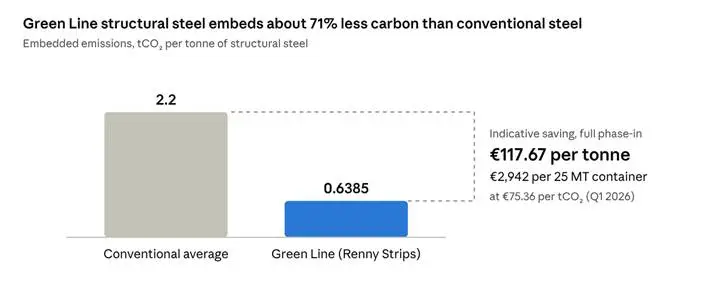
Renny Strips Ltd company data; price 75.36 EUR per tCO₂, Q1 2026
Explore the range: [internal link: Renny Strips Ltd Green Line structural steel page]
How the €117.67 builds up year by year
The figure is the 1.5615 tCO₂ gap times the €75.36 Q1 2026 price. Only 2.5% is payable in 2026, so the saving climbs year by year.
| Year | Share payable | Saving per tonne | Per 25-tonne container |
|---|---|---|---|
| 2026 | 2.5% | €2.94 | €74 |
| 2030 | 48.5% | €57.07 | €1,427 |
| 2034 | 100% | €117.67 | €2,942 |
Illustrative: price held at €75.36, free-allocation benchmark ignored.
Certified for structural use
Renny Strips Ltd holds EN 1090 certification, the European standard for the execution of steel structures and a requirement for CE-marked structural components sold in the EU. This is backed by ISO 14001, ISO 9001 and ISO 45001 certifications. The company is also rated a 5-Star Green Steel manufacturer by NISST under the Ministry of Steel, Government of India. For European structural buyers, this combines low embedded carbon with the conformity they already need.
Transparency built in
Renny Strips Ltd's AI-Monitored Emission Dashboard tracks emissions in real time and lets international buyers validate compliance data in a single click. This closes the biggest CBAM risk for structural steel exporters: missing or unverifiable data.
Related reading: Structural Steel Grades Explained (IS/ASTM/EN)
The lesson for the industry: low-carbon structural steel creates value only when it can be proved. Measurement, verification, and transparency turn a sustainability claim into a lower landed cost for every project.
Supplier Checklist for Steel Buyers
When assessing a steel supplier's carbon credentials, ask:
Do you report Scope 1, 2, and 3 emissions separately?
Is your inventory aligned with ISO 14064 or the GHG Protocol, and independently verified?
Can you provide product-level embedded emissions for CBAM declarations?
What share of your power comes from renewable sources?
How much raw material do you produce in-house, and how do you obtain emissions data from external suppliers?
Is the CBAM figure installation-level or an EU default, and for which CN codes?
Who verified the figures, and under which standard?
Conclusion
Scope 1, 2 and 3 are no longer reporting jargon. For Indian steel, they shape CBAM costs in Europe, carbon-market obligations at home and buying decisions everywhere. Manufacturers that measure precisely, verify independently, and decarbonise visibly will lead the next decade of steel trade.
Need CBAM-ready, low-carbon structural steel with verified emissions data? [Contact Renny Strips Ltd] to explore our Green Line range.
Frequently Asked Questions
What are Scope 1, 2 and 3 emissions in steel?
Scope 1 covers direct emissions from a steel plant's furnaces, processes, and captive power. Scope 2 covers emissions from purchased electricity. Scope 3 covers all other value-chain emissions, including raw materials and transport.
Which scope is largest for a steel company?
For integrated plants, Scope 1 usually dominates. For re-rollers and processors that buy semi-finished steel, purchased materials under Scope 3 are often the largest share.
Does CBAM cover Scope 3 emissions?
Not fully. CBAM focuses on direct emissions and specified precursor inputs, plus certain indirect emissions, rather than the entire value chain. For most iron and steel products, purchased electricity is not counted.
Is ISO 14064 mandatory for Indian steel companies?
Not by itself, but it provides the reporting structure and verification discipline that CBAM, CCTS and BRSR increasingly require.
How can Indian steel exporters reduce CBAM costs?
By supplying verified, product-level embedded emissions data instead of defaults, and by cutting emissions through renewable power, efficient processes and integrated raw-material production.
Which steel route has the lowest Scope 1, 2 and 3 emissions?
Scrap-based EAF usually does, because it skips ore reduction. In India, the gap narrows where furnaces run on coal-heavy grid power.
Need Help Choosing the Right Product?
Have questions about pricing, technical details, or bulk orders? Get in touch with our team.