
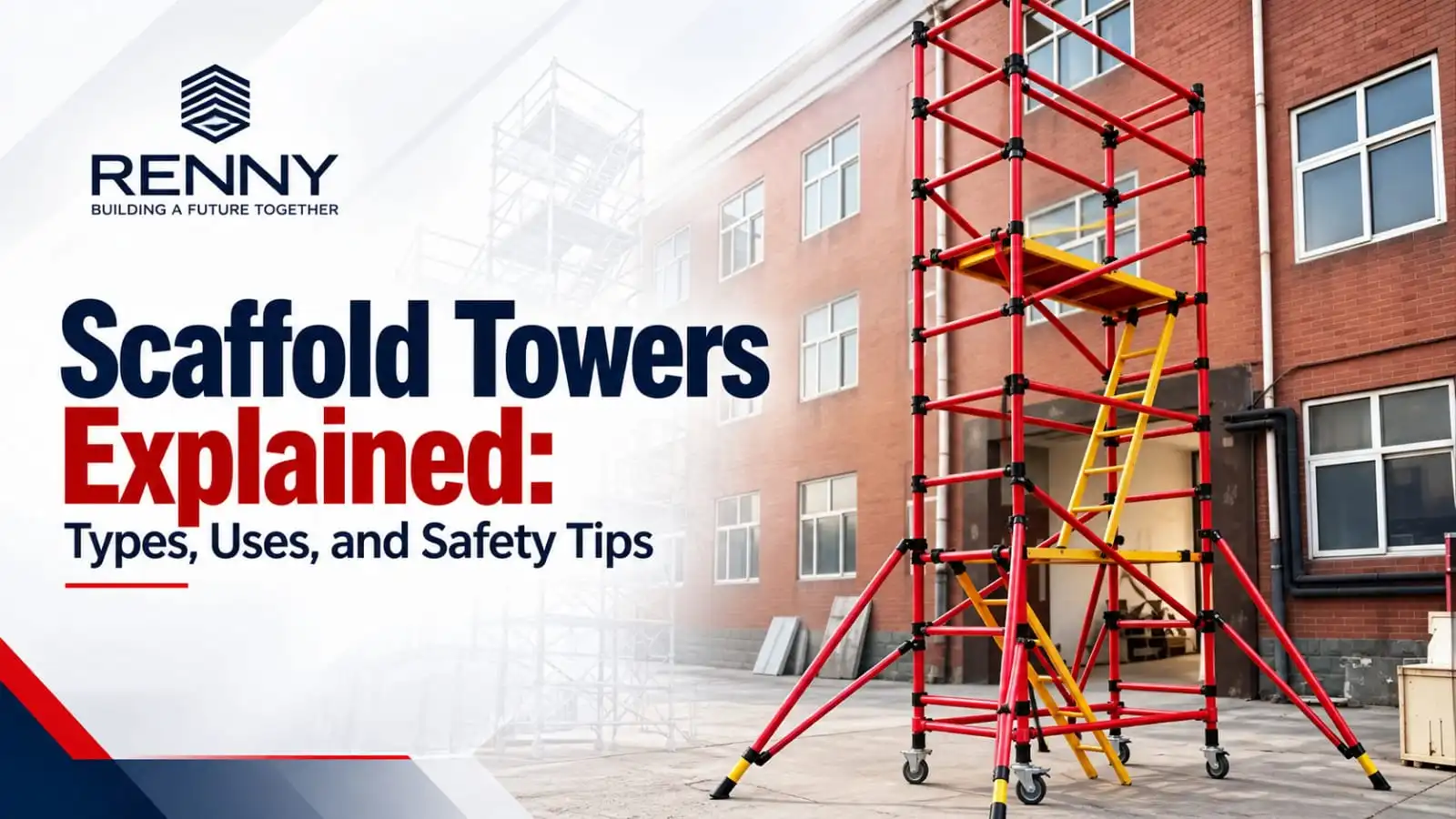
A scaffold tower is a freestanding, modular structure that gives workers a guarded platform at height. It is built from frames, braces, platforms, and guardrails, and it suits short, repeated jobs better than long-term building access. The main types are mobile, aluminium, narrow, double-width, stairway, ladder-frame and specialist towers. The right one depends on working height, load, space, mobility and environment. Safe assembly and inspection matter as much as the choice itself. For importers, carbon reporting under CBAM is a newer factor, covered near the end.
What Is a Scaffold Tower?
A scaffold tower is a self-supporting frame you build one lift upward at a time. Nothing ties it to a building, so its stability depends on its footprint, its bracing, and the ground under it.
How Does a Scaffold Tower Work?
Each part has one job (see also critical scaffolding and formwork components):
- Vertical frames carry the load down to the base.
- Horizontal and diagonal braces stop the frames from racking sideways. A missing diagonal is the quickest way to lose rigidity.
- Platform and trapdoor give a working surface. The trapdoor lets erectors climb through and stay protected.
- Guardrails and toe boards stop people and tools from falling.
- Ladders or stairs are the intended route up. Braces are not steps.
- Castors and brakes allow repositioning, but only work if locked during use.
- Stabilisers or outriggers widen the effective base when the tower's height demands it.
What Is the Difference Between a Scaffold Tower and Traditional Scaffolding?
| Scaffold tower | Traditional scaffolding | |
|---|---|---|
| Structure | Freestanding, self-contained | Tied to a building |
| Size | One work point | Whole façades or structures |
| Mobility | Relocatable (mobile types) | Fixed |
| Setup | Small crew, often under an hour | Specialist crew, hours to days |
| Typical use | Ceilings, MEP, maintenance, painting | Construction, cladding, restoration |
| Workspace | Compact platform | Continuous, wide platforms |
A tower is the wrong choice when you need continuous access along a long façade, when the job involves heavy material stacking, when ground is soft or sloped beyond the manufacturer's limits, when the site is exposed to strong wind, or when live overhead lines are nearby. For a wider view of system scaffolding, see this complete guide to scaffolding and formwork systems.
Types of Scaffold Towers
Most types are variations on one design, differing in access, width, mobility and material. Exact heights and load ratings vary by manufacturer, so treat any figures as system-specific.
Mobile Scaffold Towers
Mobile towers sit on braked castors and can be repositioned quickly, which suits work spread across a room or site. "Mobile" describes the tower, not the working method. Moving one with people or materials aboard is generally prohibited, and what is allowed depends on the manufacturer's instructions. They suit hard, even floors best.
Aluminium Scaffold Towers
Aluminium towers are light, corrosion-resistant and easy to carry, which is why they dominate light-duty work. The trade-offs are lower load capacity and electrical conductivity, which makes them unsuitable near live systems.
Narrow or Single-Width Scaffold Towers
These fit corridors, stairwells, and plant rooms. The small platform limits tools and materials.
Double-Width Scaffold Towers
Double-width towers give more platform space and usually higher capacity, but need more floor area and closer stability checks.
Stairway Scaffold Towers
Stairs let workers move between levels with tools in hand. They are preferable to ladders when access is frequent or loads must be carried up.
Ladder-Frame Scaffold Towers
Internal ladders suit most general construction and maintenance work.
Folding and Compact Scaffold Towers
Folding designs trade height and capacity for fast deployment, easy storage and transport.
Industrial and Specialist Scaffold Towers
Heavy-duty steel, GRP (fibreglass) and lift-shaft towers must be built only to the manufacturer's system instructions.
Scaffold Tower Types at a Glance
| Type | Best suited for | Key characteristic |
|---|---|---|
| Mobile steel | Plant maintenance, rugged sites | High capacity, heavier to move |
| Static steel | Long-duration heavy work | High capacity, slow to relocate |
| Mobile aluminium | Interiors, light maintenance | Lightweight, conductive |
| GRP | Electrical and substation work | Non-conductive, higher cost |
| Narrow / folding | Corridors, panel rooms | Small footprint |
| Double-width | Larger work areas | Bigger platform |
| Stairway | Frequent vertical access | Integrated stairs |
What Are Scaffold Towers Used For?
Construction and Building Work
Rendering, cladding, window installation and general exterior work.
Painting and Decorating
Ceilings, high walls and stairwells, domestic and commercial.
Maintenance and Repairs
Gutters, roof-edge repairs and facility upkeep.
Electrical, Mechanical and MEP Work
Lighting, ducts, pipework and HVAC, where towers are repositioned constantly.
Electrical warning: aluminium and steel conduct electricity. Never place a metal tower within reach of overhead lines or exposed live equipment. Caution is not a control. Use isolation, exclusion distances or a non-conductive tower.
Industrial and Commercial Applications
Shutdown maintenance, crane servicing, racking installation, and fire-system checks around live warehouse operations.
Events and Temporary Installations
Lighting rigs and camera platforms with short-term access needs.
Best Scaffold Tower Type for Different Applications
| Task | What to look for |
|---|---|
| Ceiling painting | Wide platform, smooth-rolling castors |
| Corridor lighting | Narrow tower, low weight |
| Racking installation | Steel, higher capacity, stabilisers |
| Substation work | GRP, verified non-conductive rating |
| Exterior repair | Stabilisers, firm base, known wind limit |
| Frequent tool carrying | Stairway access |
How to Choose the Right Scaffold Tower
Choose the Right Working Height
Platform height is where the deck sits. Working height is the deck plus the worker's reach, often about 2 m in supplier guidance. A "6 m working height" tower may only have a 4 m platform. Also check the maximum permitted height for your configuration, since indoor and outdoor limits usually differ.
Check the Required Load Capacity
Add up workers, tools, materials, and equipment. Illustrative example: with a platform rated at 250 kg, two workers at 85 kg each, 15 kg of tools, and a 40 kg box of fixings total 225 kg, which is fine. A single 100 kg pallet in one corner is a concentrated load and may be unacceptable even if the total is under the limit. Platform and whole-tower ratings can differ, so check the manual.
Consider the Available Space
Check doorways, corridor width, turning room, ceiling clearance, and obstacles. Headroom is easy to miss. The 3T method needs clear space above the working platform to fit the next guardrails, so a tower that fits under a ceiling may still be impossible to build.
Consider Mobility and Access
Choose mobile if you relocate often, ladder-frame for general access, stairway when carrying loads, and a static build for heavy or long-duration work.
Consider the Work Environment
Look at indoor or outdoor use, ground conditions, wind exposure, electrical hazards, public areas, and overhead obstructions.
Aluminium vs Steel vs GRP Scaffold Towers
Choose by asking which failure you can least afford. For a deeper comparison, see scaffolding materials compared.
| Aluminium | Steel | GRP | |
|---|---|---|---|
| Weight | Light | Heavy | Moderate |
| Handling | Easy | Needs more effort | Moderate |
| Durability | Good, wears in harsh use | Excellent with galvanising | Good, can degrade in UV |
| Electrical | Conductive | Conductive | Non-conductive |
| Best for | Light interior work | Industrial, rental fleets | Electrical environments |
No material wins everywhere. If electrical risk is the concern, choose GRP. If durability across many hire cycles matters, steel tends to win. If relocation labour dominates, aluminium does.
Scaffold Tower Safety Guidelines
Check the Ground Before Setting Up
Ground must be firm and level. Never level with bricks or blocks. Slope tolerances differ by manufacturer, so read the manual instead of applying a general rule. Watch for soft ground, drains, and excavations.
Assemble the Tower According to the Manufacturer's Instructions
Inspect components first. In the 3T (through-the-trap) method, the erector fits guardrails from inside the trapdoor and never stands on an unguarded deck. The advance guardrail (AGR) method is another recognised approach. Methods differ between systems.
Make Sure the Tower Is Stable
Lock castor brakes, fit stabilisers where required, keep loads low and centred, and never extend adjustable legs to gain height.
Use Guardrails, Toe Boards and Safe Access
Guardrails and toe boards stop falls of people and tools. Climb internal ladders or stairs only, never external braces or improvised access.
Follow Load Limits
Count people, tools, and materials, and never exceed the rated capacity or stack heavy loads in one spot.
Take Wind and Weather Conditions Seriously
Wind limits are set by the manufacturer. Sheeting, boards, and large panels act like sails. A sheeted tower is no longer the configuration the manufacturer tested.
Understand Electrical Hazards
Keep metal towers away from overhead lines and live equipment. Use isolation, exclusion distances or non-conductive towers.
Move Mobile Scaffold Towers Safely
Clear the route, check the floor, follow the manual, brake when stationary, and never move an occupied tower.
Common Scaffold Tower Safety Mistakes
- Exceeding rated load
- Missing braces, guardrails, or toe boards
- Unlocked castors
- Improvised or mixed components
- Ignoring wind
- Climbing the outside
- Working near electrical hazards
- Skipping inspection after changes
Scaffold Tower Inspection and Maintenance
When Should a Scaffold Tower Be Inspected?
Inspect before each use, after assembly, after alteration or relocation, and after any event that could affect stability, such as impact or severe weather. Periodic intervals depend on jurisdiction. In the UK, for example, construction towers where a fall of 2 m or more is possible are inspected after assembly and at least every 7 days. Other countries set their own rules.
What Should You Inspect?
Frames, braces, platforms, guardrails, toe boards, castors, brakes, stabilisers, locking pins, access components, corrosion, damage, and the status tag.
What Should You Do With Damaged Components?
Remove them from service. Do not improvise repairs, use only compatible replacements, and never mix systems.
Scaffold Tower vs Other Access Equipment
| Scaffold tower | Ladder | Traditional scaffolding | MEWP | |
|---|---|---|---|---|
| Platform | Yes | No | Yes | Yes |
| Duration | Hours to days | Minutes | Days to months | Hours |
| Stability | High if built properly | Low | High | High |
| Mobility | Moderate | High | None | High (powered) |
| Best for | Repeated work at one location | Very short, light tasks | Large structures | Awkward reach, one-off jobs |
Buying or Hiring a Scaffold Tower: What to Check
When Should You Buy a Scaffold Tower?
Buy when use is frequent, projects are long-term, and storage exists.
When Should You Hire a Scaffold Tower?
Hire for one-off jobs, specialist configurations, or when you want to avoid storage and inspection duties.
A useful check is total cost per hire cycle: purchase price divided by expected cycles, plus handling labour, inspection time and compliance cost. The cheapest unit is rarely the cheapest over ten cycles.
Questions to Ask a Scaffold Tower Supplier
- Working and platform height, and platform dimensions
- Load capacity and stabiliser requirements
- Material, configuration and indoor or outdoor suitability
- Applicable standards (for example EN 1004-1 for mobile towers)
- Manuals, test documentation and spare parts
Carbon and CBAM: Why Sourcing Data Matters
Steel and aluminium tower components may fall under the EU's Carbon Border Adjustment Mechanism Definitive-period reporting began on 1 January 2026, with certificate obligations following later. Confirm CN codes, thresholds and timing with a CBAM advisor.
As an example, Renny Strips' green steel carries an embedded emission intensity of 0.6385 tCO2 per tonne, against roughly 2.2 for conventional steel. On Renny's calculations, this gives an indicative saving of €117.67 per tonne, about €2,942 per 25-tonne container. Suppliers who provide per-shipment emission data reduce reliance on default values. Renny also offers an emission dashboard, backed by about 90% in-house raw material production and ISO 9001, 14001 and 45001 certification. Explore Renny's scaffolding and formwork range.
Conclusion
Scaffold towers give practical elevated access for construction, maintenance and commercial work. Different types exist because sites differ. Choosing well means matching working height, load, footprint, access, mobility and environment, then assembling, inspecting and maintaining the tower to the manufacturer's instructions and local requirements
The safest tower is not the largest or most versatile. It is the one correctly matched to the height, load, environment and task, and properly assembled and maintained for that use.
Frequently Asked Questions About Scaffold Towers
What is a scaffold tower?
A scaffold tower is a freestanding, modular access structure that provides a stable, guarded working platform for carrying out tasks at height. It can be assembled in different configurations depending on the work and site requirements.
What are scaffold towers used for?
Scaffold towers are commonly used for painting, maintenance, installation, inspection, repair, and MEP work. They are suitable for construction sites, warehouses, industrial facilities and other environments where temporary access at height is required.
What are the different types of scaffold towers?
Common types include mobile scaffold towers, aluminium towers, narrow towers, double-width towers, stairway towers, ladder-frame towers, folding towers and specialist access towers. The right type depends on the working height, available space, access requirements and application.
What is a mobile scaffold tower?
A mobile scaffold tower is a freestanding tower fitted with castors, allowing it to be repositioned around a work area when required. The castors should be securely braked when the tower is in use, and movement should always follow the manufacturer's instructions.
What are the main uses of mobile scaffold towers?
Mobile scaffold towers are useful for tasks that require repeated access to different areas, such as ceiling installation, MEP work, painting, lighting maintenance, and warehouse repairs. Their mobility can reduce the need to repeatedly dismantle and rebuild access equipment.
Are aluminium scaffold towers safe?
Aluminium scaffold towers can provide safe access when they are correctly selected, assembled, inspected and used according to the manufacturer's instructions. However, aluminium is electrically conductive, so appropriate precautions are essential when working near electrical hazards.
How high can a scaffold tower go?
The maximum working height varies by tower design, configuration, location, and manufacturer. Indoor and outdoor height limits may differ, so always check the manufacturer's instructions and ensure the tower is configured for the intended working height.
How much weight can a scaffold tower hold?
The permitted load depends on the specific tower and its configuration. The rated load should include workers, tools, equipment, and materials placed on the platform. Never exceed the manufacturer's specified safe working load.
Can you move a mobile scaffold tower with someone on it?
A mobile scaffold tower should not normally be moved while a person is on the platform. Before moving the tower, workers should descend, and the movement should be carried out in accordance with the manufacturer's instructions and applicable safety requirements.
Do scaffold towers need stabilisers?
Stabilisers may be required depending on the tower's height, base dimensions, configuration and operating conditions. Always follow the manufacturer's instructions to determine when stabilisers, outriggers or other stabilising components are required.
Can scaffold towers be used on uneven ground?
Scaffold towers should only be used on suitable, stable ground and within the manufacturer's permitted conditions. Where the system allows height adjustment, use only approved levelling equipment and methods. Never improvise with loose materials or unstable supports
How often should a scaffold tower be inspected?
A scaffold tower should be checked before use and inspected after assembly, alteration or any event that could affect its stability. Additional inspection intervals depend on applicable local regulations, site conditions, and the manufacturer's requirements.
Can scaffold towers be used in windy conditions?
Scaffold towers should only be used within the wind limits specified by the manufacturer. Strong or gusting winds can
Need Help Choosing the Right Product?
Have questions about pricing, technical details, or bulk orders? Get in touch with our team.