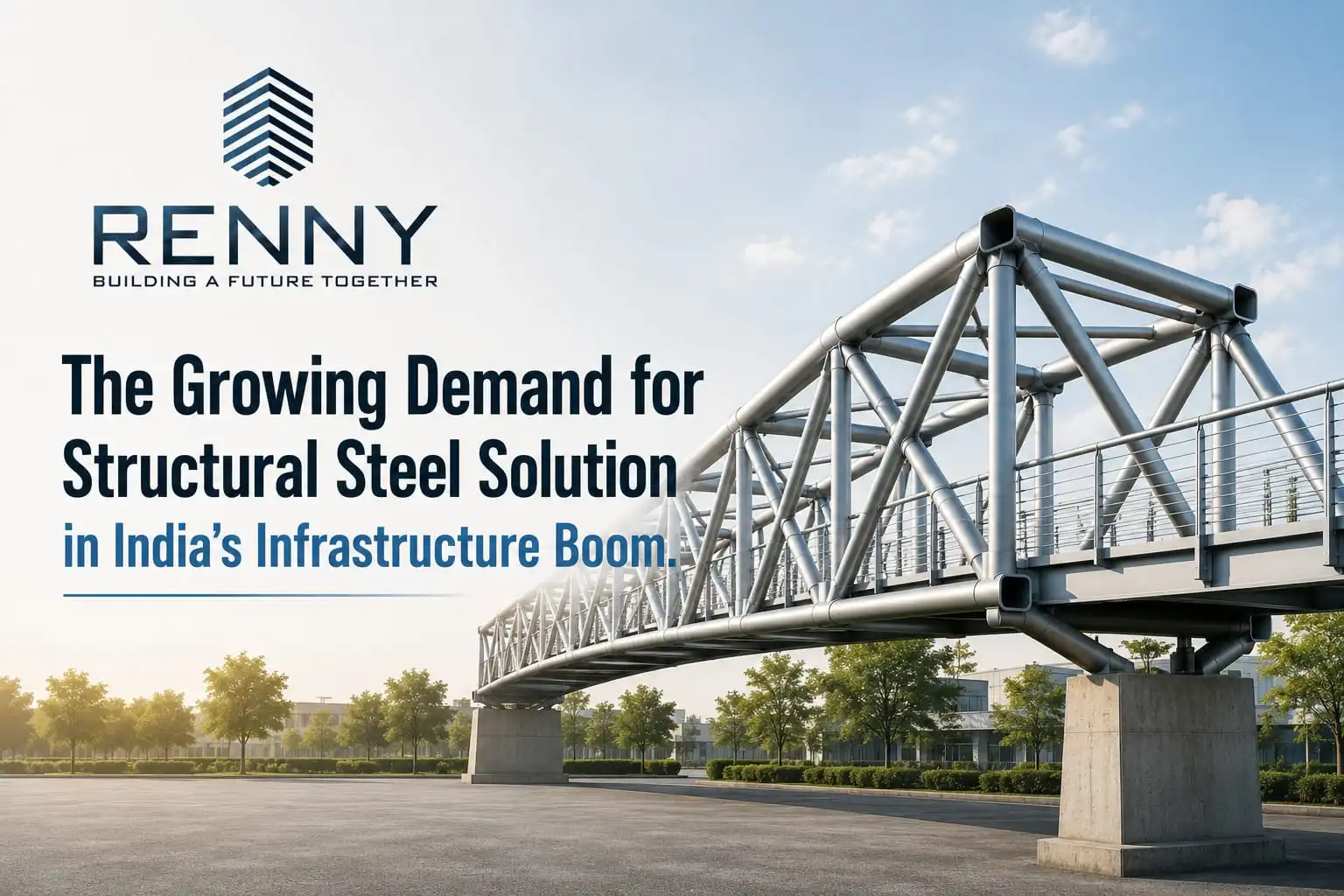
From highways to high-rises, India's next decade of growth is being built on steel circular, recyclable, and engineered to outlast.
India Is Building Its Future in Steel
India is in the middle of its most ambitious infrastructure expansion in history. Highways are unfurling across new corridors, metro networks are stitching together second- and third-tier cities, and industrial parks, refineries, smart cities, ports, and renewable energy projects are coming online at a pace the country has never seen before. Holding all of this up quite literally is structural steel.
The Union Budget allocated a record ₹12.2 lakh crore in capital expenditure for FY 2026–27, channelled into highways, railways, metros, defence, and industrial corridors. India's steel demand grew 8.1% year-on-year in April 2026, with consumption reaching 12.99 million tonnes in a single month. And structural steel now commands a 33.6% share of India's steel market, the largest of any product category.
This is not a cyclical surge. It is a structural shift in how India builds.
A Market Built on Scale
India is now the world's second-largest steel producer. The domestic steel market reached 153.4 million tonnes in 2025 and is projected to grow to 220.5 million tonnes by 2034, expanding at a CAGR of 5.95%. The construction and infrastructure sector alone accounts for roughly 41.9% of total steel demand in the country.
The drivers behind this growth are structural, not cyclical, powered by some of the country's most ambitious policy programmes:
- National Infrastructure Pipeline & PM Gati Shakti
multimodal connectivity at the national scale
- Bharatmala & Sagarmala
road and port expansion across every region
- PM Awas Yojana / Housing for All
steel-intensive affordable housing at scale
- Metro Rail Expansion:
active projects across 30+ cities
- Jal Jeevan Mission
water infrastructure reaching every rural household
- 500 GW Renewable Energy Target
a steel-intensive energy transition
- Dedicated Freight Corridors
industrial logistics infrastructure
Each of these programmes is replacing concrete-heavy traditional methods with faster, leaner, steel-led construction. As CRISIL noted, the shift toward steel-intensive construction in housing and infrastructure is now a defining feature of India's building economy.
The question for project owners, EPC contractors, and developers is no longer whether to use structural steel, but which products, at what specification, and from which kind of supplier. Understanding the applications of MS Black ERW Pipes can help buyers select the right pipe solution for infrastructure, industrial, and construction projects.
ERW Steel Pipes: The Arteries of New India
If structural steel is the skeleton of modern infrastructure, Electric Resistance Welded (ERW) steel pipes are its arteries. These pipes carry water, fuel, gas, sewage, and slurry. They form scaffolding standards, structural columns, and fencing, and they are the spine of HVAC and firefighting systems in every new commercial tower coming up across the country.
India's steel pipe and tube market is currently sized at approximately 6.98 million tonnes (2023) and is forecast to reach 7.66 million tonnes by 2030. The pipes and tubes segment contributes around 8% of India's total steel consumption, and ERW pipes account for roughly half of the ₹50,000-crore industry by value.
2026 has been particularly active. MS ERW pipe prices have firmed up by over ₹2,500 per tonne this year as Hot Rolled Coil costs rise and Jal Jeevan Mission orders accelerate. The Indian steel pipe market is projected to grow at a CAGR of 7.1% through 2033, with the ERW segment expected to be the fastest-growing category. If you're evaluating suppliers, here's what to consider when choosing the best ERW pipes manufacturer in India. Government-led infrastructure investment alone has driven a 40% rise in ERW tube usage across Indian construction applications.
What makes ERW pipes the default choice for contractors?
- Dimensional accuracy
consistent sizing that meets tight project specifications
- Smooth surface finish
critical for fluid conveyance and coating performance
- Suitability for high-volume production
aligned with large-scale procurement needs
- Proven performance
under fast-moving project timelines and quality tolerances
Steel Wire Rods: The Quiet Strength Inside Every Structure
Wire rods rarely get attention from the outside because they live inside concrete. But every reinforced column, every prestressed bridge girder, every welded mesh in an industrial floor depends on them.
Construction is the single largest end-use for steel wire rods globally, feeding into rebars, stirrups, binding wire, welded mesh, nails, fasteners, and PC strand. In India, wire rod prices rose 6.9% in Q1 2026, driven by surging demand for binding wire, chain link mesh, and PC strand under the Gati Shakti and Bharatmala programmes.
India is the fastest-growing regional market for steel wire rod globally, expanding at a CAGR of 7.1% driven by the government's 300-million-tonne steel capacity target. The global steel wire rod market reached USD 113.47 billion in 2025 and is projected to hit USD 162.90 billion by 2034.
Beyond rebars, wire rods are increasingly critical to India's energy transition, forming the galvanised cores of overhead transmission conductors, guy wires for towers, and cable systems for wind turbines and solar farms. They are, quietly, one of the most versatile and mission-critical steel products in the market today.
Scaffolding & Formwork: Building Faster, Safer, Cleaner
Behind every fast-rising tower and every viaduct cast in record time is a hidden enabler: the scaffolding and formwork system. These access and shuttering solutions determine how quickly, safely, and accurately concrete and steel structures take shape, and they are undergoing a quiet revolution.
The Indian construction scaffolding market reached USD 4.19 billion in 2024 and is projected to hit USD 6.80 billion by 2033, growing at a CAGR of 4.90%. A parallel forecast pegs growth even higher at a CAGR of 7.8% between 2026 and 2032, driven by metro projects, real estate, and industrial corridor development.
The market is rapidly shifting away from traditional bamboo and timber scaffolding toward modular steel and aluminium systems, and the reasons are direct:
- Safety
Modular metal systems significantly reduce on-site accidents and are easier to audit
- Speed
Standardised components cut assembly and dismantling time across project cycles
- Reusability
A single system can be redeployed across hundreds of project cycles
- Compliance
Indian projects are increasingly subject to international safety codes
Steel formwork already commands about 54.2% of the global formwork material share, and in India's metro-rail projects alone, aluminium formwork adoption rose 27% in 2024. The Indian market is also moving decisively toward green, end-to-end customised scaffolding and formwork systems, solutions that combine structural integrity with circular-economy thinking.
Why Structural Steel? Because Recyclability Is the New Strength
Steel was always selected for its strength, ductility, fire resistance, and load-bearing efficiency. What is changing in this decade, and what is quietly powering the boom, is the recognition that steel is also the world's most sustainable structural material.
Steel is 100% and infinitely recyclable, with no loss of properties. This recyclability is one of the key reasons why global buyers are increasingly sourcing steel from low-carbon steel suppliers committed to sustainable manufacturing. It can be melted and reused indefinitely, which is why every steel plant is also a recycling plant. Since 1900, the global steel industry has recycled over 25 billion tonnes of scrap.
The environmental case is compelling:
● 1.5 tonnes of CO₂ avoided for every tonne of steel scrap recycled: plus 1.4 tonnes of iron ore, 740 kg of coal, and 120 kg of limestone saved
● 630 million tonnes of recycled steel are used in global production each year, preventing nearly 950 million tonnes of annual CO₂ emissions
● Up to 75% CO₂ reduction is possible via Electric Arc Furnace steelmaking, which can use up to 100% scrap
For India, this matters enormously. India's green steel demand is forecast to grow from negligible levels today to 4.49 million tonnes by FY30, 24 million tonnes by FY35, and 73 million tonnes by FY40. Construction, infrastructure, and automotive industries are leading this demand curve.
For developers, EPC contractors, and asset owners, the calculation has shifted. Choosing structural steel is no longer a trade-off between strength and sustainability; it is a choice for both. Durable structures with 60+ year design lives, built to be detailed for disassembly, whose raw material can be returned to the production loop at the end of life. Steel is, increasingly, the only major structural material with that profile.
Looking Ahead: India's Infrastructure Decade Is Steel's Decade
ERW pipes, wire rods, and scaffolding and formwork systems are no longer commodities at the back of a procurement list. They are strategic inputs that determine the cost, speed, safety, and carbon footprint of every project they touch.
The manufacturers and solution providers that will lead this market are those combining three things:
- Strength and durability
the baseline that the industry has always demanded
- Precision and consistency
what modern infrastructure timelines now require
- A credible commitment to circularity
verifiable, low-carbon, recyclable production
India is building at a scale its history has never seen. And it is being built, quite literally, in steel.
Conclusion: Steel Is How India Builds Next
India's infrastructure decade is not a distant forecast. It is happening right now in the highways being laid, the metro lines being extended, the industrial corridors taking shape, and the renewable energy installations rising across the country. Structural steel is not just a material input in this story. It is the backbone of it.
What makes this moment different from previous construction cycles is the convergence of three forces at once. Scale driven by record government capital expenditure and a pipeline of programmes from Bharatmala to Jal Jeevan Mission. Precision, as modern infrastructure timelines demand consistent, high-quality steel products that perform under pressure. And sustainability — as India's green steel demand moves from negligible today to 73 million tonnes by FY40, and the industry recognises that steel's infinite recyclability makes it the only structural material built for a circular economy.
ERW pipes, wire rods, and scaffolding and formwork systems sit at the intersection of all three. They are no longer commodity line items — they are strategic decisions that shape the cost, speed, safety, and carbon footprint of every project they touch.
India is building at a scale its history has never seen. The question is no longer whether structural steel will power that growth. The question is which products, at what specification, and from which suppliers are equipped to meet the moment.
Frequently Asked Questions
1. Why is structural steel the dominant material in India's current infrastructure boom?
Structural steel has overtaken every other product category to claim a 33.6% share of India's steel market, and the reasons go beyond strength alone. Steel enables faster construction timelines, supports leaner designs compared to concrete-heavy methods, and is now recognised as the world's most sustainable structural material due to its infinite recyclability. With government programmes like PM Gati Shakti, Bharatmala, and metro rail expansion across 30+ cities all demanding speed and durability, structural steel is the natural fit for the scale and pace of India's build-out.
2. How are wire rods contributing to India's infrastructure and energy transition?
Wire rods are one of the most quietly critical steel products in India's current build-out. Inside every reinforced concrete column, bridge girder, and industrial floor lies wire rod-derived reinforcement rebars, stirrups, binding wire, welded mesh, and PC strand. Demand has accelerated sharply under Bharatmala and Gati Shakti, with Indian wire rod prices rising 6.9% in Q1 2026 alone. Beyond construction, wire rods are now essential to India's energy transition: they form the galvanised cores of overhead transmission conductors, guy wires for towers, and cable systems for wind turbines and solar farms. India is the fastest-growing regional market for steel wire rod globally, expanding at a CAGR of 7.1%, and that trajectory is only strengthening as the country pursues its 500 GW renewable energy target.
3. Why are scaffolding and formwork systems increasingly seen as strategic infrastructure inputs rather than temporary site equipment?
The shift is being driven by safety mandates, speed requirements, and sustainability thinking, all converging at once. India's construction scaffolding market is projected to grow from USD 4.19 billion in 2024 to USD 6.80 billion by 2033, and the industry is rapidly moving away from bamboo and timber toward modular steel and aluminium systems. These systems reduce on-site accidents, cut assembly and dismantling time across project cycles, and can be redeployed hundreds of times — making them both operationally and economically superior over a project portfolio. As Indian infrastructure projects increasingly align with international safety codes and green building standards, the scaffolding and formwork system a contractor selects directly affects cost efficiency, site compliance, and overall project carbon footprint. It is no longer a back-of-the-list procurement decision.
4. How is India's green steel transition affecting procurement decisions for infrastructure projects?
The shift toward green steel is moving faster than most procurement teams anticipated. India's green steel demand is forecast to grow from negligible levels today to 4.49 million tonnes by FY30, 24 million tonnes by FY35, and 73 million tonnes by FY40, with construction and infrastructure leading that demand curve. For developers and EPC contractors, this means the carbon footprint of structural steel is becoming a project-level metric, not just a corporate sustainability talking point. Electric Arc Furnace steelmaking, which can use up to 100% scrap and deliver up to 75% CO₂ reduction compared to conventional routes, is increasingly the benchmark buyers are asking suppliers to meet. Choosing a steel partner with a credible, verifiable commitment to low-carbon production is fast becoming a procurement requirement, particularly on projects with ESG reporting obligations or international financing.
5. What role does steel's recyclability play in long-term infrastructure planning?
Steel is the only major structural material that is 100% and infinitely recyclable with no degradation in properties, and that changes the economics of infrastructure over its full life cycle. Since 1900, the global steel industry has recycled over 25 billion tonnes of scrap. Every tonne of steel scrap recycled avoids 1.5 tonnes of CO₂ emissions and saves 1.4 tonnes of iron ore, 740 kg of coal, and 120 kg of limestone. For infrastructure planners and asset owners designing structures with 60-plus year design lives, this means steel-framed buildings and bridges are not just durable — they are designed to re-enter the production loop at the end of life. In a circular economy framework, structural steel is not a cost to be managed at demolition; it is a recoverable asset. That profile is increasingly influencing material selection at the master planning stage.
6. How is India's steel demand being supported by policy, and is this growth sustainable beyond the current budget cycle?
The current infrastructure push is backed by the single largest capital expenditure allocation in India's budgetary history, ₹12.2 lakh crore in FY 2026–27, channelled across highways, railways, metros, defence manufacturing, and industrial corridors. But the demand story does not rest on a single budget. It is anchored in multi-year programmes Bharatmala, Sagarmala, PM Awas Yojana, the Jal Jeevan Mission, the Dedicated Freight Corridors, and the 500 GW renewable energy target, each with decade-long implementation timelines and independent procurement pipelines. India's domestic steel market, which reached 153.4 million tonnes in 2025, is projected to grow to 220.5 million tonnes by 2034 at a CAGR of 5.95%. The government's stated target of 300 million tonnes of domestic steel capacity reinforces that this is a structural policy, not a cyclical stimulus. For steel manufacturers and solution providers, the pipeline is visible, deep, and spans well beyond any single fiscal year.
7. What should EPC contractors and project developers look for when selecting a structural steel supplier for large-scale infrastructure projects?
At the scale India is now building, supplier selection is a strategic decision, not just a commercial one. Three criteria define the suppliers equipped to meet this moment. First, product consistency and dimensional precision modern infrastructure timelines leave no room for material variability that causes rework or delays; ERW pipes, wire rods, and structural sections must meet tight specifications reliably across high-volume orders. Second, supply chain depth and delivery reliability, a supplier's ability to commit to phased delivery schedules across long project cycles, not just spot orders, is what separates strategic partners from transactional vendors. Third, a demonstrable commitment to sustainable, low-carbon production, as green building certifications, ESG disclosures, and international financing standards become standard features of large infrastructure projects, the carbon credentials of a steel supplier are increasingly part of the project's own compliance profile. The structural steel companies that will lead India's infrastructure decade are those that bring all three to the table.
Sources:
IMARC Group | IndexBox | IBEF | BlueWeave Consulting | worldsteel | BIR | The Insight Partners | 6Wresearch | CRISIL | Global Growth Insights | Nexizo | industryresearch.biz
Need Help Choosing the Right Product?
Have questions about pricing, technical details, or bulk orders? Get in touch with our team.