
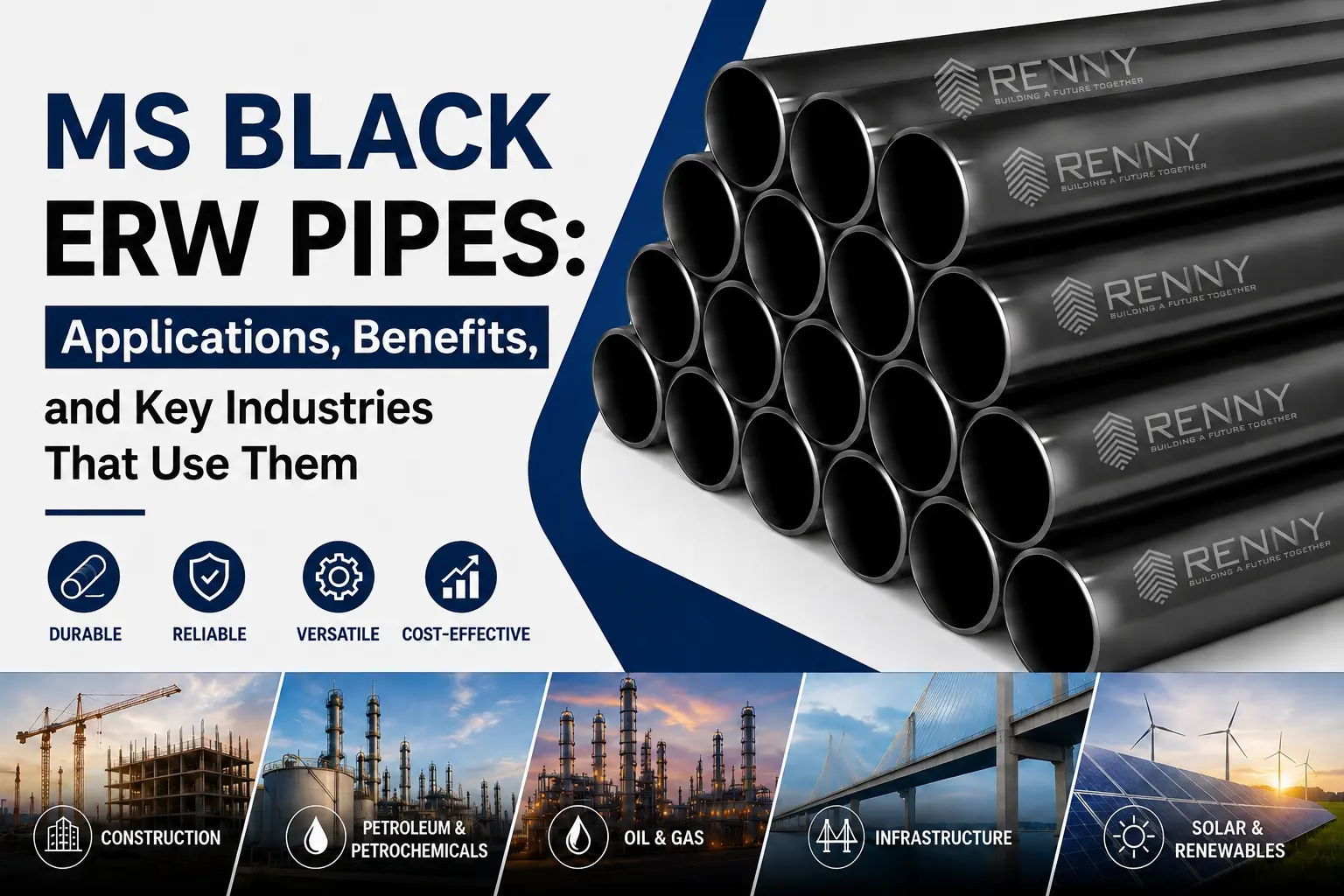
When modern infrastructure demands strength, reliability, and cost-efficiency in equal measure, MS Black ERW (Electric Resistance Welded) pipes have emerged as one of the most relied-upon structural inputs in the country, forming the working backbone of buildings, water grids, refineries, power plants, and industrial systems across India and global export markets. At Renny Strips Limited, a fully vertically integrated structural products manufacturer in Ludhiana, Punjab, we maintain stringent industry standards and superior quality control at every stage from raw material to finished product. Backed by in-house steel melting, narrow-width HR coil rolling, and 22 MW of captive solar, our ERW pipe mill is engineered to meet the demands of India’s infrastructure decade and an increasingly carbon-sensitive global market. This brief covers what MS Black ERW pipes are, the industries they serve, the benefits they deliver, and the differentiated edge Renny brings to every tonne we manufacture.
What Are MS Black ERW Pipes?
MS Black ERW pipes are mild steel pipes manufactured through the Electric Resistance Welding process. Steel coils are progressively formed into a cylindrical shape, and the longitudinal edges are heated and welded without filler material producing a strong, uniform seam. The “black” finish refers to the natural, uncoated surface of the steel, which retains the dark oxide layer formed during manufacturing. Made from low-carbon mild steel, ERW pipes offer excellent ductility, weldability, and structural strength, and are produced in a wide range of diameters, wall thicknesses, and lengths to meet exact engineering specifications.
At Renny Strips, ERW pipes are produced at an annualised capacity of ~37,476 MTPA, drawing on in-house HR coils slit and trimmed to precise widths before entering our pipe mills. High-frequency solid-state ERW technology with D2-grade roll sets and W-forming delivers consistent profiling and tight dimensional tolerance If you're evaluating suppliers, it's also important to understand what differentiates the best ERW pipes manufacturer in India. every pipe is certified under IS 4923:2017, IS 18573:2024, IS 1161:2014, IS 1239 Part 1:2004, and IS 3601:2006.
Key Properties of Renny’s MS Black ERW Pipes
- Fully Integrated Supply Chain
Raw material (HR coils) produced in-house, ensuring consistent quality and reduced lead times.
- Precision Welding
High-frequency solid-state ERW technology delivers uniform, reliable weld seams.
- Dimensional Accuracy
W-forming technology with D2-grade roll sets ensures tight tolerances and consistent profiling.
- Versatile Range
Available in square, rectangular, and round sections to meet diverse project requirements
- BIS Certified
Products manufactured under IS 4923:2017, IS 18573:2024, IS 1161:2014, IS 1239 Part 1:2004, and IS 3601:2006
Manufacturing Process of Renny’s MS Black ERW Pipes
Steel Melting
- The manufacturing process begins at our in-house Steel Melting Shop (SMS).
- Raw materials are melted in induction furnaces to produce high-quality MS billets.
Hot Rolling
- The MS billets are processed through our rolling mill.
- Billets are hot-rolled into narrow-width Hot Rolled (HR) coils.
Slitting & Width Preparation
- HR coils are slit and trimmed to precise widths.
- The prepared steel strips are then fed into the ERW pipe manufacturing line.
Pipe Forming
- Steel strips are progressively formed into a tubular shape through a series of forming rolls.
ERW Welding
- The longitudinal edges of the formed tube are joined using High-Frequency Electric Resistance Welding (ERW) technology.
- This ensures a strong, uniform, and reliable weld seam.
Sizing & Calibration
- The welded pipes pass through a sizing mill.
- Final dimensions and shape accuracy are achieved during this stage.
Finishing Operations
- Pipes undergo end-finishing processes based on customer requirements.
- Options include plain-end, threaded, and bevel-end finishes.
Integrated Manufacturing Advantage
- Complete backward integration from steel melting to finished pipes.
- Eliminates dependency on external coil suppliers.
- Ensures full control over steel chemistry and mechanical properties.
- Enhances product consistency and quality.
- Reduces production costs and improves operational efficiency.
Applications of MS Black ERW Pipes
MS Black ERW pipes serve a wide spectrum of applications. Their versatility is rooted in a simple fact: very few structural products combine strength, weldability, precision, and cost-efficiency in one package.
Construction & Structural Framework
Columns, beams, frameworks for warehouses, industrial sheds, and multi-storey buildings; fencing, Scaffolding & Formwork Systems, and guardrails.
Infrastructure & Water Management
Municipal and rural water supply, irrigation, stormwater drainage, and sewage networks under Jal Jeevan and Smart Cities. Where corrosion resistance is essential, many projects also use GI Pipes for long-term water distribution applications.
Industrial Fluid & Gas Transport
Water, compressed air, oil, and light chemicals through factories, refineries, and processing plants
Petroleum & Petrochemicals
Distribution piping and components inside petrochemical processing units.
Power Generation
Fluid conveyance, boiler frames, cooling systems, and transmission support structures.
Machinery & Heavy Engineering
Machine frames, conveyor systems, automotive chassis, and heavy equipment assemblies
Solar & Renewables
Module mounting structures and solar tracker frames are a fast-growing segment as India accelerates toward 500 GW of non-fossil capacity. This increasing demand reflects the broader growth of structural steel solutions supporting India's infrastructure expansion.
Specialised Industries
Heat exchangers, distillery and brewery units, dairy and food processing, sugar industries, and chemical and fertiliser plants.
Key Industries Built on ERW
The ERW round-pipe segment is projected to grow strongly through 2030, driven by demand from oil & gas, construction, and utility sectors. In India, government-led infrastructure spending alone has driven a 40% rise in ERW tube usage across construction applications, with the segment the fastest-growing category in the country’s broader steel pipe market.
| Industry | Primary Uses | Why ERW? |
|---|---|---|
| Construction | Frames, scaffolding, columns, trusses | Strength, cost-efficiency, and weldability |
| Infrastructure | Water supply, irrigation, drainage | Durability, corrosion resistance |
| Oil & Gas | Fluid transport, distribution piping | Strength, leak-resistant welds |
| Power | Cooling systems, boiler frames, and supports | Consistency, thermal performance |
| Chemical & Fertilizer | Process piping, heat exchangers | Formability, coatable surface |
| Food & Dairy | Distillery, processing, sugar plants | Hygienic surface, easy cleaning |
| Automotive & Machinery | Machine frames, conveyors, chassis | Precision, adaptability |
| Solar & Renewables | Module mounting, tracker frames | Lightweight strength, scale-ready |
Benefits of MS Black ERW Pipes
High strength & durability
The ERW process creates a continuous, consistent weld seam ideal for heavy-load applications and harsh service environments
Cost-effectiveness
Significantly lower production cost than seamless pipes is a critical advantage on large-scale infrastructure projects without compromising structural performance.
Precision & consistency
Uniform diameter, wall thickness, and length reduce on-site fabrication time and project rework
Excellent weldability & formability
Low-carbon chemistry enables easy welding, bending, and shaping, giving designers flexibility in construction and fabrication.
Corrosion resistance with coatings
The bare black finish can be galvanised or painted to extend service life in outdoor, marine, and chemically aggressive environments. For projects requiring factory-applied zinc protection, GI Pipes are often preferred over black pipes because of their enhanced corrosion resistance.
Sustainability
Recycled scrap inputs, energy-efficient processing, and Renny Strips’ 22 MW solar facility materially cut the embodied carbon of every tonne we produce
Versatility
A single product family covers small-scale irrigation lines through to load-bearing structural elements in multi-storey buildings and industrial plants.
Why Choose Renny Strips For MS Black ERW Pipes
Renny Strips is not merely a pipe manufacturer; we are a fully backward-integrated structural products manufacturer with end-to-end control from molten steel to finished pipe. That integration is increasingly a strategic advantage as buyers contend with carbon-border regulations, BIS compliance scrutiny, and supply-chain disruption
- Integrated capacity
Steel melting (~1,99,200 MTPA), MS billets, narrow-width HR coils (~97,222 MTPA), and finished ERW pipes (~37,476 MTPA) every tonne traceable from melt to mill, chemistry controlled at source
- 1,000+ SKUs
Across pipes, tubes, scaffolding, formwork, and structural sections a single supplier for project-wide structural needs, foundation to facade.
- Solar-powered manufacturing
A 22 MW captive solar plant powers a meaningful share of production reducing emissions and insulating output from grid price volatility.
- BIS, ISO, EN 1090 & CE certified
ISO 9001, 14001, 45001, EN 1090-1/2 and EN ISO 3834-2 with TÜV Rheinland verification for both steel and infra divisions.
Conclusion
MS Black ERW pipes represent far more than a commodity input; they are a foundational material in India's infrastructure story and a growing force in global structural markets. From municipal water networks and solar mounting systems to petrochemical plants and multi-storey frameworks, their combination of structural strength, dimensional precision, weldability, and cost-efficiency makes them the material of choice across virtually every capital-intensive sector.
As infrastructure spending accelerates, carbon-border regulations tighten, and supply-chain resilience becomes a procurement priority, the sourcing decision behind every tonne of ERW pipe carries greater consequence than ever before. Buyers increasingly need a manufacturer who can guarantee not just product quality, but chemistry traceability, emissions credentials, and regulatory compliance from melt to mill.
That is precisely the standard Renny Strips is built to meet. With complete backward integration from steel melting through HR coil rolling to finished pipe, a 22 MW captive solar plant that meaningfully reduces embodied carbon, and a certification portfolio spanning BIS, ISO, EN 1090, and CE, Renny brings industrial-grade accountability to every order, whether a domestic infrastructure contractor or an export buyer navigating CBAM requirements.
In an industry where the difference between a reliable supplier and the right partner can determine project timelines, compliance exposure, and long-term asset performance, Renny Strips offers something the market rarely finds in one place: full-chain control, sustainability credibility, and the product depth of 1,000+ SKUs to serve a project from foundation to facade.
Frequently Asked Questions
What does "Black" mean in MS Black ERW Pipes?
The term "Black" refers to the dark oxide layer (mill scale) left on the pipe surface after the hot rolling and welding process. No coating or galvanizing is applied, giving it a natural black finish.
What is ERW in pipe manufacturing?
ERW stands for Electric Resistance Welding a process where steel strips are rolled into a cylindrical shape, and the edges are fused together using electric current, without any filler material.
How is MS Black ERW pipe different from seamless pipe?
Seamless pipes are made from solid steel billets without a weld seam, making them stronger under extreme pressure. ERW pipes have a weld seam but are more cost-effective and dimensionally accurate for standard applications.
Can MS Black ERW Pipes be used for a drinking water supply?
Generally, they are not recommended for potable water without an internal lining or coating, as the black oxide surface can cause corrosion over time. Galvanized or lined pipes are preferred for drinking water.
Are MS Black ERW Pipes suitable for underground installation?
Yes, but they require external protective coatings (like bitumen, epoxy, or wrapping tape) to prevent corrosion from soil moisture and chemicals
Can MS Black ERW Pipes handle high-temperature applications?
MS Black ERW Pipes perform well in moderate temperature ranges. For very high-temperature environments (above 400°C), alloy steel or stainless steel pipes are more suitable.
Are MS Black ERW Pipes used in structural applications?
Absolutely. They are widely used in structural frameworks, scaffolding, columns, poles, and hollow sections in construction and infrastructure projects.
Need Help Choosing the Right Product?
Have questions about pricing, technical details, or bulk orders? Get in touch with our team.