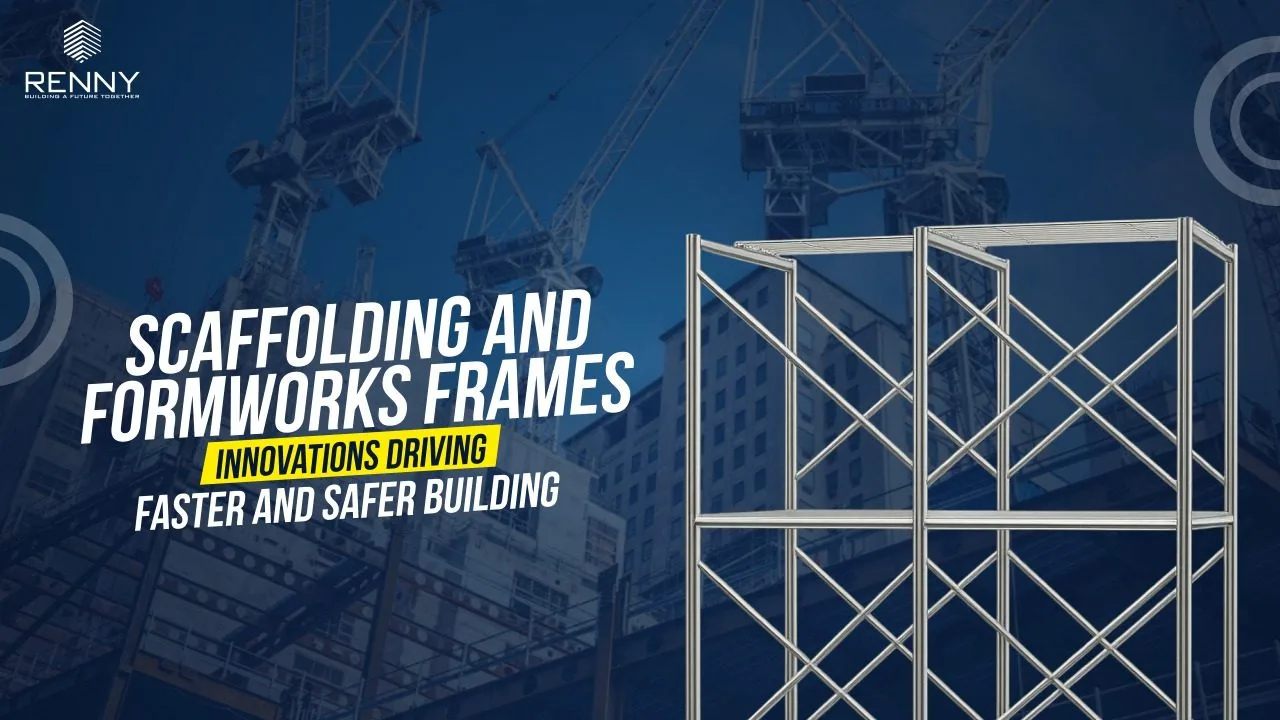
Walk onto any active concrete-frame site in India and you'll see two temporary steel systems doing most of the heavy lifting: scaffolding, which gets workers and materials up to where the work happens, and formwork, which holds poured concrete in shape until it can stand on its own. Both are regulated under IS 2750 and IS 4014, and both have changed a lot in the last decade — modular connections, higher-grade steel, digital tracking. This guide covers what these frames actually do, the types in common use, the standards that apply, and where the real gains in speed and safety are coming from.
Quick Overview
- Scaffolding frames give workers and materials temporary, safe access to elevated parts of a structure.
- Formwork frames act as a mould, holding wet concrete in place until it cures.
- Steel scaffolding in India falls mainly under IS 2750 and IS 4014.
- Modular systems — H-frames, cuplock, ringlock — have replaced most traditional tube-and-coupler scaffolding because they go up faster with less skilled labor.
- Falls and structural failures remain leading causes of site injuries, which is why locking mechanisms, anti-slip decking, and corrosion protection have become standard rather than optional.
What Are Scaffolding and Formwork Frames?
Scaffolding Frames — Definition and Function
A scaffolding frame is a temporary steel structure erected around or inside a building so workers can reach elevated areas safely. Most are built from mild steel tube meeting IS 1239 or IS 3589 specifications, designed to be assembled and taken down repeatedly across different projects. The job of a scaffold frame is simple in principle: carry the weight of people, tools, and material without flexing or shifting under normal use.
Formwork Frames — Definition and Function
A formwork frame — sometimes called shuttering or shoring — holds freshly poured concrete in its intended shape until it's strong enough to support itself. That means resisting the pressure of wet concrete pushing outward, staying dimensionally stable through the pour, and coming away cleanly afterward without marking or damaging the finished surface.
How Scaffolding and Formwork Work Together on Site
On most multi-storey concrete jobs, the two systems overlap. Scaffolding gets workers up to place and vibrate the concrete; formwork, often carried by that same scaffold structure, shapes the pour. It's common for shoring frames to double as both formwork support and the working platform for the floor above — which is part of why frame compatibility across a project matters as much as the individual purchase decision. Mixing coupling systems or load classes mid-project tends to cause more site headaches than it saves in cost.
Scaffolding Frame vs. Formwork Frame — Quick Comparison
| Aspect | Scaffolding Frame | Formwork Frame |
|---|---|---|
| Primary function | Worker/material access platform | Mould/support for wet concrete |
| Typical load type | Live load (people, tools, materials) | Static + hydrostatic load (wet concrete) |
| Typical time on site | Days to weeks, reused floor to floor | Until concrete reaches stripping strength (often 1–7 days, depending on grade and curing) |
| Common materials | MS tube, steel pipe frames | Steel props, H-frames, plywood or steel panels |
| Governing standards | IS 2750, IS 4014 | IS 14652 (props), IS 4990 (plywood formwork), general structural codes |
Types of Scaffolding and Formwork Frames
The right frame type comes down to building height, load, and how fast the structure needs to move between floors. Here's what's actually in use on Indian and export sites today.
H-Frame Scaffolding
Named for the H-shaped end panels linked by horizontal and diagonal braces, H-frames are the workhorse of modular scaffolding. Quick to erect, easy to stack for multi-storey access, and common on facades, industrial plants, and general-purpose scaffolding jobs.
Door / Walk-Through Frames
Basically an H-frame with a wider base opening. Workers, wheelbarrows, and small equipment can move through the scaffold without dismantling any part of it — handy on busy sites where material has to keep moving.
Ladder Frames
These build a ladder rung directly into the frame, giving workers a fixed, code-compliant path between scaffold levels instead of leaning a separate ladder against the structure.
Cuplock and Ringlock Systems
Node-based systems where horizontal and diagonal members lock into fixed points on a vertical standard, using a rotating cup or ring collar. They offer more configuration freedom than a fixed H-frame, which is why they get chosen for irregular geometries, heavy shoring, and industrial jobs where the load path isn't uniform.
Shoring and Formwork Frames
Heavier-duty vertical supports built to carry formwork and the wet concrete above it until the slab or beam cures. Rated separately from general-access scaffolding because the loads involved are higher and more concentrated.
Frame Type × Best Use Case × Approx. Load Class
| Frame Type | Best Use Case | Approx. Load Class* |
|---|---|---|
| H-Frame | General access, facades, low-to-mid rise | Light to medium duty |
| Door/Walk-Through Frame | Sites with continuous material movement | Light to medium duty |
| Ladder Frame | Multi-level access, frequent worker movement | Light to medium duty |
| Cuplock/Ringlock | Irregular structures, heavy industrial scaffolding | Medium to heavy duty |
| Shoring/Formwork Frame | Slab and beam formwork support | Heavy duty (static + hydrostatic load) |
*Actual safe working loads depend on manufacturer, steel grade, and frame spacing. Check the supplier's technical datasheet before use on site.
For more on the components that pair with these frames, see our guides on scaffolding steel props and jacks and ringlock scaffolding systems.
Governing Standards for Steel Scaffolding and Formwork Frames
On any organized site, compliance isn't a formality — it's usually the first thing a safety auditor or structural consultant checks before signing off on a frame system.
IS 2750 — Specification for Steel Scaffoldings
Sets the material, dimensional, and manufacturing requirements for steel tubular scaffolding components in India. Most domestic manufacturers design their product lines against this baseline.
IS 4014 — Code of Practice for Steel Tubular Scaffolding
Where IS 2750 covers how a frame should be made, IS 4014 (in two parts) covers how it should be erected, braced, loaded, and dismantled. Together they're effectively the manufacturing and usage rulebook for steel scaffolding in India.
International Reference Standards
On projects with export components or overseas consultants, EN 12811 — the European standard for temporary works equipment — is the usual reference point. Manufacturers serving both domestic and export markets generally design to whichever standard is stricter. Standards get revised periodically. Confirm the current edition and any amendments with BIS or your structural consultant before specifying frames for a project.
Innovations That Help You Build Faster
Modular Configurations That Cut Assembly Time
Pre-engineered frames — H-frame, cuplock, ringlock — remove the need to measure, cut, and clamp individual tubes on site the way traditional scaffolding required. Standardized connection points mean fewer steps to erect and strike, which is a big part of why modular systems now dominate mid-to-large commercial and residential jobs.
Digital Integration — BIM, Load Simulation, RFID/QR Tracking
BIM lets contractors model scaffold and formwork layouts before frames ever arrive on site, catching clashes or load errors on screen instead of mid-pour. Pair that with RFID or QR-tagged inventory, and a site team can tell at a glance which frames are in use, due for inspection, or nearing the end of their reuse cycle — less downtime, and less risk of a compromised frame ending up back in rotation.
Quick-Release Formwork Systems
Quick-release, or "flying," formwork uses drop-head props and a mechanised strike mechanism, so the panel comes off while the prop stays under the curing slab. That cuts the time and labor needed to strip formwork and set it up again on the next floor. More detail in our guide to scaffolding steel props and jacks .
Faster Vertical Progression for High-Rise and Industrial Builds
Some frame systems are built so one level doubles as the working platform for erecting the level above, letting high-rise and industrial jobs climb floor to floor without a full teardown-and-rebuild cycle each time.
Reduced Manpower Requirements
Fewer loose parts — bolts, clamps, individual tubes — means modular frames need smaller crews to erect and strike safely than traditional coupler scaffolding does. That matters more than it used to, given how tight the supply of skilled scaffolding labor has gotten.
Innovations That Build Safer
Enhanced Locking and Bracing Systems
Cup, ring, and pin connections now lock positively rather than relying on friction — a real improvement over older clamp designs, which can work loose under vibration or repeated loading.
High-Strength Steel and Aluminium Alloys
Higher-grade steel, and on some systems aluminium alloy, lets manufacturers raise load capacity without a proportional jump in frame weight. That's a win on two fronts: more safety margin, and frames that are easier to handle manually on site.
Anti-Slip and Anti-Skid Platforms
Textured or perforated decking cuts slip risk in wet or dusty conditions. Given that slips, trips, and falls are among the most common causes of scaffolding injuries, this is one of the simpler upgrades that makes a measurable difference.
Fire-Resistant and Corrosion-Resistant Coatings
Galvanized and powder-coated finishes hold up better in humid or coastal environments and extend how long a frame stays in usable condition. Fire-resistant coatings add a layer of protection on sites where welding or other hot works happen near scaffolding.
Intelligent Weight Distribution
Wider base plates and better-optimized brace angles spread load more evenly across a frame, so no single leg or connector is carrying a disproportionate point load.
Uniform Load Distribution and Surface Finishing in Formwork
On the formwork side, tighter manufacturing tolerances mean more even pressure across the concrete face during a pour — which shows up later as a cleaner surface finish and a lower risk of blowouts.
Safety Feature Checklist — What to Look For
- Positive-locking connection points, not friction-only
- Rated load capacity documented per frame
- Anti-slip platform surface
- Galvanized or powder-coated corrosion protection
- Traceable batch or serial marking
- Compliance with IS 2750 / IS 4014 or the applicable equivalent
Sustainable and Eco-Friendly Frame Engineering
Reusable, High-Life Components
Steel frames hold up across dozens of projects when they're maintained properly, which means less material consumed per project compared to timber or single-use shuttering.
Reduced Concrete Wastage
Well-fitted formwork leaves fewer gaps for concrete to escape through during a pour, cutting overpour and waste — worth noting given how much embodied carbon goes into producing concrete in the first place.
Energy-Efficient Manufacturing
More manufacturers are shifting toward captive renewable power, in-house raw material processing, and digital emissions tracking to bring down the footprint of frame production itself.
How to Choose the Right Scaffolding and Formwork Frames
Load Capacity and Site Requirements
Match the frame's rated safe working load to what it'll actually carry: workers, materials, wind load, and for shoring frames, the weight of wet concrete overhead. Underestimating load class is one of the more common causes of scaffold failure on site.
Material Grade and Finish
Check the steel grade and coating against the environment the frame will sit in. A coastal or high-humidity site needs stronger corrosion protection than a dry inland one — this isn't always obvious from a spec sheet alone.
Certification and Traceability
Only buy frames traceable to a manufacturer batch and certified against IS 2750/IS 4014 or the applicable standard. This matters for safety audits, and it matters for insurance and liability if something goes wrong later.
Supplier Track Record and Logistics
Look at manufacturing scale, consistency across batches, and how reliably a supplier delivers. A supplier who can hold consistent dimensions and finish across a large multi-phase order saves you from compatibility issues down the line.
Buyer's Checklist Before Purchasing
| Criteria | What to Verify |
|---|---|
| Load rating | Documented safe working load per frame/component |
| Standard compliance | IS 2750, IS 4014, or applicable export standard |
| Material certification | Steel grade, mill test certificates |
| Coating/finish | Matched to site environment |
| Traceability | Batch/serial marking on each frame |
| Supplier capacity | Manufacturing scale and delivery timelines for project volume |
How Renny Strips Supports Modern Construction Needs
Manufacturing Precision and Capacity
Renny Strips manufactures scaffolding and formwork tube products with a stated capacity of 77,778 MTPA, referenced against IS 1239, IS 3589, API 5L, ASTM A53, and ISO 9001 quality management certification.
Certified Quality
Building to these standards means every batch meets consistent dimensional and material benchmarks, which cuts down on the compatibility or load-rating surprises that can crop up across a large order.
Built for the Site
Products are engineered around the load, corrosion-resistance, and connection reliability that active construction sites demand — not general-purpose steel tube specs adapted after the fact.
Final Thoughts
Scaffolding and formwork frames have come a long way from basic tube-and-coupler assemblies. Today's systems are modular, increasingly digital, and built to move faster between floors while cutting down on the incidents that plague older setups. Getting the choice right comes down to matching load requirements, standard compliance, and a supplier's track record to the specific project — not just taking whatever's available locally. As timelines get tighter and safety compliance gets stricter alongside them, the frame system chosen at the start of a project has more influence on how it gets built than most site teams give it credit for.
Frequently Asked Questions
What is the difference between a scaffolding frame and a formwork frame?
A scaffolding frame is an access structure supporting workers and materials at height. A formwork frame is a mould that holds wet concrete in shape until it cures. They're often used together but serve different structural purposes.
What are the different types of scaffolding frames?
The main types are H-frames, door/walk-through frames, ladder frames, and node-based systems like cuplock and ringlock — each suited to different layouts and loads.
Which Indian standard governs steel scaffolding frames?
Mainly IS 2750, which covers specification, and IS 4014, which covers code of practice for steel tubular scaffolding.
How do I choose the right formwork frame for my project?
Match rated load capacity to the pour weight and site conditions, confirm material certification, and check the supplier's compliance with the relevant standard before ordering.
How long do steel scaffolding and formwork frames last?
With proper maintenance and corrosion protection, frames can be reused across dozens of projects. Service life depends more on coating quality, storage, and inspection frequency than on a fixed number of years.
What load can a formwork frame typically support?
It varies by design, steel grade, and spacing — always check the manufacturer's rated safe working load for the specific frame and setup rather than assuming a standard figure.
Are modular frame systems more cost-effective than traditional scaffolding?
Generally yes, because they cut assembly time and labor needs compared to tube-and-coupler scaffolding, even where the upfront frame cost is similar.
What safety features should modern scaffolding frames have?
Positive-locking connections, documented load ratings, anti-slip platforms, corrosion-resistant coatings, and traceability — these are the features most directly tied to fewer site incidents.
Need Help Choosing the Right Product?
Have questions about pricing, technical details, or bulk orders? Get in touch with our team.