
Price is the easy variable. It's the one everyone compares first, and honestly, the least useful one on its own. Because the scaffolding you end up buying holds people and materials at height, sometimes for months. Get the manufacturer wrong and you're not looking at a late delivery so much as safety incidents, structural failures, costs that keep surfacing well after the invoice is closed.
And the stakes have gone up. Construction timelines in India are tighter than they were five years back, safety audits don't let much slide anymore, contractors can't afford scaffolding that turns into a liability three months into a build. Raw material sourcing, quality control, delivery reliability — all of it feeds straight into how safe and how efficient your site actually is.
So here's what we'll cover: the qualities that separate a manufacturer worth trusting from one that just reads well on a spec sheet. Raw materials, compliance, manufacturing capability, supply chain, sustainability, after-sales support. Along the way we'll flag where a manufacturer like Renny Strips actually meets these benchmarks — not as a sales pitch, just as a practical reference point.
What Makes a Reliable Ringlock Scaffolding Manufacturer?
Comparing quotations side by side only gets you so far. Two suppliers can quote almost the same number and hand you completely different products — one built on properly sourced steel with tight tolerances, the other cutting corners you won't notice until the scaffold's already standing. What follows is a way to look past the price tag toward what actually determines how the thing performs on site.
High-Quality Raw Materials
A Ringlock system is only as strong as the steel that goes into it. Full stop. Poor steel means weaker load capacity, uneven wall thickness, joints wearing out before they should. It's the one input that, if it's wrong, no amount of clever downstream engineering saves you.
Strength and durability aren't just numbers on a spec sheet — they're the difference between a standard holding its shape after thousands of loading cycles and one that doesn't, between a ledger that shrugs off a crew leaning on it and one that bends. Consistency matters here just as much as raw strength does. A batch of tubes with varying thickness scatters weak points unpredictably across your scaffold. That's arguably worse than material that's uniformly just okay.
Renny Strips handles this at the source. Roughly 90% of its raw material comes from in-house, backward-integrated production — billets through to finished tube. Less variance batch to batch. Less guesswork for whoever's specifying the order.
Compliance with Safety and Quality Standards
Talk is cheap. What actually proves quality is documented testing against recognized standards — not a factory floor demo, but real numbers under realistic load. Dimensional accuracy matters too: wall thickness, outer diameter, coupler fit, all of it needs to sit within tight tolerance, because small deviations stack up fast once you're assembling a multi-lift structure.
Certifications give you something to check against. IS 1239, IS 3589, API 5L, ASTM A53 — these aren't badges for a website footer, they're evidence a manufacturer's process has actually been audited and held up. ISO 9001 adds another layer on top, confirming the quality system itself is structured and repeatable rather than dependent on which shift happens to be on the floor that day.
Renny Strips runs checks at multiple stages of production, not just a single inspection at the end of the line. Catches problems before they become someone else's problem.
Advanced Manufacturing Capabilities
Old machinery gives you old-world tolerances. If a manufacturer's still running decades-old equipment, precision suffers, and so does consistency once order volumes climb. Modern machinery tightens up control over dimensions and finish — which sounds abstract until you're the one trying to fit components together on site and they actually fit.
Automation helps too, though not by removing people from the equation. It reduces the variability that creeps in with manual processes at scale. A factory that's automated its tube forming and finishing stages produces unit 10,000 that looks and performs the same as unit 1. That's what lets contractors order in bulk without crossing their fingers over batch-to-batch surprises.
Reliable Supply Chain and On-Time Delivery
Construction schedules rarely have room to breathe. A scaffolding delivery running two weeks late can stall an entire phase — and the knock-on costs, idle labor, penalty clauses, subcontractors rescheduling around a gap that shouldn't exist, often dwarf what the scaffolding itself cost.
Delivery timelines aren't just a promise a sales team makes. They come down to production capacity — whether a facility can actually scale up for large or urgent orders without falling behind on everyone else's. This is where vertical integration earns its keep. A manufacturer controlling its own raw material supply isn't as exposed to the shortages or price spikes that ripple through a fragmented supply chain. Renny Strips' backward-integrated setup, producing most of its own raw material rather than leaning on outside vendors, gives it more control over continuity, and that flows through to more predictable delivery on the client's end.
Industry Experience and Technical Expertise
There's a real gap between a manufacturer that's handled a few small residential jobs and one that's supplied large industrial or infrastructure projects. Experience across different project types builds an instinct for edge cases — odd load configurations, awkward site geometry, non-standard heights — that you only get from having run into those problems before.
Good manufacturers don't just take the order and ship it out the door. They bring engineering knowledge into the conversation, recommend products based on your actual site conditions rather than whatever's sitting ready in the warehouse. Technical consultation, where it's on offer, can save a contractor from an expensive mismatch between what got ordered and what the project actually needed.
Product Range and Customization
Ringlock isn't one-size-fits-all, whatever the marketing suggests. Standards, ledgers, verticals, jacks, transoms, diagonal braces — all of it needs to come in the right lengths and configurations for your particular job. A narrow product range forces compromises on design, or worse, forces you to mix components from different vendors and hope they're compatible.
Custom requirements come up more than people expect going in: odd heights, unusual loads, project-specific accessories nobody stocks as standard. A manufacturer that treats a custom order as routine rather than a disruption is worth more than one offering rock-bottom pricing on a limited catalog. And for the bigger jobs, scalable manufacturing matters — fulfilling a bulk order on schedule without quality slipping once volume climbs.
Sustainable Manufacturing Practices
Sustainability stopped being a nice-to-have a while back. It's turning into a procurement requirement, especially on projects with export exposure or ESG commitments attached. Green steel — produced with a smaller carbon footprint — is something contractors are increasingly asked to specify, not just something a manufacturer offers if you ask nicely.
Low-carbon production , whether it comes from renewable energy or a more efficient process design, cuts the environmental footprint of every tonne going into your scaffolding. Environmental compliance — proper handling of emissions, waste, energy use — is a decent signal a manufacturer's thinking past this quarter's output numbers.
Renny Strips has put money into captive solar power and emissions monitoring across its operations, which positions its steel for buyers who need to account for embodied carbon in procurement. That's only going to matter more as rules like CBAM extend further into supply chains.
Competitive Pricing Without Compromising Quality
The cheapest quote is rarely the best value. What matters is what you actually get for the number: material quality, tolerance accuracy, delivery reliability, how long the product lasts. A system priced 10% lower that needs replacement parts after eighteen months instead of five years isn't cheaper. It just looks that way on day one.
Manufacturing efficiencies — less waste, in-house sourcing, streamlined production — let well-run manufacturers offer genuinely competitive pricing without gutting the product to get there. That's a different thing entirely from thinner steel or skipped testing steps just to hit a lower number. Long-term savings come from durability and lower maintenance, not from whatever number's on the first invoice.
Technical Support and After-Sales Service
The relationship shouldn't end the moment the truck leaves. Installation guidance — even just clear assembly documentation — cuts down on errors on site and speeds up setup. Product support matters too, for whenever the crew hits a fit issue or a component question mid-installation, which happens more often than anyone likes to admit.
Proper documentation, load charts, technical specs, gives site engineers what they need to plan safely instead of guessing. And ongoing assistance for repeat orders or expanding an existing system says something about a manufacturer thinking long-term rather than treating every order as a one-off.
Proven Reputation and Customer Trust
Reputation builds slowly. It's hard to fake, unlike a website. It comes from years of manufacturing capability being tested against real project demands, order after order. Long-term relationships with repeat clients — contractors who keep coming back — say more about reliability than any single testimonial ever could.
Consistent quality across years and thousands of units is really the thing to look for. Any manufacturer can have a good month. Holding that quality over a decade is a different achievement altogether.
Why Construction Companies Choose Renny Strips
Rather than repeat the brand name through every section above, it's worth laying this out directly: why has Renny Strips become a go-to Ringlock scaffolding manufacturer for construction companies across India?
Close to 90% of raw material comes from in-house production, which means tighter control over steel quality and consistency than manufacturers stuck depending on outside suppliers. That backward integration carries into modern manufacturing infrastructure, where automated, precision-engineered processes hold output steady across large runs. Quality control sits at multiple stages of the process rather than getting bolted on as a final check before shipping.
On delivery, Renny Strips' production capacity and integrated supply chain support on-time delivery even for large or urgent orders — a real advantage on projects where a schedule slip costs actual money. The company also moved toward green steel and low-carbon production, using captive solar power and emissions tracking to bring down the footprint of its output, which increasingly matters for contractors carrying their own sustainability commitments.
Beyond manufacturing, there's an experienced engineering team on hand for product selection and project-specific requirements, backed by a supply chain and production capacity that supports everything from small orders to large infrastructure projects.
Benefits of Choosing the Right Ringlock Scaffolding Manufacturer
Getting this decision right pays off well past the purchase itself:
- Improved worker safety — properly manufactured components with consistent load-bearing performance cut the risk of structural failure on site.
- Faster installation — standardized, precisely engineered parts fit together without the on-site fiddling that eats into schedule.
- Reduced project delays — reliable delivery timelines keep scaffolding availability from turning into a bottleneck.
- Lower maintenance costs — durable, corrosion-resistant components need less frequent repair.
- Better structural stability — consistent material means the scaffold performs as designed across its full height and load range.
- Long-term cost savings — fewer replacements, less downtime, less liability exposure, adding up over a project portfolio.
Conclusion
It comes down to a handful of things that actually matter: raw material quality, compliance with recognized safety and quality standards, real manufacturing capability, delivery you can count on, sustainable production, and technical support that doesn't vanish once the invoice clears. Price plays a role. It just shouldn't be the deciding one, not when worker safety and project timelines are what's actually on the line.
Renny Strips brings these qualities together — in-house raw material production, rigorous quality checks, a manufacturing setup built for scale and sustainability both. If you're evaluating scaffolding suppliers for an upcoming project, get in touch with Renny Strips to talk through your Ringlock scaffolding requirements and see what their manufacturing capability can do for your next build.
Frequently Asked Questions
- What is Ringlock scaffolding?
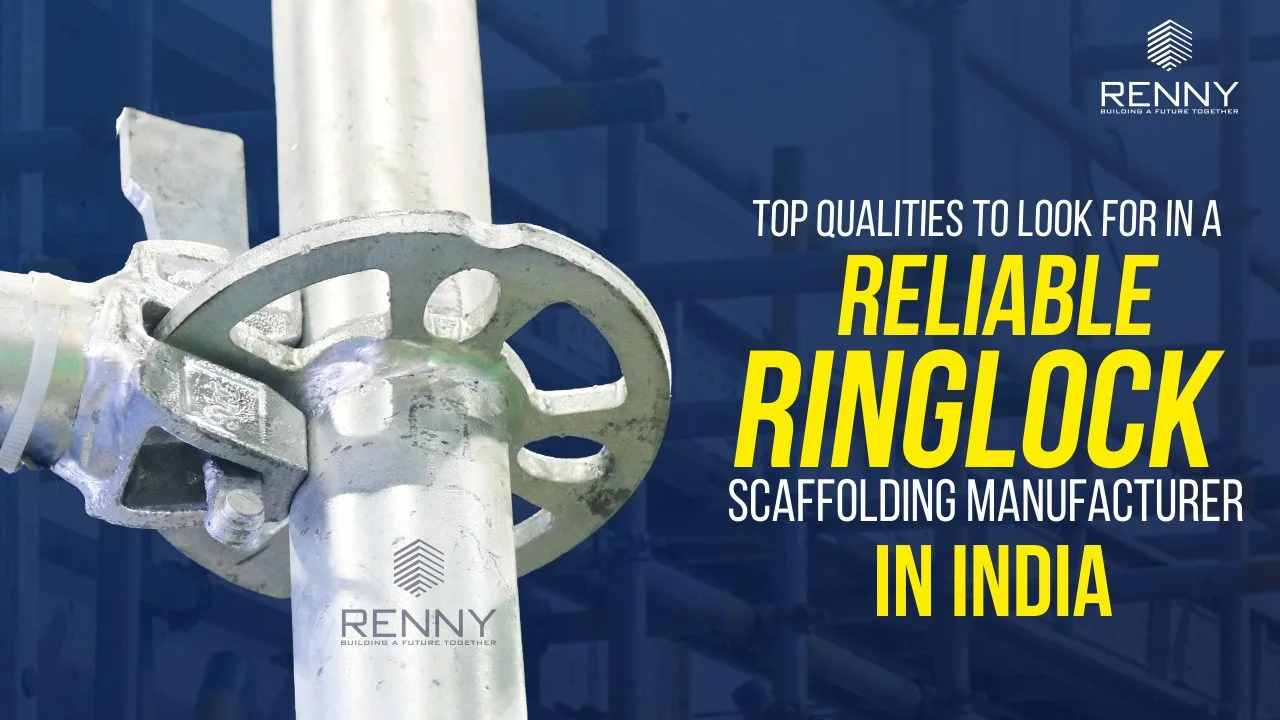
A modular scaffolding system built around steel verticals fitted with rosettes — ring-shaped connection nodes — into which horizontal ledgers and diagonal braces lock at set intervals. Quick to assemble and dismantle, with strong load-bearing performance, which is why it shows up across industrial, commercial, and infrastructure construction.
- Why is Ringlock scaffolding widely used?
It goes up and comes down faster than traditional tube-and-coupler systems, needs fewer loose components, and offers strong structural stability from the multi-directional locking at each node. Speed plus reliability is a combination that suits large or time-sensitive projects particularly well.
- How do I choose the best Ringlock scaffolding manufacturer in India?
Don't stop at pricing. Check raw material sourcing and quality control, confirm the relevant certifications, look at manufacturing capacity and delivery track record, ask what after-sales technical support actually looks like. A manufacturer that's transparent about all this is usually one worth working with.
- What certifications should a Ringlock scaffolding manufacturer have?
IS 1239, IS 3589, API 5L, ASTM A53, and ISO 9001 are the relevant ones, depending on the specific product and application. They indicate the manufacturer's materials and processes have actually been tested against recognized benchmarks, not just claimed to be.
- Why is raw material quality important in Ringlock scaffolding?
The steel used determines strength, durability, consistency, directly. Poor or inconsistent raw material creates weak points that undercut load-bearing capacity and raise safety risk, no matter how good the engineering is downstream.
- Why choose Renny Strips for Ringlock scaffolding?
In-house raw material production, modern manufacturing infrastructure, strict quality control, a reliable supply chain, and a growing focus on sustainable, low-carbon steel — together, that's a scaffolding partner built for performance and for the long haul.
Need Help Choosing the Right Product?
Have questions about pricing, technical details, or bulk orders? Get in touch with our team.