
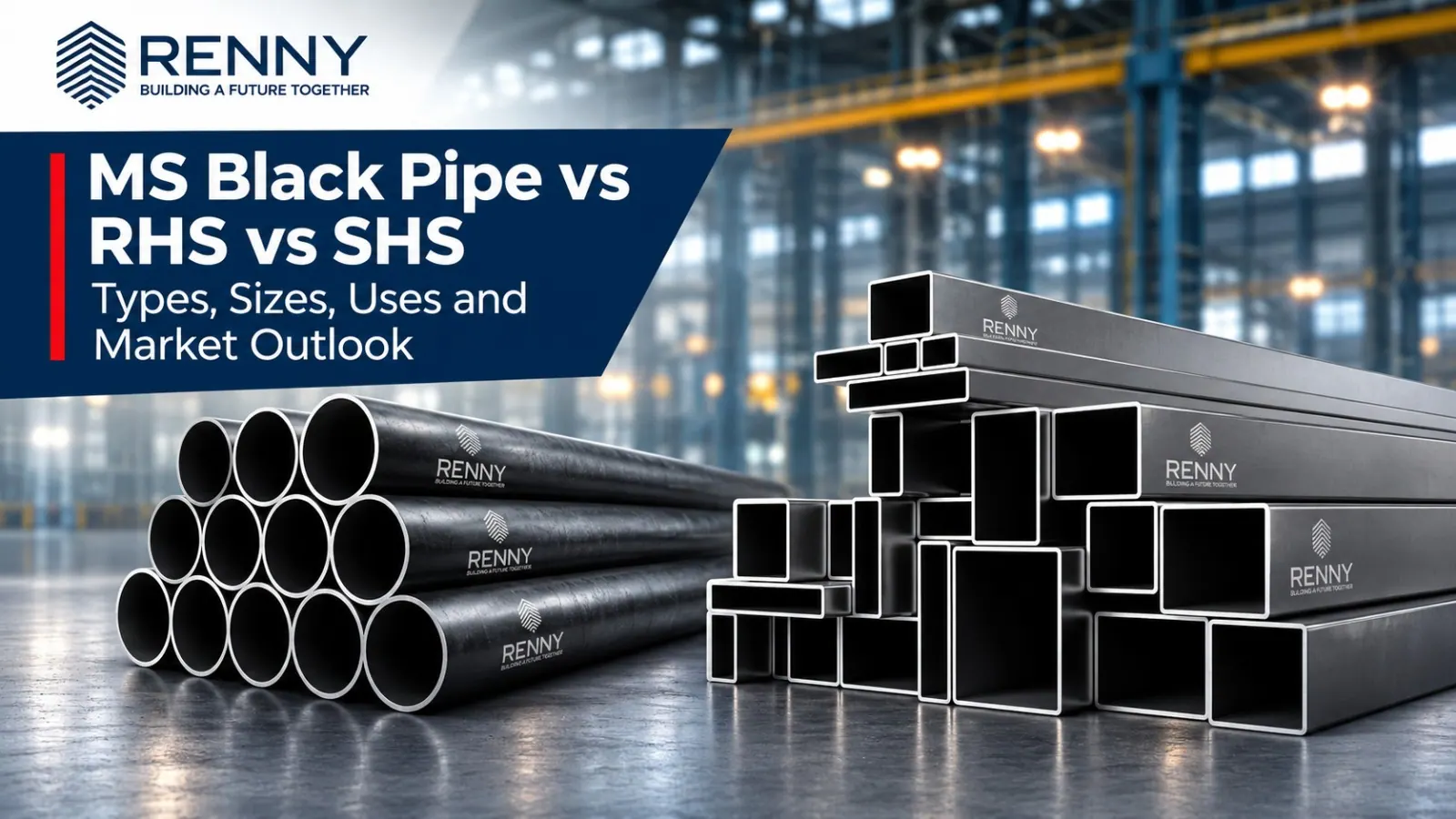
Walk into any steel yard and you’ll hear “pipe,” “tube” and “hollow section” used as if they meant the same thing. They don’t. Round MS black pipe suits fluid lines, poles and twisting loads. SHS suits columns. RHS suits beams, purlins and long spans. Pick the wrong one and you pay for it later, in extra steel, a frame that flexes or a rework order. This guide covers how the three differ, how to size and weigh them, how to buy them, and where the market is heading in India and abroad.
Key takeaways
- Only round MS black pipe is made to carry fluids. SHS and RHS are structural.
- SHS bends equally about both axes. RHS is far stiffer about its deeper axis.
- Weight per metre comes from a one-line formula, so you can check any supplier’s chart yourself.
- Closed sections can corrode from the inside if they aren’t sealed or vented properly.
- For EU exports, verified emissions data now affects the landed price.
What Is MS Black Pipe?
MS black pipe is a round mild steel pipe, usually made by electric resistance welding (ERW). It does two jobs, carrying fluids and carrying loads, which is why it shows up in so many comparisons with hollow sections. Renny’s ERW pipes and tubes range covers the sizes most buyers ask for.
Why It Is Called “Black” and How It Is Made
“Black” refers to the dark iron-oxide scale left on the surface after hot-rolled coil is formed and welded. It isn’t paint or a coating. The strip edges are joined by high-frequency welding, then the tube is sized, straightened and cut to length.
IS 1239 Pipe Classes: Light, Medium and Heavy
IS 1239 (Part 1) grades pipe by wall thickness at the same outside diameter. Heavy class is the thickest and heaviest per metre, and it’s the one to pick for tougher service. Light class makes sense where weight and cost matter more. The standard is generally applied to nominal bores up to about 150 mm, though you should check the current edition for the exact range.
MS Black Pipe vs GI Pipe
| Parameter | MS Black Pipe | GI Pipe |
|---|---|---|
| Surface | Uncoated, oxide scale | Zinc-coated |
| Corrosion Resistance | Low unless painted | High |
| Cost | Lower | Higher |
| Typical Use | Painted structures, fire lines, compressed air | Potable water, outdoor and humid exposure |
| Drinking Water | Not recommended | Commonly used |
What Are SHS and RHS?
SHS and RHS are closed, cold-formed steel sections with flat faces. Together with round pipe (CHS), they make up the hollow structural section (HSS) family.
SHS vs RHS: Full Form and Geometry
- SHS (Square Hollow Section): Four equal sides, for example 50 × 50 mm.
- RHS (Rectangular Hollow Section): Two long and two short sides, for example 100 × 50 mm.
Size is written as width × height × wall thickness, all in mm.
How SHS and RHS Are Manufactured
- Hot-rolled coil is slit into strips of the right width.
- The strip is formed into a round tube and ERW-welded.
- Sizing rolls reshape the round tube into a square or rectangle.
- The section is straightened, cut to length and inspected.
The rolling step is why the corners are rounded. Real section properties come out slightly lower than those calculated for perfect sharp corners. For the full route from coil to finished section, see our guide to structural steel manufacturing in India.
Standards for Hollow Sections
Indian Standards
- IS 4923:2017: Hollow steel sections for structural use. It sets yield-strength grades such as YSt 240 and YSt 310. A higher grade lets a designer choose a lighter section for the same load.
- IS 1161: Steel tubes for structural purposes, mainly round.
- IS 1239: Tubes for fluid conveyance.
- IS 3601: Tubes for mechanical and general engineering.
International Equivalents
- EN 10219: Cold-formed welded hollow sections, used for CE-marked structural work in Europe.
- ASTM A500: The US specification for cold-formed structural tubing.
MS Black Pipe vs SHS vs RHS: Key Differences
| Feature | MS Black Pipe | SHS | RHS |
|---|---|---|---|
| Governing Standard | IS 1239, IS 1161 | IS 4923 | IS 4923 |
| Bending Behaviour | Identical about every axis | Identical about both axes | Much stiffer about the deeper axis |
| Torsion | Best of the three | Good | Good |
| Carries Fluids | Yes | No | No |
| Joints | Needs saddle or fish-mouth cuts | Flat faces, easy to weld and bolt | Flat faces, easy to weld and bolt |
| Cladding and Fittings | Awkward on a curved surface | Simple | Simple |
| Best Use | Pipelines, poles, scaffolding, railings | Columns, posts, frames | Beams, purlins, chassis |
Which Is Stronger: Round, Square or Rectangular Tube?
None of them wins every time. Strength depends on load direction, steel grade, wall thickness and member length.
Here is one comparison at almost the same weight, using the second moment of area (I) for bending, with sharp-corner values:
| Section | Weight (kg/m) | I (cm⁴) |
|---|---|---|
| Round 60.3 × 3.2 | 4.51 | About 23.5 |
| SHS 50 × 50 × 3 | 4.43 | About 20.8 |
The round tube comes out roughly 13% stiffer in bending for about 2% more weight. It also has the same radius of gyration on every axis, which helps in long compression members. SHS and RHS need buckling checks on their weaker axis. Treat these numbers as a comparison, not a design. A structural engineer should make the final call.
Fabrication and Design: Flat Faces vs Curved Joints
Flat faces on SHS and RHS take plates, brackets and cladding without special cutting. Round pipe needs profile-cut joints, which adds fabrication time. That’s why architects and fabricators lean towards square sections for visible frames, and round sections for curved work and poles.
How to Choose Between MS Black Pipe, SHS and RHS
Start from the load, not the shape.
Decision Matrix by Load and Use
| If Your Main Need Is... | Choose | Reason |
|---|---|---|
| Moving water, air or gas | MS Black Pipe | Only the round pipe is made for fluids |
| Axial compression (columns) | SHS | Equal stiffness on both axes |
| Bending in one direction (beams, purlins) | RHS | Most material sits along the depth |
| Twisting or multi-directional load | MS Black Pipe | Same properties about every axis |
| Clean look, simple joints | SHS or RHS | Flat faces |
| Curved or tubular design | MS Black Pipe | Natural profile |
Does RHS Orientation Matter?
Yes, a lot. For a 100 × 50 × 3 RHS, the strong-axis I is about 112 cm⁴ and the weak-axis I is about 37 cm⁴. Lay the same member flat and it deflects roughly three times as much under the same load. Mark the intended orientation on the drawing, because crews on site won’t guess it.
Quick Selection Rule
Round for flow and torsion, SHS for columns, RHS for beams.
MS Black Pipe, SHS and RHS Size and Weight Chart
Weights are theoretical, from nominal dimensions at 7.85 g/cm³. SHS and RHS weights can run a few percent lower because of corner radii, so confirm against the manufacturer’s section table.
MS Black Pipe Weight Chart
Round MS Black Pipe Weight Chart
| OD × Thickness (mm) | kg/m |
|---|---|
| 33.7 × 3.2 | 2.41 |
| 48.3 × 4.0 | 4.37 |
| 60.3 × 3.2 | 4.51 |
| 76.1 × 3.2 | 5.75 |
| 88.9 × 4.0 | 8.37 |
| 114.3 × 4.5 | 12.18 |
SHS Weight Chart
| Size × Thickness (mm) | kg/m |
|---|---|
| 40 × 40 × 2.5 | 2.94 |
| 50 × 50 × 3.0 | 4.43 |
| 60 × 60 × 4.0 | 7.03 |
| 100 × 100 × 5.0 | 14.92 |
RHS Weight Chart
| Size × Thickness (mm) | kg/m |
|---|---|
| 80 × 40 × 3.0 | 5.37 |
| 100 × 50 × 3.0 | 6.78 |
| 120 × 60 × 4.0 | 10.80 |
| 150 × 100 × 5.0 | 18.84 |
Weight Formulas, With an Example
- Round Pipe: Weight (kg/m) = (OD − t) × t × 0.02466
- SHS or RHS: Weight (kg/m) = 2t × (B + H − 2t) × 0.00785
A 6 m length of 48.3 × 4.0 mm pipe weighs 4.37 × 6, or about 26.2 kg.
Applications of MS Black Pipe, SHS and RHS Across Industries
| Sector | Typical Use | Preferred Section |
|---|---|---|
| PEB and Warehouses | Columns, purlins, rafters | SHS for columns, RHS for purlins |
| Fire Protection | Hydrant and sprinkler mains | MS Black Pipe |
| Solar | Mounting structures, columns, torque tubes | SHS, RHS or round, per tracker design |
| Transport | Truck, trailer and bus bodies | RHS |
| Agriculture | Greenhouses, fencing, irrigation frames | MS Black Pipe |
| Architecture | Gates, grills, façade sub-frames | SHS and RHS |
| Utilities | Poles, bollards, handrails | MS Black Pipe |
For a deeper look at round pipe use cases, read about MS black ERW pipe applications and the key industries that use them.
Buyer’s Checklist: Specifying and Inspecting Hollow Sections
What to State in an RFQ
- Standard and grade, for example IS 4923:2017 with the yield grade.
- Shape, size and wall thickness.
- Length and cut tolerance.
- Finish: black, painted or galvanized.
- Test certificates, including the mill test certificate with heat number.
- End use, so the supplier can flag a mismatch.
Marking and Traceability
Ask for the manufacturer’s mark, size and standard on each bundle or section, and a heat number that matches the certificate. Keep batches separate on site.
Corrosion in Closed Sections
The NACE IMPACT study (2016) put global corrosion costs at about US$2.5 trillion a year, roughly 3.4% of world GDP. Hollow sections add a specific risk, because moisture trapped inside corrodes where nobody can see it.
- Seal the ends of sections that will stand outdoors, or provide drain holes.
- Hot-dip galvanizing of closed sections needs vent and drain holes. Without them, trapped air and fluid make the dipping unsafe.
- Specify the coating system before fabrication, not after.
If the section will stand outdoors for years, a galvanized option is worth pricing. See GI square hollow pipe manufacturers in India.
Buying by Tonne, Metre or Installed Cost
Suppliers quote per tonne, but fabricators think per metre. Convert with the weight formulas above. On long spans, a correctly oriented RHS can cut tonnage compared with SHS, so compare installed cost, not the rate per tonne alone.
Demand Drivers: Why Hollow Sections Are Growing in India
India was the world’s second-largest crude steel producer in 2024, at about 150 million tonnes, according to worldsteel. The Ministry of Steel reports that finished steel consumption grew 7% to 164 million tonnes in FY26, led by infrastructure and construction. Per-capita use was 109.2 kg in CY25 against a world average of 209 kg, so there’s a long runway.
Three forces favour tubes and hollow sections:
- Public Infrastructure: Metros, airports, bridges and logistics parks use steel frames.
- Quality Regulation: The move to mandate BIS certification for more steel pipes favours certified makers.
- Steel Over Concrete: PEBs, warehouses and solar parks are increasingly framed in steel.
Market Size and Growth Outlook for India and Global Hollow Sections
India Steel Pipes Market
IMARC Group estimates the market at 14.6 million tons in 2025, growing at a 7.41% CAGR to 28.7 million tons by 2034.
India Structural Tubes
The organised structural tube segment is about 9 million tonnes a year. It’s projected to reach 17.3 million tonnes by FY30, and its share of total steel use is expected to rise from 6.5% to 8.3%.
Global Hollow Sections
One industry estimate puts the market at USD 41.8 billion in 2025, rising to about USD 69 billion by 2035 at a 5.1% CAGR. The 2025 mix is put at 35% square, 38% rectangular and 27% circular. Treat market estimates as directional, since publishers define scope differently.
Exporting Steel Pipes and Hollow Sections: CBAM and EU Rules
CBAM Timeline
- 1 January 2026: The definitive period begins.
- From 1 February 2027: Certificates for 2026 imports go on sale.
- 30 September 2027: The first annual declaration is due.
30 September 2027: the first annual declaration is due. Is Your Product in Scope?
CBAM covers iron and steel goods under the EU’s combined nomenclature, including many welded tubes and fittings (headings in the 7305 and 7306 range). Check your exact CN code against Annex I of the regulation. A simplification adopted in 2025 also exempts importers below an annual mass threshold of 50 tonnes, so the buyer’s volume matters.
Opportunities and Challenges
| Opportunity | Challenge |
|---|---|
| India has an EU steel quota of over 1.9 mt. | EU import quotas cut by about 47% against 2024, with the out-of-quota duty doubled to 50%. |
| An FTA annexure may extend any CBAM flexibility to India. | No country-specific CBAM exemption for steel. |
| Demand for ESG documentation in the Gulf, Africa and South-East Asia. | "Melt and pour" traceability now required. |
| Low verified emissions reduce the buyer's carbon cost. | Unverified exporters face EU default values with a mark-up that rises to 2028. |
Why Verified Data Decides Landed Cost
The EU importer pays, but the cost shows up in the exporter’s price. A supplier with verified, low emissions per tonne can quote a lower landed cost than one relying on default values. Renny’s CBAM guidance explains the reporting detail.
Choosing the Right Section and the Right Manufacturer
Shape is an engineering call. The supplier decides quality, compliance and delivery.
What Renny Strips Offers
Renny Strips Ltd has made structural steel since 1996. It produces MS black pipe, SHS and RHS to IS 1239, IS 1161, IS 4923:2017 and IS 3601, and makes about 90% of its raw material in-house. It holds EN 1090, ISO 9001, ISO 14001 and ISO 45001 certifications.
Green Steel and Verified Emission Data
Renny’s 5-star green steel, recognised by NISST under the Ministry of Steel, has an embedded emission intensity of 0.6385 tCO₂/MT against a conventional 2.2 tCO₂/MT. That’s an indicative saving of about €117.67 per MT in carbon-linked import costs. An AI-monitored dashboard delivers verified data in one click, and a 22 MW captive solar plant powers production.
Frequently Asked Questions
What is the difference between RHS and SHS?
SHS has four equal sides and equal bending stiffness on both axes, which suits columns. RHS has unequal sides and is much stiffer about its deeper axis, which suits beams and purlins.
Which is stronger: round, square or rectangular tube?
None is stronger in every case. Round resists torsion best, SHS suits columns, and RHS suits beams loaded in one direction. Grade, thickness and length also matter.
Why is it called MS black pipe?
The name comes from the dark iron-oxide scale left after hot rolling and welding. The pipe is uncoated mild steel.
What is the difference between MS black pipe and GI pipe?
GI pipe is zinc-coated for corrosion resistance. MS black pipe is uncoated, cheaper, and normally painted after fabrication.
Can MS black pipe be used for drinking water?
It’s generally not recommended. Uncoated steel corrodes in contact with water, so GI or other approved pipe is preferred for potable supply.
What is IS 4923:2017?
It’s the BIS specification for hollow steel sections used in structural work, covering grades, dimensions and tolerances for square and rectangular sections.
How do I calculate the weight of SHS, RHS or round pipe?
For SHS or RHS, use 2t × (B + H − 2t) × 0.00785. For round pipe, use (OD − t) × t × 0.02466. Dimensions are in mm and the result is in kg/m.
Is SHS or RHS better for columns and beams?
SHS is better for columns because it has equal stiffness on both axes. RHS is better for beams because most of its material sits along the bending depth.
Does RHS orientation affect strength?
Yes. A 100 × 50 × 3 RHS is about three times stiffer with the long side vertical than flat. Wrong orientation removes the main advantage of RHS.
Are SHS and RHS made by ERW?
Most are. The steel is ERW-welded into a round tube, then reshaped by sizing rolls into a square or rectangle.
Does CBAM apply to steel pipes and hollow sections?
Many welded tube and section codes are in scope. The EU importer pays for embedded emissions, so verified low-emission supply reduces landed cost.
What size range does MS black pipe come in?
Common structural sizes run from about 33.7 mm to 114.3 mm OD and beyond, with wall thickness set by the IS 1239 class or the IS 1161 specification.
Need Help Choosing the Right Product?
Have questions about pricing, technical details, or bulk orders? Get in touch with our team.