
The same steel tube can last five years or forty. What decides it is often one choice at the specification stage: a zinc coating, or none.
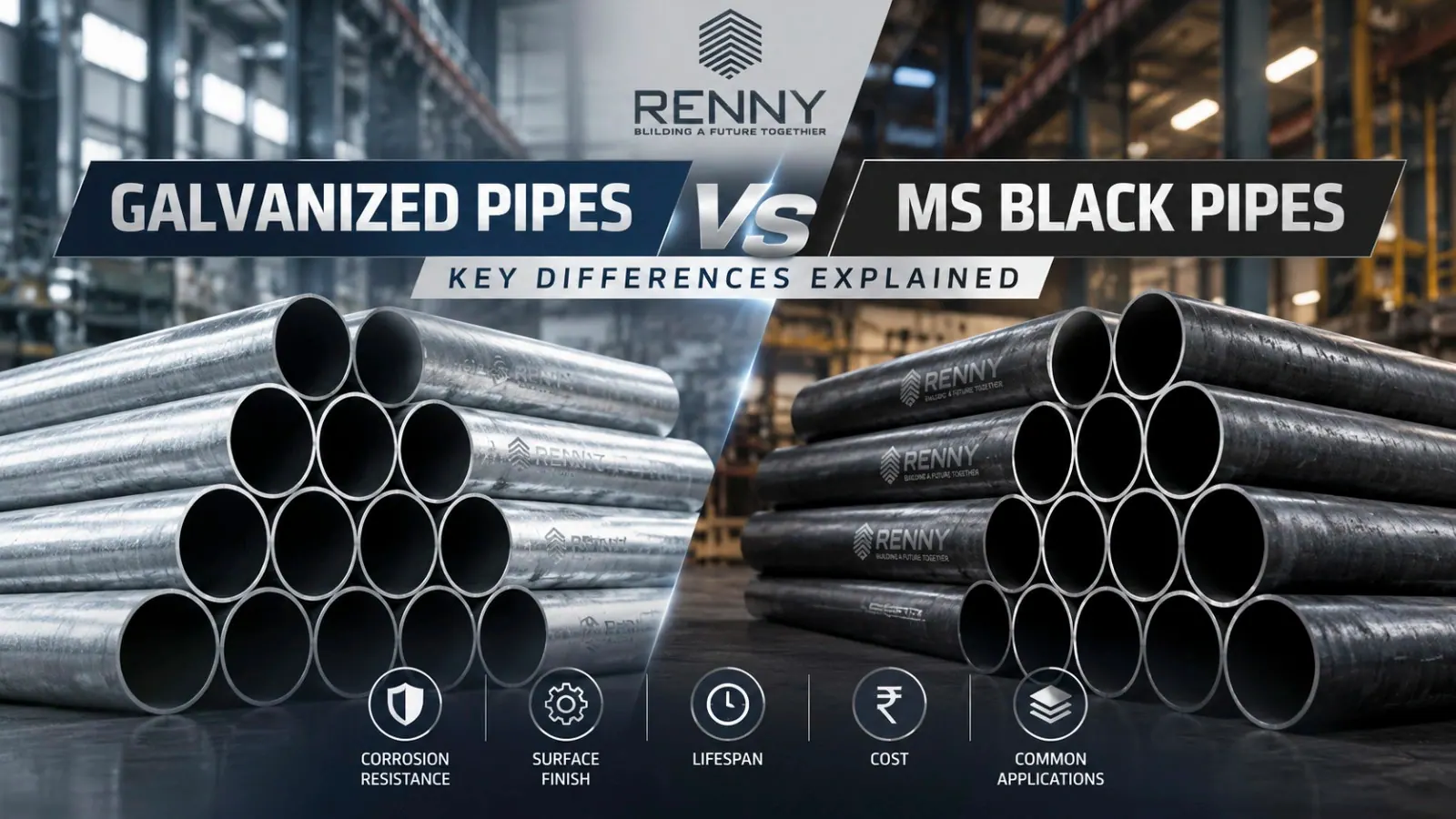
Galvanized pipes are mild steel pipes coated in zinc, which gives them strong corrosion resistance for water, outdoor and buried service. MS Black Pipes are uncoated mild steel pipes, preferred for gas, steam and welded structures, and cheaper upfront. Both have the same base-steel strength.
The stakes are large. India consumed 14.6 million tons of steel pipes in 2025, and demand is projected to reach 28.7 million tons by 2034, growing 7.41% a year (IMARC). Yet buyers still treat "GI", "ERW" and "MS Black Pipe" as three rival products. They are not. This guide compares GI pipes vs MS Black Pipes on coating, performance, standards, uses, upkeep and cost.
The stakes are large. India consumed 14.6 million tons of steel pipes in 2025, and demand is projected to reach 28.7 million tons by 2034, growing 7.41% a year (IMARC). Yet buyers still treat "GI", "ERW" and "MS Black Pipe" as three rival products. They are not. This guide compares GI pipes vs MS Black Pipes on coating, performance, standards, uses, upkeep and cost.
Galvanized Steel Pipe vs Black Steel Pipe at a Glance
Galvanized pipes win on corrosion resistance and water service; MS Black Pipes win on gas, heat, weldability and upfront cost.
| Factor | Galvanized (GI) pipe | MS Black Pipe (ERW) |
|---|---|---|
| Surface | Hot-dip zinc coating, minimum 360 g/m² (IS 4736) | No zinc layer; unpolished (mill scale) or varnished |
| Corrosion resistance | High: barrier plus sacrificial protection | Low unless painted or coated |
| Typical life outdoors | Often 20 to 50 years, depending on environment | Shorter in wet or outdoor conditions |
| Natural gas / LPG | Not recommended | Preferred |
| Potable water | Preferred | Not suitable uncoated |
| Welding | Possible; needs fume extraction and zinc touch-up | Easy |
| High temperature | Coating degrades above about 200°C | Suits steam and hot process lines |
| Upfront cost | Typically 15 to 25% higher | Lower |
| Governing standards | IS 1239 + IS 4736; ASTM A53 (galvanized) | IS 1239 / IS 3589; ASTM A53 (black) |
- Choose galvanized pipes for: water, outdoor, buried, humid or coastal service.
- Choose MS Black Pipes for: gas, steam, high heat and structures that will be welded and painted on site.
What Are MS Black Pipes?
MS Black Pipes are uncoated mild steel pipes, usually made by electric resistance welding (ERW). Hot-rolled coil is slit, formed into a tube and welded along the seam with high-frequency current. The dark, matte finish comes from mill scale, an iron oxide layer formed during hot rolling.
Mild Steel Pipe Properties That Matter in Service
- Strength: the full mechanical strength of the base steel
- Weldability: no coating to burn off, so site welding is fast and clean
- Heat tolerance: stable at high temperatures, which suits steam and process lines
- Cost: the lowest upfront price of any steel pipe option
These properties belong to the base steel, so galvanized pipe shares them. Zinc adds protection, not strength.
Unpolished vs Varnished MS Black Pipes
Two finishes are sold in the market, and they behave differently on site.
| Finish | What it is | Best for |
|---|---|---|
| Unpolished | Natural mill-scale surface, no added coating | Pipes welded, blasted, primed or painted soon after delivery: structural fabrication, industrial pipelines |
| Varnished | Thin varnish layer applied after manufacturing | Exposed structural work, furniture, fabrication, and pipes stored in yards or warehouses |
Varnish gives better corrosion resistance than bare scale, a cleaner look, less contamination in storage and less preparation before painting. It is still not galvanizing: a varnished pipe has no zinc layer, no sacrificial protection and is not meant for long-term outdoor or water-carrying service. Renny's ERW pipes and tubes are BIS-certified, with around 90% of raw material produced in-house.
What Are Galvanized Steel Pipes?
Galvanized steel pipes are steel pipes, usually MS Black Pipes, coated in zinc. In India they are widely called GI pipes, short for galvanized iron, although the base metal is mild steel. They are easy to spot by their silvery-grey surface, which may be spangled or matte.
How Hot-Dip Galvanizing Builds the Zinc Coating
- Clean the pipe to remove oil and dirt.
- Pickle it in acid to strip rust and scale.
- Flux it so the zinc wets the surface evenly.
- Dip it in molten zinc at around 450°C, where the zinc bonds metallurgically with the steel, inside and out.
Barrier and Sacrificial Protection
- Barrier: the zinc layer seals steel off from moisture and oxygen.
- Sacrificial (cathodic): zinc corrodes before steel, so scratches and cut edges stay protected.
Hot-Dip Galvanized vs Pre-Galvanized (GP) Pipes
| Type | How it is made | Result |
|---|---|---|
| Hot-dip galvanized (GI) | Coated after the pipe is formed | Zinc inside and out, including the weld; standard for water supply |
| Pre-galvanized (GP) | Formed from coil that is already zinc-coated | Thinner coating; weld seam left uncoated |
GI Pipe vs ERW Pipe: Clearing Up the Confusion
"GI pipe vs ERW pipe" is one of the most searched comparisons in Indian steel procurement, and one of the most misunderstood. ERW describes how a pipe is made. GI describes how it is finished. Most GI pipes sold in India are ERW pipes that were hot-dip galvanized after welding.
The real comparison is between two finishes of the same pipe: MS Black Pipe (ERW, uncoated) and galvanized pipe (ERW with zinc). Seamless pipes, pierced from a solid billet, are a separate category used mainly for high-pressure oil, gas and boiler duty.
Difference Between Galvanized and Black Pipes: What Actually Changes
The table above gives the verdicts. The reasons behind them are below.
Zinc Coating Thickness: Reading GSM, Microns and IS 4736
IS 4736 requires a minimum zinc coating mass of 360 g/m², measured across inner and outer surfaces. Renny's galvanized pipes carry 385 g/m² (385 GSM). Zinc weighs about 7.14 g/m² for every micron of thickness, so mass converts to thickness like this:
| Coating mass | Approximate thickness | Note |
|---|---|---|
| 360 g/m² | About 50 microns | IS 4736 minimum |
| 385 g/m² | About 54 microns | Renny galvanized pipes |
This matters when comparing quotes. Some suppliers quote grams per square metre and others quote microns, and standards such as EN ISO 1461 specify thickness on a different basis. Ask which measure a figure uses before treating two numbers as equal. Uniformity and adhesion are checked by standard tests, including a bend test for smaller bores.
Corrosion Resistance: How Each Pipe Fails
- MS Black Pipe: red rust forms once the mill scale or varnish is breached, followed by pitting. In water lines, rust scale also builds up inside the bore and restricts flow.
- Galvanized pipe: the zinc wears away slowly instead of the steel. White rust, a powdery zinc corrosion product, appears in damp or poorly ventilated storage and is the early warning sign.
- Limits: galvanizing is not corrosion-proof. Strong acids and some chemicals attack zinc, so aggressive process fluids need a different specification.
Steel Pipe Durability: Estimated Zinc Life by Environment
Durability depends on how fast the environment consumes the zinc. ISO 9223 grades atmospheres from C2 to C5 and gives a zinc loss range for each. Dividing a 54-micron coating by those rates gives an estimate of how long the coating lasts on outer surfaces:
| Environment (ISO 9223) | Zinc loss, microns per year | Estimated coating life |
|---|---|---|
| C2: dry, rural, sheltered | 0.1 to 0.7 | 75+ years |
| C3: urban, light industry | 0.7 to 2.1 | About 26 to 77 years |
| C4: industrial, inland coastal | 2.1 to 4.2 | About 13 to 26 years |
| C5: marine, heavy industry | 4.2 to 8.4 | About 6 to 13 years |
These are estimates, not guarantees. They explain why 20 to 50 years is realistic for typical outdoor use and why coastal projects need heavier coating or added protection. Buried pipe depends on soil chemistry, and internal life depends on water quality.
Welding and Fabricating Each Pipe
- MS Black Pipe: weld directly; there is nothing to burn off.
- Galvanized pipe: heating zinc releases zinc oxide fumes. Use extraction and protective equipment, then restore the weld zone with zinc-rich paint.
- Cutting and threading: both remove zinc at the cut. Touch up every cut end and thread on galvanized pipe.
Gas, Heat and Pressure Limits
In gas systems, flakes of zinc from the inner wall can block regulators and burner orifices, which is why MS Black Pipes remain the accepted choice for natural gas and LPG. Galvanized coating also degrades above about 200°C, so steam, boiler and hot-oil lines use MS Black Pipe. Pressure rating, by contrast, comes from wall thickness and steel grade, not from the zinc.
Upfront vs Lifecycle Cost
Galvanized pipes cost more at purchase, but the full cost includes upkeep.
Lifecycle cost = purchase price + (repaint cost x number of repaints) + replacement cost, if life is shorter than the horizon
An illustrative index over 20 years, not a price list: MS Black Pipe at 100, galvanized at 120 (a 20% premium). If the MS Black Pipe needs four repaints at 20 each, its lifecycle cost is 180 against 120 for galvanized. In dry, sheltered indoor service with no repainting, MS Black Pipe stays cheaper. In humid, coastal or buried service, the premium is usually recovered.
Galvanized Steel Pipe Specifications and Standards
In India, the Bureau of Indian Standards (BIS) sets galvanized steel pipe specifications through three documents:
- IS 1239 (Part 1): mild steel tubes for water, gas, air and steam, from 15 NB to 150 NB
- IS 4736: hot-dip zinc coating on mild steel tubes
- IS 3589: larger-diameter steel pipes for water and sewage
IS 1239 Classes: Light, Medium and Heavy
IS 1239 grades pipes by wall thickness. Each class carries a colour band for quick identification on site: yellow for Light, blue for Medium and red for Heavy. Medium and Heavy are the usual choice for plumbing and fire-fighting lines.
| Nominal bore | Outside diameter (mm) | Light wall (mm) | Medium wall (mm) | Heavy wall (mm) |
|---|---|---|---|---|
| 15 NB (½") | 21.3 | 2.0 | 2.6 | 3.2 |
| 25 NB (1") | 33.7 | 2.6 | 3.2 | 4.0 |
| 50 NB (2") | 60.3 | 2.9 | 3.6 | 4.5 |
| 100 NB (4") | 114.3 | 3.6 | 4.5 | 5.4 |
Indicative IS 1239 dimensions. Refer to the product catalogue for the full size chart and tolerances.
Testing, Lengths and End Finish
- Hydrostatic test: each tube must hold about 5 MPa without leakage.
- Lengths: random lengths of 4 to 7 metres.
- Ends: plain, threaded (IS 554 / BSP) or screwed-and-socketed.
IS, EN and ASTM Standards Compared
Export buyers usually specify by their home standard. The standards below are broadly comparable but not interchangeable, so confirm the exact edition in the purchase order.
| Standard | Region | What it covers |
|---|---|---|
| IS 1239 (Part 1) with IS 4736 | India | Black and galvanized tubes, 15 to 150 NB, Light, Medium and Heavy classes; coating minimum 360 g/m² |
| IS 3589 | India | Larger-diameter pipes for water and sewage |
| BS EN 10255 | Europe | Non-alloy steel tubes for welding and threading; galvanizing is typically checked against EN ISO 1461 |
| ASTM A53 | USA | Black and hot-dipped zinc-coated welded and seamless pipe, sized by NPS and schedule |
Read our full guide on Structural Steel Grades
Steel Pipe Applications: Where Each Pipe Belongs
The right pipe depends on what flows through it and where it is installed.
Water Supply and Building Plumbing
Galvanized pipes are used for potable water, building distribution, agricultural irrigation, borewell columns and rural drinking water schemes. Public infrastructure drives demand: under the Jal Jeevan Mission, rural tap water coverage rose from 17% of households in 2019 to about 79.7% by February 2025, and the mission has been extended to 2028.
Gas, Steam and Process Lines
MS Black Pipes serve natural gas and LPG distribution, steam, boiler and hot-oil lines, and any line that will be welded and painted on site.
Fire Protection
Split the system by function. Fire sprinkler lines typically use galvanized pipes. Fire hydrant mains use MS Black Pipes with internal and external protection.
Structural, Fencing and Solar
- MS Black Pipes: structural frames, columns and trusses, plus mechanical, automotive and general engineering parts.
- Galvanized pipes: scaffolding, fencing, railings and handrails, greenhouse frames, solar module mounting structures, and electrical and telecom conduit.
Steel Pipe Maintenance: Galvanized vs MS Black Pipes
Maintenance is where the two pipes differ most after installation.
Maintaining MS Black Pipes
- Prime and paint exposed pipe promptly, and repaint on a cycle set by the environment.
- Store pipe off the ground and under cover to limit rust before use.
- Touch up varnish scratches, since varnish is only a thin film.
- In water service, watch for internal scale and flow loss.
Maintaining Galvanized Steel Pipes
- Routine upkeep is light: the zinc does the work.
- Inspect cut ends, threads and weld zones, and touch up with zinc-rich paint.
- Treat white rust early; keep stacks ventilated and dry.
Inspection Checklist and Replacement Signs
- Rust or flaking across a growing share of an MS Black Pipe's surface
- Continuous white rust or bulging on a galvanized pipe
- Rusty or discoloured water at outlets
- Falling flow or pressure
- Leaks at threads or joints
- Bare steel at cuts or welds that was never touched up
How to Choose Between Galvanized Pipes and MS Black Pipes
Five questions settle most specifications:
- What will flow through it? Water points to galvanized. Gas, steam or oil points to MS Black Pipe.
- Where will it be installed? Outdoor, buried, humid or coastal exposure favours galvanized.
- Will it be welded on site? MS Black Pipe is simpler; galvanized needs fume control and touch-up.
- What is the operating temperature? Above about 200°C, choose MS Black Pipe.
- Which cost matters more? Lowest purchase price: MS Black Pipe. Lowest cost over the pipe's life: usually galvanized.
Common Buying and Installation Mistakes
- Specifying galvanized pipe for gas lines. Zinc flakes cause the blockages described above.
- Treating varnish as galvanizing. A varnished MS Black Pipe has no zinc layer.
- Skipping the coating check. Read the coating mass on the mill test certificate, not just the product name.
- Joining dissimilar metals without isolation. Zinc and steel together are generally fine, because the zinc keeps protecting. The risk is copper, brass or stainless components in the same line, so use dielectric fittings.
- Buying pre-galvanized (GP) pipe for buried water. Its uncoated weld seam is the weak point underground; specify hot-dip galvanized.
How to Verify a Pipe Is Really Galvanized
- Read the mill test certificate and compare coating mass with the IS 4736 minimum.
- Measure thickness on a sample with a magnetic gauge.
- Ask for a coating uniformity test (IS 2633).
- Inspect the surface: true zinc is continuous and bonded, while silver paint over black steel scratches off.
Why the Steel Behind the Pipe Matters: Green Steel and CBAM
For export buyers, the choice no longer ends at coating. Under the EU's Carbon Border Adjustment Mechanism (CBAM), importers must account for the carbon embedded in the steel they buy. Renny Strips is rated a 5-Star Green Steel manufacturer by NISST under the Ministry of Steel, Government of India, and every Renny pipe, galvanized or MS Black, is made from that steel.
| Measure | Renny | Conventional benchmark |
|---|---|---|
| Embedded emission intensity | 0.6385 tCO₂ per tonne | About 2.2 tCO₂ per tonne |
| Operational emissions | 40% lower | Industry standard |
For European buyers, lower embedded carbon translates into lower carbon-linked import costs on every consignment. See how this supports CBAM-ready green steel sourcing.
Renny's Galvanized and MS Black Pipe Range
Both pipe types come from one source, so buyers can choose the finish without changing supplier.
| Product | Finish or coating | Key benefit |
|---|---|---|
| Galvanized (GI) pipes | Hot-dip zinc, 385 GSM | Protection above the 360 g/m² IS 4736 minimum |
| MS Black Pipes, unpolished | Natural mill-scale surface | Most economical; ready for site welding and painting |
| MS Black Pipes, varnished | Thin varnish layer | Cleaner finish, better storage protection, less preparation |
| Parameter | Renny range |
|---|---|
| Round pipes | 33.7 mm to 88.9 mm outer diameter |
| Square sections | 50 × 50 mm, 60 × 60 mm, 72 × 72 mm |
| Rectangular sections | 60 × 40 mm, 80 × 40 mm, 96 × 48 mm |
| Wall thickness | 1.50 mm to 5.00 mm |
| Grades | YS235 to YS460, E250, E350 |
| Standards | IS 1239 (Part 1):2004, IS 1161:2014, IS 4923:2017, IS 3601:2006, IS 18573:2024 |
Why Buyers Choose Renny
- Specialty size range: round, square and rectangular sections in grades up to YS460.
- Heavier zinc coating: extra margin over the standard minimum for long service life.
- Green Line pipes: a lower-carbon option for CBAM-bound exports.
- On time, every time: integrated production from steel to finished pipe keeps supply consistent.
Conclusion: The Right Pipe for the Right Job
Neither pipe is better in every situation. Galvanized pipes are the clear choice for water, outdoor and corrosive environments. MS Black Pipes are the right call for gas, steam, structural and welded work. What matters most is a supplier who builds quality in from the steel up: Renny brings 30 years of manufacturing experience, BIS-certified products, and ISO 9001, ISO 14001 and ISO 45001 certification.
Talk to Renny's technical team for size charts, IS 1239 test certificates and domestic or export pricing.
Frequently Asked Questions
What Is the Difference Between Galvanized Pipes and MS Black Pipes?
Galvanized pipes carry a hot-dip zinc coating that resists rust, so they suit water and outdoor use. MS Black Pipes are uncoated mild steel, so they suit gas, steam and welded structures, and cost less upfront.
Is GI Pipe the Same as ERW Pipe?
Not exactly. ERW is the manufacturing method; GI is the zinc finish. A GI pipe is usually an ERW pipe that was hot-dip galvanized after welding.
Can Galvanized Pipes Be Used for Gas Lines?
Not recommended. Zinc can flake from the inner wall and block regulators and burner orifices. MS Black Pipes are the standard for natural gas and LPG.
Can Black Steel Pipe Be Used for Drinking Water?
Not uncoated. Bare mill-scale steel rusts in water, which hurts flow and water quality. Use galvanized pipes, or suitably protected pipe, for potable supply.
How Long Do Galvanized Pipes Last?
Typically 20 to 50 years in outdoor and water-supply use. Life depends on coating thickness, water chemistry, soil conditions and installation quality.
What Is the Minimum Zinc Coating on GI Pipes in India?
IS 4736 sets a minimum of 360 g/m² for hot-dip galvanized mild steel tubes, measured across inner and outer surfaces. Renny's galvanized pipes carry 385 g/m².
Can Galvanized Pipes Be Welded?
Yes, but heating zinc releases zinc oxide fumes. Use extraction and protective equipment, then touch up the weld zone with zinc-rich paint.
How Much More Do Galvanized Pipes Cost Than MS Black Pipes?
Typically 15 to 25% more upfront. Over about 20 years, galvanized pipes often cost less in humid, coastal or buried service because they avoid repainting and early replacement.
Which Is Stronger, MS Black Pipe or Galvanized Pipe?
Both are equally strong, because both start as the same mild steel pipe. Zinc adds corrosion protection, not mechanical strength.
How Do I Tell a Galvanized Pipe From an MS Black Pipe?
Galvanized pipe has a silvery-grey zinc surface; MS Black Pipe is dark and matte. For proof, check the coating mass on the mill test certificate.
Need Help Choosing the Right Product?
Have questions about pricing, technical details, or bulk orders? Get in touch with our team.