Scaffolding Steel Props and Jacks

Ultimate Guide to Scaffolding Steel Props and Jacks for Strength and Safety in Construction

When working onsite, reliable propping systems can often make the difference between a smooth operation and one fraught with instability. That’s where Scaffolding Steel Props and Jacks come into play—key elements for creating strong, safe support in concrete formwork, elevated platforms, shoring and more. At Renny Strips, we’ve seen how the right specification, correct usage and strict maintenance of props and jacks lead to safer facilities, improved productivity and longterm economy.

What are Scaffolding Steel Props and Jacks?

Props and jacks are adjustable steel support members used to transfer loads safely from formwork, slabs or beam soffits down to supporting surfaces. A steel prop is typically a tubular member with an adjustable screw or jack plate allowing fine height correction; the jack is a specific component (jack nut or base jack) allowing height control and bearing at the top or bottom of the prop. These systems are engineered to meet demanding structural mandates.

At Renny Strips, our fabrication of formwork and scaffolding includes highstrength S355 carbon steel, with finishes such as hot dip galvanised (H.D.G.), powdercoated, painted, electro galvanised or selffinish, to ensure corrosion resistance and durability even in harsh onsite conditions.

Why Strength and Safety Matter

In every construction zone, the loads involved are heavy and often unpredictable. Effects such as concrete pouring, lateral forces from wind, working platform traffic and dynamic changes during curing or demolition all place a burden on the props and jacks used. If they are under specified, poorly installed or not maintained, consequences may include:

  • Uneven settlement of formwork leading to cracking or failure
  • Uncontrolled deflection or collapse of shoring, risking injury and work disruption
  • Premature wear, corrosion or fatigue of components, increasing cost over time

By selecting the right scaffolding steel props and jacks, ensuring highquality finishes, and regular inspection, those risks are mitigated. Renny Strips emphasises “Safety & Stability” and “Material Strength” as core strengths of our system offerings.

Key Parameters to Specify

When choosing props and jacks, professionals should examine these parameters carefully:

  1. Load capacity – Ensure the props are rated for the maximum anticipated load (including dynamic factors). Manufacturer’s data and test reports should be available.
  2. Height adjustability – The prop must accommodate required elevation from floor to slab/beam underside, with sufficient adjustment range via the jacks or screw threads.
  3. Finish and corrosion resistance – Especially for outdoor or exposed environments: galvanised, powdercoated or selffinish steel ensure longevity. Renny offers multiple finishes to match site requirements.  
  4. Material quality – Use highgrade steel (such as S355 carbon steel) and components forged or fabricated to meet standards like AS1576 or EN 12811.  
  5. Compatibility and modularity – Props should work seamlessly with the rest of the formwork/shoring system — modular systems allow easier assembly, reuse and logistic ease. At Renny, there’s emphasis on “Universal Fit” and “Versatile Use” of scaffolding/formwork systems.  
  6. Inspection and certification – Every prop/jack should be traceable, testcertified and subject to periodic inspection for wear, thread damage, corrosion or misalignment.

Installation Best Practices

Even the highestquality props and jacks will perform poorly if installed incorrectly. Here are bestpractice steps:

  • Base preparation: Ensure the supporting ground or structure is level, compacted and able to bear the load. Use base plates and bearing pads as required.
  • Prop placement: Place props vertically where possible; avoid excessive lean or offsetting load paths. Props should bear directly under the load transfer point (beam, slab formwork, etc.).
  • Adjusting height: Elevate the prop to fit snugly but allow some adjustment via the jack nut or screw thread. Avoid forcing the prop beyond its vertical adjustment range.
  • Bracing and lateral stability: While props handle vertical loads, lateral stability must also be ensured—especially high stacks of props may require ties or bracing to resist tipping.
  • Load staging: Introduce loads gradually rather than instant full load. Monitor for settlement or movement.
  • Inspection: Before loading, inspect every prop and jack for thread damage, base plate distortion, corrosion, or missing components. During use, monitor for signs of deflection, cracking of adjacent formwork or unusual movement.

Maintenance & Lifecycle Considerations

Props and jacks are reusable assets, but regular maintenance is vital:

  • After each use, clean off concrete splatter, rust, and other debris to preserve threads and surfaces.
  • Store upright, off the ground, under cover if possible, to minimise corrosion.
  • Threads should be lightly greased to prevent galling and ensure smooth adjustment over time.
  • Periodic inspection should include measuring deviation from vertical, thread wear, corrosion of jack plates or base plates, and any distortion of tubes.
  • Retire any component that shows major corrosion, cracking, or distortion; these compromise strength and safety.

Renny Strips emphasises that their components are built for “Reusability” and “Long Life Cycles” — a key factor when choosing a supplier who understands the full lifecycle of construction assets.

Choosing the Right Supplier

Selecting a supplier for scaffolding steel props and jacks involves more than price. Here’s what to look for:

  • Manufacturing standards: Are materials and fabrication conforming to recognised standards (eg: AS1576, EN 12811)? At Renny Strips, those standards are explicitly cited.
  • Finish options: Availability of corrosionresistant finishes (H.D.G., powder coat, painted, electro galvanised) helps adapt to diverse site environments.
  • Technical support: Can the supplier provide guidance on load computations, height adjustment limits, safe usage practices and logistics?
  • Stock and logistics: Given the nature of construction projects, timely supply, backups and reuse support are essential. Renny emphasises “Reliable Supply” and “Integrated Logistics” as part of their offering.
  • Track record and testimonials: Check references for performance under actual site conditions, in both simple and complex support environments.
  • Lifecycle cost: Lower upfront cost may hide higher maintenance, rework or early retirement costs — so factor in durability, reusage, corrosion resistance and resale value.

Onsite Safety Checklist

To further cement safe operation of props and jacks, maintain the following checklist:

  • All props and jacks are clearly tagged with identification, date of last inspection and safe working load.
  • No props are overloaded – check actual applied load and compare with rated load.
  • Adjustment threads are fully engaged and free of damage or deformation.
  • Bearing plates and nuts are correctly fitted, and all locking nuts/washers are secured.
  • Hazardous areas (near edges, openings, heavy traffic) have additional protective measures such as guardrail systems or exclusion zones.
  • Regular checks during concrete pour and curing phases — monitor for settlement, misalignment or damage.
  • Endof‐shift inspection logged and any issues corrected before next morning.

Conclusion:

When the mission is safe, stable, efficient support of slabs, beams or elevated platforms, the role of scaffolding steel props and jacks cannot be overstated. From specifying the correct load capacity and adjustability, choosing finishes that resist corrosion, installing with precision, and committing to maintenance and reuse — the rewards are fewer delays, lower risk and better return on investment.

At Renny Strips, our experience in forging, fabrication and precisionengineered components for formwork and scaffolding spans decades. Whether you’re working on infrastructure, highrise commercial construction, industrial fabrication or complex modular systems, the right props and jacks form the foundation of structural safety and operational efficiency.

For contractors, engineers and site managers who demand highperformance, durable and globally compliant propping systems — investing in quality is not optional. With the right equipment and procedures in place, you move from risk management to proactive stability, enabling the project to stay on schedule, within budget and above standard.

Let’s build safe, strong structures together.

Scaffolding & Formwork Company in India

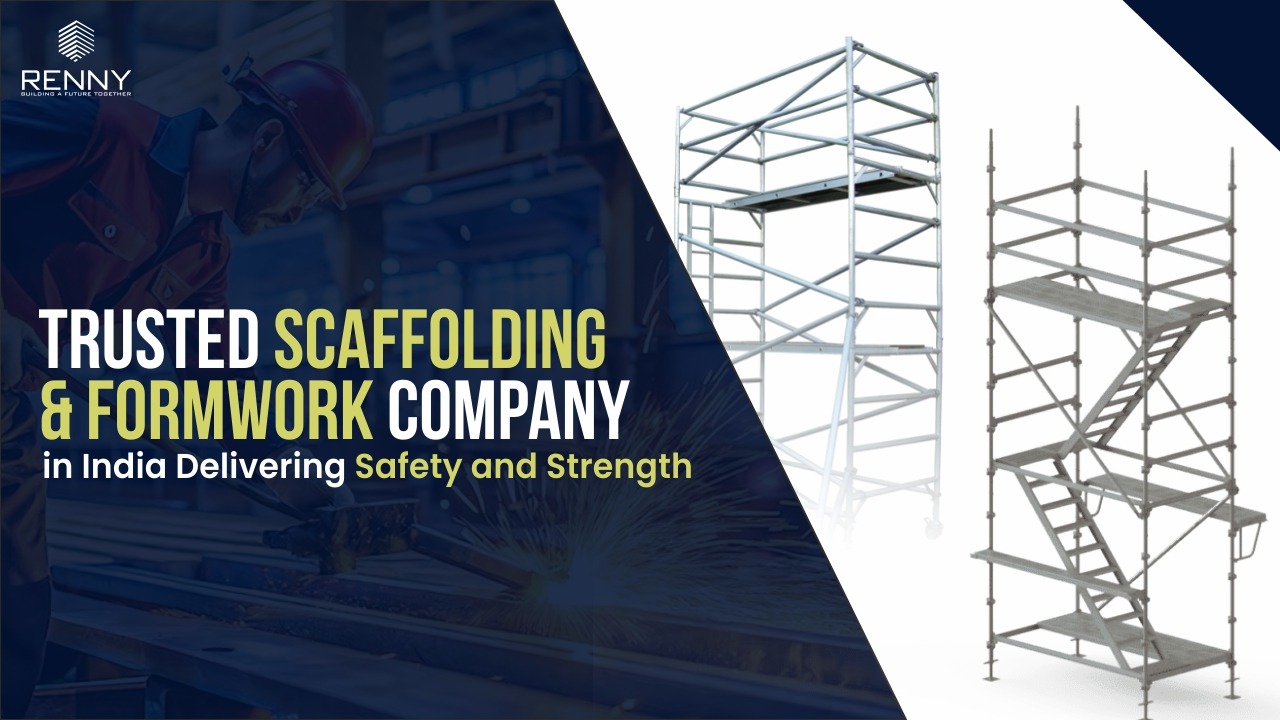
Trusted Scaffolding and Formwork Company in India Delivering Safety and Strength

Scaffolding & Formwork Company in India

Renny Strips stands out as a leading Scaffolding and Formwork Company in India, committed to providing robust construction solutions that prioritize both safety and structural strength. In an industry where reliability is paramount, the company has earned a reputation for delivering high-quality scaffolding and formwork systems that cater to diverse construction needs—from residential and commercial buildings to large-scale industrial projects.

Safety remains the cornerstone of any construction project. A dependable scaffolding system ensures workers can operate at heights with confidence, while well-designed formwork provides the framework for concrete structures to set precisely, reducing the risk of structural flaws. Renny Strips combines cutting-edge materials, innovative designs, and strict quality controls to create scaffolding and formwork solutions that not only meet but often exceed industry safety standards.

At the heart of Renny’s approach is a steadfast commitment to safety. Their engineered components—such as forged Couplers, Combi Plates, Jack Nuts, Prop Nuts, and modular systems like Cuplock, Ringlock, Formwork Panels, Steel Props & Jacks, Kwikstage, and Frames—are precision-made from high-strength Q235 carbon steel. They conform to standards such as AS1576, EN 12811, EN 1090, and ISO 3834, ensuring each product meets global benchmark stability and load-bearing requirements.

Renny solutions are built to withstand the toughest conditions. Components are available in galvanized, powder-coated, painted, electro-galvanized, or self-finish options—offering resilience against corrosion and allowing extended reuse across multiple cycles, resulting in lower maintenance costs and enhanced sustainability.Their scalability and modular design—combined with ergonomic ease of handling—ensure quick assembly, reduced labor, and adaptability to complex architectural needs.

A hallmark of Renny Strips is its sustainability-focused operations. With 90% of raw materials produced in-house, they maintain stringent quality control and deliver one of the industry’s shortest lead times, translating into dependable, on-time solutions for clients. Set to operate a 22 MW solar power plant that supplies around 40% of its energy needs, helping reduce its carbon footprint significantly—by as much as 75% compared to industry norms—and paving the way for green construction practices.

Renny Strips continues to expand its product offerings—growing from approximately 1,000 SKUs to 3,000 SKUs—so customers gain access to a broader spectrum of advanced, customizable solutions that align with evolving construction demands.Their global reach approx 40+ countries across six continents, including markets like Europe and North America, where low-emission products will benefit from reduced taxation under the upcoming Carbon Border Adjustment Mechanism (CBAM).

One of the key advantages of partnering with a trusted scaffolding and formwork provider is the assurance of reliability under challenging conditions. Renny Strips offers modular scaffolding systems that are easy to assemble, flexible to adapt to complex architectural designs, and robust enough to handle heavy loads. Their formwork solutions utilize advanced engineering techniques, ensuring uniformity and accuracy in concrete placement, which ultimately enhances the durability of the structure.

Durability is another defining factor of Renny Strips’ offerings. The materials used in scaffolding, such as high-strength steel and aluminum, are carefully selected to withstand extreme environmental conditions. Whether it’s resisting corrosion in humid climates or bearing heavy construction loads, these materials guarantee longevity, reducing maintenance costs and project downtime. Similarly, the formwork systems are designed for multiple reuse cycles without compromising structural integrity, making them both cost-effective and environmentally responsible.

In addition to material quality, Renny Strips emphasizes innovation. Their engineering team continuously develops solutions that optimize assembly time, reduce labor requirements, and improve overall efficiency on-site. By integrating smart design with practical usability, the company ensures that contractors and construction managers can focus on project execution rather than troubleshooting structural support challenges. This level of precision and adaptability distinguishes Renny Strips as a leading Scaffolding and Formwork Company in India.

Compliance with national and international safety standards is integral to Renny Strips’ operations. All scaffolding and formwork products undergo rigorous testing to ensure they meet prescribed load-bearing capacities and stability benchmarks. Moreover, the company offers training and guidance to construction teams on safe handling and usage practices, further reinforcing its commitment to workplace safety.

Customer-centric solutions are a hallmark of Renny Strips’ approach. Understanding that each project presents unique challenges, the company provides customized scaffolding and formwork solutions tailored to specific site requirements. From high-rise urban buildings to complex industrial facilities, their expertise ensures that structural support systems are engineered to provide maximum efficiency, safety, and cost-effectiveness.

The construction industry is continuously evolving, and adapting to modern architectural demands requires flexibility and forward-thinking solutions. Renny Strips excels in offering modular systems that can be easily adjusted or expanded as projects progress. This adaptability not only accelerates construction timelines but also enhances the overall quality of the finished structure.

Partnering with a trusted scaffolding and formwork company is an investment in both safety and project success. Renny Strips’ unwavering focus on quality, innovation, and client satisfaction positions it as a reliable partner for contractors, engineers, and developers seeking dependable structural support solutions. Their ability to combine engineering precision with practical usability ensures that every project benefits from strength, stability, and efficiency.

Renny Strips exemplifies excellence as a Scaffolding and Formwork Company in India. Through a combination of superior materials, innovative engineering, strict adherence to safety standards, and customer-focused solutions, the company empowers construction professionals to achieve exceptional results while minimizing risks. Whether managing a high-rise development or an industrial facility, Renny Strips delivers scaffolding and formwork systems that embody reliability, durability, and structural integrity—qualities that form the foundation of every successful construction project.

Best Scaffolding & Formwork Manufacturers in India

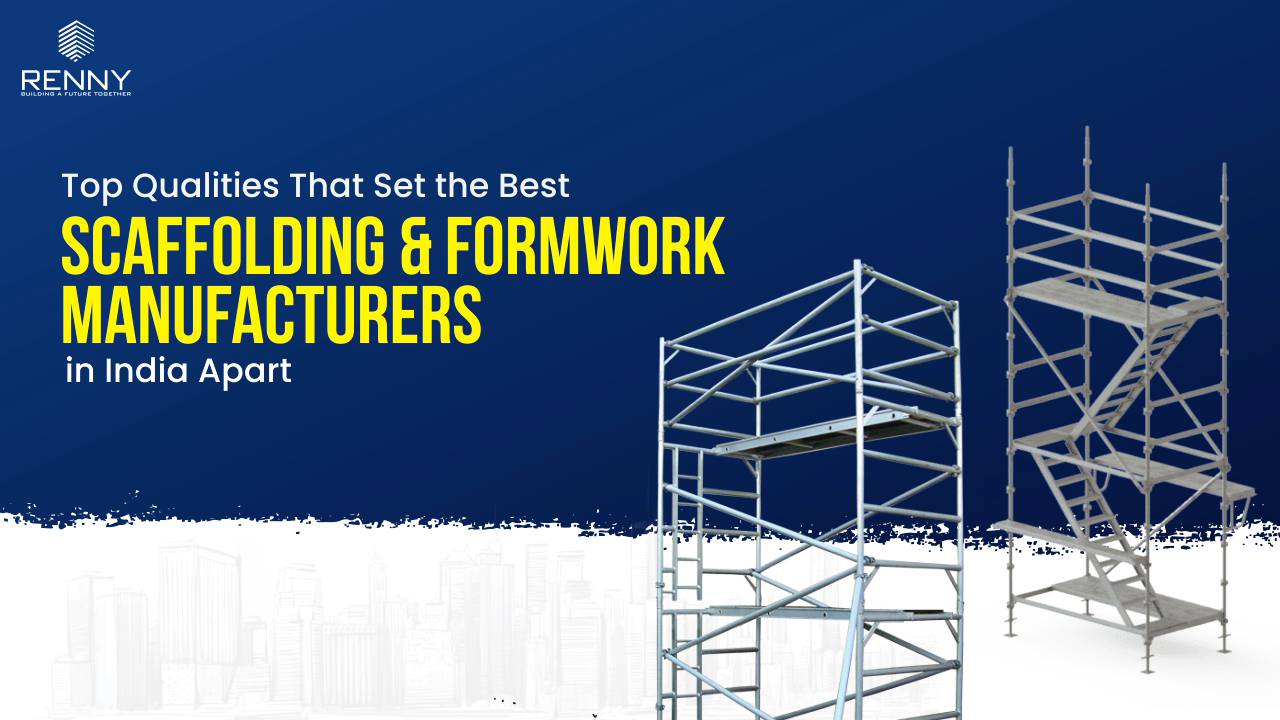
Top Qualities That Set the Best Scaffolding & Formwork Manufacturers in India Apart

Best Scaffolding & Formwork Manufacturers in India

Spend even a day on a construction site where deadlines are slipping, and you’ll quickly realize, poor scaffolding can bring everything to a halt. Shaky joints, missing parts, unstable platforms, it’s not just frustrating, it’s risky.

What most people don’t see is this: the real difference between a site that runs smoothly and one that constantly hits snags often comes down to the  Scaffolding & Formwork Manufacturer in India behind the scenes, some raise the bar, others barely meet it.

It’s about knowing what matters when choosing a scaffolding partner in India. Let’s unpack the top qualities that separate the best scaffolding manufacturers from the ones just playing in the industry.

How to Identify the Best Scaffolding & Formwork Manufacturer in India?

An Uncompromising Obsession with Safety

The top-tier players don’t just say they care about safety, they bake it into every step.

These are the companies that won’t ship a single unit unless it’s been rigorously tested for load-bearing, dimensional tolerance, and fatigue resistance. Their scaffolding systems meet not just Indian standards (IS 2750, IS 4014), but also global ones like BS EN 12811 or OSHA guidelines.

They go beyond compliance. They perform stress simulations, conduct independent audits, and sometimes even simulate accidental impact to check resilience. Because at the end of the day, if it can’t handle unpredictable site conditions, it doesn’t belong on the job.

High-Grade Raw Materials That Don’t Rust, Buckle, or Crack

Here’s a simple truth: even the best design fails if the steel isn’t up to mark.

The best scaffolding & Formwork Manufacturer in India  source only from trusted steel mills. They prefer high-tensile carbon steel, hot-dipped galvanized pipes, or precision-drawn aluminum, depending on the end-use. You won’t find mystery metal or re-rolled scrap in their inventory.

Want to know if they’re serious about material quality? Ask if they do ultrasonic testing, or if they can show you MTCs (Material Test Certificates). If they can’t, move on. Great scaffolding begins at the mill, not the factory.

Precision Engineering at Scale

This is where the greats pull ahead of the pack. Why does this matter? Because a millimeter’s misalignment in a scaffold can compromise the entire structure when scaled vertically. The goal isn’t just “good enough.” It’s repeatable accuracy, where every piece locks in snugly without site hacks or forced fitting.

Some of the best-run Indian scaffolding units also have in-house design teams working with 3D CAD software. They don’t just manufacture; they engineer site-specific solutions before the first tube is cut.

Real Customization, Not Just Multiple Sizes

You can always tell a serious manufacturer by how they respond to special requests. Need modular scaffolding that fits around a cooling tower with varying curvature? Want a hybrid system for metro pillar shuttering and facade work? The top names won’t flinch. They’ve done it before.

Instead of shoving “closest match” items at you, they take the time to understand your project, study your drawings, and co-create what’s required. It’s not just about what’s in stock. It’s about who’s willing to create what you need.

Documentation That Speaks the Language of Engineers

Let’s be honest, no one wants to chase specs written in vague language like “suitable for standard loads.” Top players provide precise, detailed technical documents. Their catalogs come with full dimensional drawings, safe working load data, torque ratings, and installation guidelines. You’ll often see QR-coded manuals, digital on boarding videos, and quick-reference checklists built for project engineers.

It’s this level of detail that empowers clients to make informed decisions, and it shows how well the manufacturer understands real-world job site needs.

On-Site Support That’s Actually Useful

Any manufacturer can send you metal parts. But the best ones send people too. Whether it’s training your ground staff, assisting with first-time assembly, or troubleshooting joint configurations, they’re there. In person. With tools, drawings, and practical experience.

Some even deploy certified scaffold inspectors who audit your setup and issue safety reports. Others offer remote support via video call with real-time walkthroughs. Because problems don’t only happen in boardrooms, they happen on site. And the best manufacturers know how to show up when it counts.

Consistent Deliveries, Even to Remote Corners

Ever had to explain to a site manager why work stopped because the scaffolding didn’t arrive? The best manufacturers plan around this. They maintain strategically located warehouses, build buffer inventory, and use route-optimized logistics to get material to even the most remote locations in India.

A few have started offering live GPS tracking for shipments. Others work with project management tools to sync scaffold delivery with the progress of civil work. You’re not just buying metal, you’re buying time. And late deliveries cost far more than overnight freight charges.

Clients Who Speak for Them, Loudly and Willingly

Here’s a simple trick to find the truth: ask for project case studies or client references. The scaffolding & Formwork Manufacturer in India will happily give you a list of past work, from refinery shutdowns in Jamnagar to data center builds in Noida. They’ll show you photos, share learnings, and connect you with clients who’ve worked with them for years. If a manufacturer struggles to show this, they’re either too new, or too forgettable.

Final Thought  

Scaffolding is like the skeleton of your project. And just like you wouldn’t build a building on a weak foundation, you shouldn’t build your trust on weak manufacturing. When you choose a scaffolding manufacturer, you’re choosing who stands behind you when safety, deadlines, and complexity collide.

So, go visit the factory. Ask about their last big project. Sit down with their engineers. And trust your gut when you see who treats your work as seriously as you do. Because the  best scaffolding & Formwork Manufacturer in India don’t just manufacture, they elevate your entire project.