
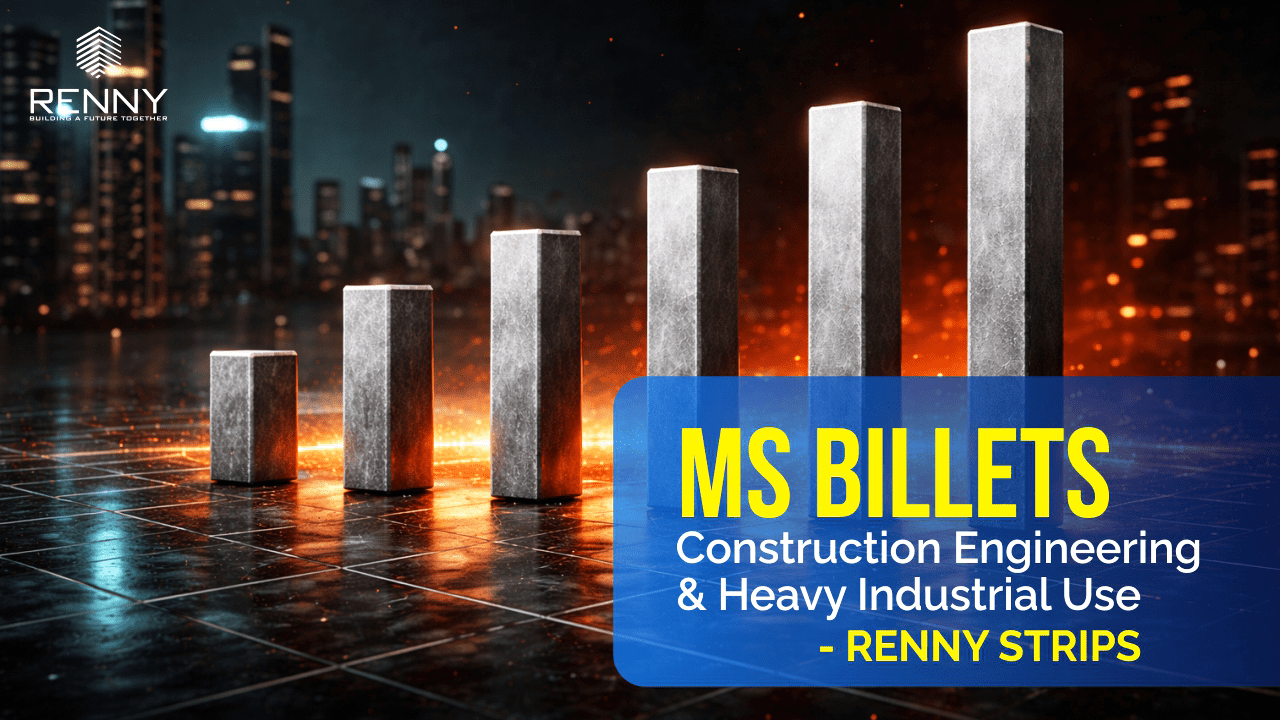
Mild steel billets, commonly referred to as MS Billets, are foundational semi-finished steel products that serve as the raw material for a wide range of structural and industrial components. At Renny Strips, our MS billets are engineered to deliver unmatched strength, uniformity, and metallurgical integrity suited for demanding applications across construction engineering and heavy industries.
What Is an MS Billet?
An MS billet is a semi-finished length of mild steel, usually cast with a square cross-section, that mills roll or forge into finished products. "MS" stands for mild steel, meaning low carbon content, generally below 0.25%.
After reheating, a billet is typically turned into:
- TMT bars and other reinforcing bars
- Angles, channels, flats and beams/li>
- Wire rods for wire, nails and fasteners (see our wire rods)
- Forging blanks for shafts, gears and machine parts
A billet is not a finished product, so whatever flaws it carries, such as inclusions, segregation or surface cracks, are rolled into the bar, rod or section made from it.
What Makes MS Billets Integral to Modern Steel work?
MS billets are produced through controlled casting or rolling processes to achieve a square or rectangular cross-section, ensuring consistent dimensions and a homogeneous internal structure. These billets are the starting point for transforming raw steel into long products such as rebars, structural beams, channels, rods, and more. Their versatility and material properties make them indispensable for downstream processing, including forging, rolling, extrusion, and machining.
For industries where strength, durability, and reliability are non-negotiable, the choice of MS billet directly influences product performance. Whether forming the backbone of infrastructure or creating load-bearing machine parts, these billets enable engineers and fabricators to achieve high standards of quality and safety.
Core Metallurgical Characteristics
High-quality MS billets exhibit a balanced chemical composition with controlled carbon content, which results in excellent mechanical properties such as tensile strength, ductility, and weldability. These traits ensure that billets can withstand heavy loads and adapt to complex fabrication processes without compromising structural integrity.
Key material properties relevant to industrial applications include:
- Uniform Composition
Enables predictable behavior during forming and processing.
- Good Weldability
Supports robust joint formation in structural assemblies.
- Machinability
Facilitates precise shaping and customization of parts.
- High Strength
Ensures performance under high stress or load conditions.
These material traits are crucial for industries where safety, performance, and lifecycle expectations are stringent.
Typical Chemical Composition
Chemistry shifts with the grade and with the product the billet will become. The ranges below are typical for mild steel billets.
| Element | Typical range | Why it matters |
|---|---|---|
| Carbon | 0.10-0.25% | Sets strength and hardness; too much hurts weldability and ductility |
| Manganese | 0.30-1.00% | Adds strength and toughness, and offsets the effect of sulphur |
| Silicon | Up to 0.30% | Acts as a deoxidiser and adds some strength |
| Sulphur | 0.050% max | Excess makes steel brittle during hot working |
| Phosphorus | 0.050% max | Excess lowers toughness, especially in cold conditions |
Check the heat-wise test certificate against your specification instead of relying on typical values.
MS Billet vs Ingot vs Bloom vs Slab
These four terms get mixed up often. The difference comes down to size, shape and how the steel was cast.
| Product | Shape and size | How it is cast | Typically rolled into |
|---|---|---|---|
| Ingot | Large tapered block | Poured into moulds | Re-rolled in mills that still use this route |
| Billet | Square, up to about 150 x 150 mm | Continuous casting (CCM) | Rebars, wire rods, small sections, forgings |
| Bloom | Square or rectangular, larger than a billet | Continuous casting, or rolled down from ingots | Heavy sections, rails, large forgings |
| Slab | Wide, flat rectangle | Continuous casting | Plates, hot rolled coil, sheet |
The practical gap between an MS ingot and an MS billet is quality. Continuous casting gives a smoother surface and a more uniform interior, which is why modern rolling mills prefer billets.
MS Billets in Construction Engineering
In construction engineering, MS billets are a critical upstream product. They are most often transformed into reinforcing bars (rebars), structural frames, beams, columns, and other essential steel sections that form the skeleton of buildings, bridges, flyovers, and heavy civil infrastructure.
Reinforced Concrete Frameworks
Reinforced concrete relies on steel reinforcement to provide tensile strength to complement concrete’s high compressive strength. MS billets become the feedstock for reinforcing bars that secure concrete elements against cracking and deformation under load. The dependability of these rebars is directly tied to the quality of the billets from which they are derived, influencing long-term durability and structural resilience.
Load-Bearing Structural Components
Structural steel used in beams, columns, and trusses begins life as MS billets. These profiles must reliably bear heavy loads and accommodate design tolerances in commercial, industrial, and multi-storey construction projects. It is why engineers emphasize billet quality in terms of uniformity and mechanical performance.
Welded and Fabricated Assemblies
Fabricated assemblies such as brackets, braces, and connector plates rely on billets that can be cleanly welded and shaped. The ability to form strong welds reduces failure risks at critical junctions. This requirement is especially important in seismically active regions and load-intensive structural systems.
MS Billets for Heavy Industry and Engineering
Outside of construction, MS billets are essential to heavy industrial sectors including automotive, machinery manufacturing, energy, and transportation systems. Their role spans from basic structural support to highly engineered components.
Automotive and Machinery Components
Billets serve as the raw material for forged shafts, gears, axles, and other machine components that must endure cyclic stresses and abrupt load changes. The uniform material properties of MS billets ensure consistent performance through machining and heat treatment.
Industrial Fabrication and Forging
In forging shops and metalworking facilities, billets are transformed by heat and pressure into high-precision components for heavy equipment and tools. Their ductility enables deformation without cracking while maintaining sufficient strength for demanding uses.
Infrastructure and Energy Applications
Steel products derived from MS billets are used in pipelines, pressure vessels, and structural supports for power generation and distribution systems. Their reliability under thermal cycling and mechanical loading makes them well suited for use in oil, gas, and renewable energy projects alike.
The Casting and Manufacturing Process
Producing high-performance MS billets begins with quality raw materials and precise process control. Continuous casting machines (CCM) and controlled furnace conditions ensure billets are formed with minimal inclusions and uniform grain structure, key factors that enhance subsequent forging and rolling performance.
Renny Strips' commitment to advanced de-scaling technology, precision casting, and rigorous quality assurance ensures each billet meets exacting standards for metallurgical soundness. A well-manufactured billet translates into predictable behavior in production lines and superior finished product quality.
From Melt to Billet: Production Steps
- Charging and melting.
Scrap, sponge iron or pig iron is melted in an induction furnace, electric arc furnace or converter.
- Refining.
The chemistry is adjusted to the target grade and slag is removed.
- Ladle treatment.
Deoxidisers go in, and the melt is brought to the right temperature for casting.
- Continuous casting.
Liquid steel runs through a water-cooled mould and solidifies into a continuous strand.
- Cutting and cooling.
The strand is cut to length and cooled under control.
- Inspection.
Dimensions, surface condition and chemistry are checked before dispatch.
The furnace route affects residual elements and carbon footprint, so ask any supplier which one they use.
MS Billet Sizes, Grades and Standards
The table shows what buyers commonly specify. Confirm the exact size and grade against your rolling plan before you place an order.
| Parameter | Common specification |
|---|---|
| Cross-section | 100 x 100, 120 x 120, 125 x 125, 130 x 130 and 150 x 150 mm |
| Length | Usually 6 m to 12 m, cut to order |
| Carbon content | Up to 0.25% for mild steel grades |
| Reference standards | IS 2830 for re-rolling billets; IS 1786 for the rebars rolled from them |
| HSN code | 7207 (semi-finished products of iron or non-alloy steel) |
| Documents | Heat-wise test certificate, plus a chemical analysis on request |
Current sizes and availability are listed on our MS billets page.
Selecting MS Billets: Factors to Consider
Professionals specifying billets for construction or industrial use should evaluate several key criteria:
- Material Grade and Composition:
Ensure the billet’s chemical makeup aligns with design requirements.
- Dimensional Accuracy:
Reduces waste and enhances fit in downstream processes.
- Surface Quality:
Minimizes defects that can propagate during forming or machining.
- Supply Chain Reliability:
Ensures consistent delivery schedules for uninterrupted manufacturing.
- Production Route:
Shows how the steel was melted and cast, which affects residual elements and consistency from heat to heat.
- Test Certificates:
Lets you check chemistry and mechanical results batch by batch before the material reaches your line.
Choosing billets with these qualities adds value by reducing production challenges and enhancing final product performance.
Exporting MS Billets to Europe: CBAM and Documentation
European buyers now ask for more than a mill certificate. Iron and steel fall under the EU's Carbon Border Adjustment Mechanism (CBAM), and semi-finished steel under CN code 7207 is in scope. Since 1 January 2026, EU importers have to account for the emissions embedded in these goods, so they need emissions data from the exporter for each consignment.
Expect to be asked for:
- Commercial invoice and packing list
- Heat-wise test certificate
- Embedded emissions data for the product
- Proof of country of origin
For how the mechanism works in detail, see our CBAM page.
Renny Strips: Your Partner in Structural Steel Solutions
At Renny Strips, our MS billets stand out for their metallurgical purity, dimensional consistency, and adaptability across critical applications. With decades of industry expertise and a commitment to quality, we provide bulk and custom solutions for forward-looking construction and industrial enterprises.
From forging precision components to enabling heavy-load architectural steel work, Renny Strips’ MS billets are engineered to deliver the performance and reliability professionals expect. With integrated logistics, advanced production facilities, and stringent quality systems, we support your projects from concept through execution.
Frequently Asked Questions
What is an MS billet?
An MS billet is a semi-finished length of mild steel, usually square in section, that mills roll or forge into finished products such as rebars, wire rods and structural sections.
What is the difference between an MS ingot and an MS billet?
Ingots are poured into moulds and have a coarser grain structure. Billets are continuously cast, which gives a smoother surface and a more uniform interior.
What are MS billets used for?
They are the raw material for TMT bars, wire rods, angles, channels, flats and forged parts for machinery and vehicles.
What is the HSN code for MS billets?
MS billets fall under HSN code 7207, semi-finished products of iron or non-alloy steel.
What sizes do MS billets come in?
Common sections run from 100 x 100 mm to 150 x 150 mm, usually in lengths of 6 m to 12 m, cut to order.
How are MS billets made?
Steel is melted, refined to the target chemistry, then continuously cast into a strand that is cut to length and cooled.
Need Help Choosing the Right Product?
Have questions about pricing, technical details, or bulk orders? Get in touch with our team.