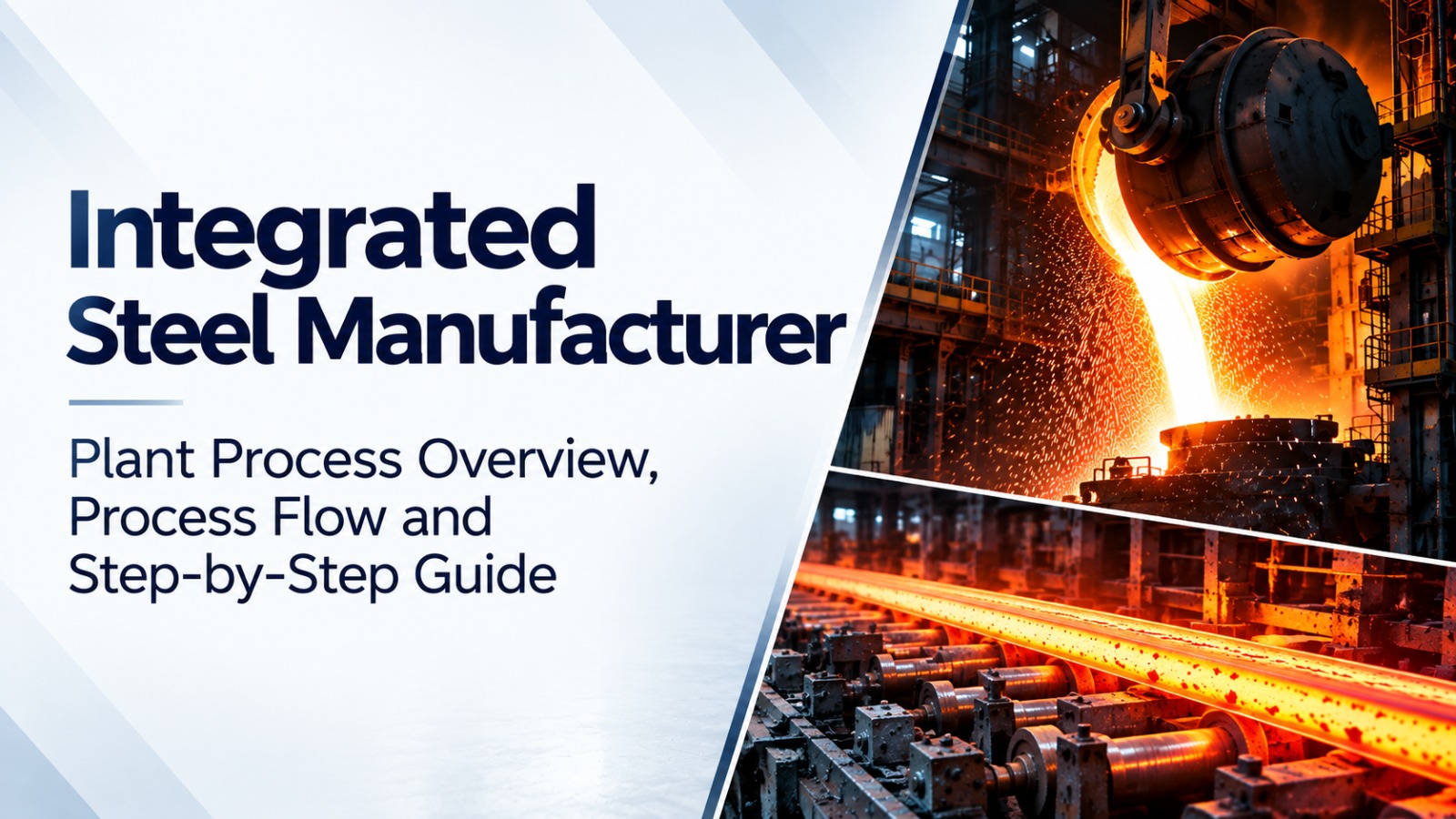
An integrated steel manufacturer runs several connected stages of steel production under one roof: melting, casting, rolling and, in many cases, finished products like pipes. How many stages it actually owns varies from plant to plant. What matters to buyers is simple. When one producer handles the chemistry, the scheduling and the test records, there are fewer handovers where things can go wrong.
India is now the world's second-largest crude steel producer, at roughly 150 million tonnes in 2024 according to the World Steel Association. With that much supply around, the useful question is no longer whether steel is available but who controls how it is made. This guide covers the plant process, the flow from melt to market, how integrated and non-integrated producers compare, and what to check before you place an order.
What Is an Integrated Steel Manufacturer?
An integrated steel manufacturer makes its own steel and takes it through casting, rolling and processing in-house, instead of buying billets, slabs or coils from the open market.
Types of integrated steel plants
The word "integrated" is used loosely, so it helps to separate the two models common in India.
| Model | Starting inputs | Steelmaking unit | Typical scope |
|---|---|---|---|
| Classical BF-BOF plant | Iron ore, coking coal, fluxes | Blast furnace, then basic oxygen furnace | Large primary producers |
| Vertically integrated manufacturer | Scrap, sponge iron, alloys | Electric or induction furnace | Melting through to finished products |
BF-BOF accounts for roughly 70% of global crude steel output (World Steel Association). Not every integrated producer owns mines or a blast furnace, so the practical question is always which stages are in-house.
How is it different from a steel processor?
A processor buys semi-finished steel and re-rolls, slits or fabricates it. Its work may be excellent, but the chemistry was decided by someone else's furnace. An integrated manufacturer decides it at its own.
Integrated Steel Manufacturer Plant Process Overview
An integrated plant strings its units together so each one feeds the next, with little reheating, hauling or re-inspection in between. The layout depends on the steelmaking route, and blast furnace ironmaking and DRI are alternatives rather than compulsory stages. Most plants include these units:
- Raw material yard
metallics, fluxes such as limestone and dolomite, and alloys are received, tested and blended.
- Ironmaking (route-dependent)
a blast furnace makes hot metal, or DRI and sponge iron are used as inputs.
- Steelmaking and refining
a BOF, electric arc or induction furnace produces liquid steel, and ladle treatment then adjusts carbon, manganese, sulphur and phosphorus to the grade.
- Continuous casting
liquid steel solidifies into billets, blooms or slabs.
- Rolling and finishing
hot rolling, slitting, tube forming, coating and fabrication.
- Captive utilities
in-house power, oxygen, water treatment and by-product recovery.
Casting is the pivotal handoff. Renny's MS billets come straight off its own casting machine and become the feed for every rolling and tube-making line downstream.
Integrated Steel Manufacturer Process Flow Explained
The process flow shows how metallic inputs become liquid steel, then billets, then finished products. The stages themselves are standard across the industry. The advantage comes from how directly they connect: material moves on without being sold, trucked and re-inspected between suppliers, one metallurgical team answers for chemistry from melt to finished pipe, and each heat can be linked to its test records all the way to dispatch. That record continuity matters more every year for compliance and carbon reporting.
One plant, different routes by product
Products do not all follow the same path through the plant.
| Product family | Route through the plant |
|---|---|
| Wire rods | Melting, casting, billet reheating, rolling into rod |
| Narrow-width HR coils | Melting, casting, hot rolling into coil |
| ERW pipes and tubes | HR coil, slitting, forming, ERW welding, sizing, coating |
| Scaffolding and formwork parts | Tubes or sections, then cutting, welding, galvanising |
Renny's narrow-width HR coils are both a product sold to customers and the feedstock for its own tube mills, which is where the melt-to-pipe chain becomes easy to see.
Where quality checks happen
Checks are spread along the flow instead of left to the end. Incoming material is tested for chemistry, every heat is analysed by spectrometer, casting and rolling are monitored for surface and dimensional drift, ERW seams are inspected and flattening-tested, and finished product goes through hydro, mechanical and dimensional tests before dispatch.
Integrated Steel Manufacturer Step-by-Step Guide: From Melt to Market
This is the sequence for a vertically integrated plant making rods, coils and pipes. Steps 6 to 9 apply only to certain products.
- Raw material verification: inputs are tested for chemistry before charging.
- Steel melting: inputs are melted under controlled temperature and power.
- Refining and alloying: chemistry is trimmed to the target grade and confirmed before tapping.
- Continuous casting: liquid steel is cast into billets and checked for defects.
- Hot rolling: billets are rolled into coils or wire rods to the required tolerance.
- Slitting (coils only): coils are cut to the strip width each pipe size needs.
- Forming and ERW welding (pipes and tubes only): strip is formed into a tube and seam-welded. This is the stage behind ERW pipes and tubes.
- Sizing, straightening, cutting and coating: done where the specification calls for it, including galvanising.
- Fabrication: components such as scaffolding parts are cut, welded and finished.
- Testing and certification: mechanical, chemical and dimensional results go into mill test certificates.
- Packaging and dispatch: each batch ships with documents tying it back to its heat number.
How Does an Integrated Steel Manufacturer Maintain Consistent Quality?
Owning the stages helps, but consistency comes from controls and evidence. A good habit for any buyer is to ask what proof exists for each control point, and the table below shows what to request.
| Control point | What it prevents | Evidence to request |
|---|---|---|
| Raw material and heat chemistry | Off-grade steel | Incoming inspection and heat analysis reports |
| Casting and rolling monitoring | Surface defects, dimensional drift | Dimensional inspection reports |
| Weld inspection on ERW products | Seam defects | Weld test and hydro test records |
| Mechanical testing | Strength or ductility shortfall | Tensile, yield and elongation results |
| Heat-number traceability | Mixed or unidentified batches | Mill test certificate tied to the heat |
Integration does not guarantee defect-free steel, and a supplier who claims it is overselling. What it does is make it easier to connect records across the stages the manufacturer controls.
Integrated vs Non-Integrated Steel Plants: What Is the Difference?
| Factor | Integrated manufacturer | Non-integrated producer or re-roller |
|---|---|---|
| Production scope | Multiple connected stages in-house | Processes purchased billets, slabs or coils |
| Raw material | Depends on actual in-house coverage | Depends on external suppliers |
| Quality and traceability | Records can run across owned stages | Upstream records depend on the supplier |
| Delivery planning | Planned across linked stages | Exposed to feedstock availability |
| Price behaviour | Less exposed to billet swings, but energy and input costs still apply | Follows feedstock price movements |
| Carbon data | Can be collected across owned stages | Needs upstream data to be complete |
| Small-batch flexibility | Moderate | Often high |
Does an integrated plant always make better steel?
No. Integration improves coordination, but suitability still comes down to the specification, the test results and the application. A well-run re-roller with traceable feedstock can beat a poorly run integrated mill, and price follows the same logic. The cheapest quote is rarely the cheapest delivered, conforming material.
When does a non-integrated supplier make sense?
Small batches, specialised processing and quick regional availability can favour a re-roller, as long as the material meets the specification and arrives with upstream records.
Why Do EPC Contractors and Industrial Buyers Choose Integrated Steel Manufacturers?
Contractors looking for a steel supplier for EPC projects are usually trying to remove variables on site. An integrated producer appeals because specifications and documentation are more predictable, production schedules are easier to see when stages are planned together, and one manufacturer answers for the stages it controls. That also means fewer vendors to manage when pipes, coils and fabricated parts come from the same place.
None of this is automatic. Lead time and price depend on capacity, utilisation, logistics and contract terms. The sensible approach is to compare suppliers on measurable history: on-time-in-full delivery, rejection rates at receipt, and how long a quality query takes to resolve. Also compare quotes on total cost, including freight, rework, inspection, delays and the inventory buffer you hold against them, rather than on price per tonne alone.
How Does an Integrated Steel Manufacturer Support Sustainability and CBAM Reporting?
The EU's Carbon Border Adjustment Mechanism entered its definitive period on 1 January 2026, and iron and steel imports are in scope. Importers need emissions data for the steel they bring in, so producer-level data has become a commercial asset. A manufacturer that controls melting, casting and rolling can meter energy and material flows across those stages, while a re-roller usually depends on upstream figures it cannot measure.
Reported, verified and compliant are not the same
A reported figure is one the producer states. A verified figure has been checked by an independent body against a defined boundary and standard. Compliance means the figure is accepted under the applicable regulatory rules. Ask for the boundary, methodology, reporting period and verifier. EU-bound buyers can see what Renny offers on its CBAM page.
Renny's documented performance
Renny reports an embedded emission intensity of 0.6385 tCO₂ per tonne, verified by TÜV Rheinland to ISO 14064-3, and holds a 5-Star Green Steel rating from NISST under the Ministry of Steel. It has 43 MW of captive solar, with 22 MW commissioned in January 2026 and 21 MW being installed for Unit IV, and offers a real-time emissions dashboard so buyers can run their own CBAM and ESG checks.
Renny Strips Limited: A Vertically Integrated Steel Manufacturer in India
Renny Strips Limited, based in Ludhiana, has about 30 years of legacy and reports producing around 90% of its raw material in-house. Its chain runs from induction furnaces with digital furnace control to a continuous casting machine, then to rolling mills making narrow-width HR coils and wire rods. Tube mills turn the coils into pipes and tubes, and coating lines and electro-galvanising add corrosion protection.
Fabrication sits at the end of that chain. CNC machines, robotic welding and CAM-programmed tools produce scaffolding and formwork systems, supported by an in-house design centre using AutoCAD, SolidWorks and CAM. Renny's certifications include EN 1090, ISO 3834, CE, ISO 9001, ISO 14001, ISO 45001 and BIS across the range. Check that each certificate's scope covers the exact product you are buying.
Unit IV expansion
Renny is investing ₹400 crore in Unit IV, a 35-acre automated plant due to go live in 2027. Group melting capacity is set to rise 88%, from 2,00,000 to 3,75,000 TPA, and scaffolding and formwork output from 1,500 to 6,500 tonnes per month. The plant will have 30 welding robots, 5 tube lasers and an automatic hot-dip galvanising line.
If you want to talk through specifications, volumes or delivery schedules, enquire about Renny's steel products and manufacturing capabilities.
How to Evaluate an Integrated Steel Manufacturer Before Placing an Order
Run any supplier through these questions before you commit:
- Which stages are really in-house, and what share of raw material is captive?
- Does the product meet the applicable BIS, IS, EN or ASTM standard for your use?
- Are mill test certificates issued per batch and tied to heat numbers?
- Are certifications valid, and do they cover this exact product?
- What capacity, lead time and delivery commitments will go into the contract?
- Can they share emissions data with its boundary, method and verifier?
Frequently Asked Questions About Integrated Steel Manufacturers
What is heat-number traceability in steel manufacturing?
It links a finished product or batch to the production heat it came from and to that heat's test records. The mill test certificate normally carries the heat number, chemistry and mechanical results.
What is the difference between a BF-BOF plant and an induction furnace plant?
BF-BOF plants make hot metal from iron ore and coking coal, then refine it in an oxygen furnace. Induction furnace plants melt scrap and sponge iron electrically. They differ in scale, inputs and emissions profile.
Why is steel from an integrated manufacturer often more consistent?
The manufacturer can coordinate chemistry, process parameters and checks across the stages it owns. Consistency still depends on equipment, testing and documented procedures.
Does an integrated steel manufacturer always offer lower prices?
No. Price depends on raw material, energy, utilisation, logistics and market conditions. Compare the cost of conforming material delivered on time.
Which certifications should buyers check?
BIS product certification, ISO management-system certificates, and product or project standards such as EN 1090 for structural components. Requirements depend on the product, application and destination market.
How can an integrated manufacturer support CBAM reporting?
Control of several stages makes process-level emissions data easier to collect. Buyers should still verify boundary, methodology and independent verification instead of assuming compliance.
How does integration improve supply reliability?
It reduces dependence on outside feedstock for the stages made in-house and allows planning across them. Actual reliability also depends on capacity, maintenance, logistics and contract commitments.
Is Renny Strips Limited an integrated steel manufacturer?
Yes, by its own account. It reports in-house melting, billet casting, rolling and downstream manufacturing, with about 90% of raw material produced internally.
Choosing the Right Integrated Steel Manufacturer for Your Requirements
Integration connects production stages and can improve coordination, traceability and planning, but evidence is what proves quality. Verify specifications, certificates, capacity, delivery commitments and emissions data before you order. Renny Strips Limited offers melt-to-market manufacturing from Ludhiana, backed by documented quality systems and sustainability data. Share your product specifications, project requirements or bulk volumes with Renny's team to get started.
Need Help Choosing the Right Product?
Have questions about pricing, technical details, or bulk orders? Get in touch with our team.