
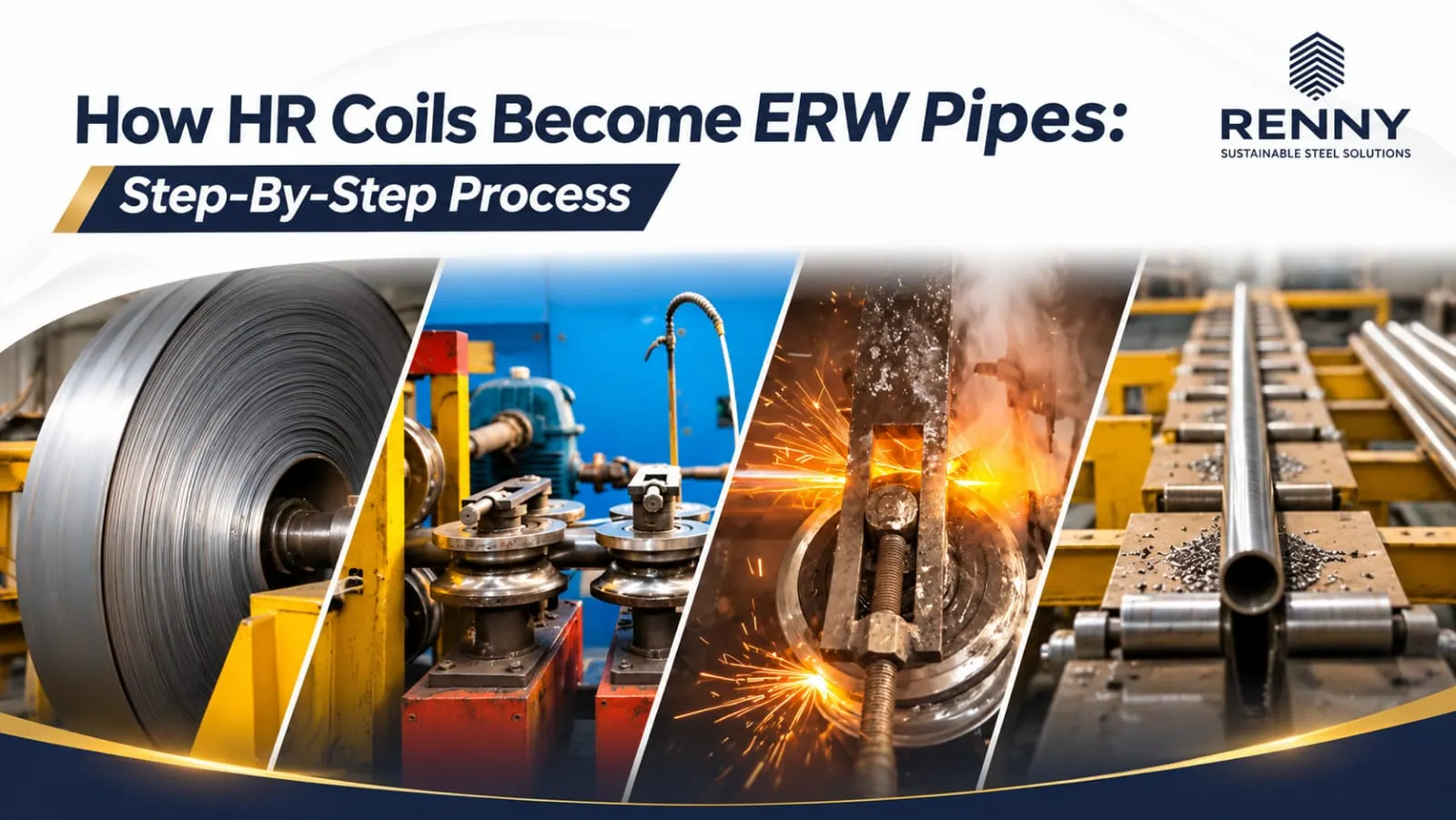
HR coil to ERW pipe is a continuous cold-forming and welding route: a hot-rolled coil is slit into strips, rolled into an open tube, closed by high-frequency electric resistance welding with no filler metal, then sized, tested and cut to length.
Every scaffold, roof truss and solar mounting structure starts as a coil, and the coil sets the ceiling for the pipe. India produced about 150 million tonnes of crude steel in 2024, second only to China (worldsteel), and ERW pipes and hollow sections are one of the main ways that steel reaches construction and infrastructure.
HR Coil to ERW Pipe: Plant Process Overview
An ERW plant turns coil into finished pipe in eight stations, most of them on one continuous mill line, and the weld station is the only point where metal is joined.
The eight stations at a glance
- Coil yard: incoming HR coil is identified by heat number and stored.
- Slitter: the wide coil is cut lengthwise into strips called skelp.
- Joiner and accumulator: strip ends are welded together, and a strip reserve keeps the mill running.
- Forming mill: cold rolls bend the strip into an open tube.
- High-frequency welder and bead scarfer: the seam edges are heated and forged together, then the bead is trimmed.
- Cooling, sizing and shaping: the tube is cooled, sized, shaped for square or rectangular sections, and straightened.
- Flying saw: cuts the moving tube to length without stopping the line.
- Finishing and galvanising: ends are finished and marked, then pipes are varnished or hot-dip galvanised.
Two plant routes: slit-to-width vs integrated coil-to-pipe
| Route | Where the coil comes from | What it means for the pipe |
|---|---|---|
| Bought-in coil | Wide HR coil from a steel mill, slit in-house or by a service centre | Quality varies by supplier lot, and traceability usually stops at the mill test certificate |
| Own narrow width coil | Steel rolled in-house close to pipe-strip width | Less slitting and edge-trim waste, and tighter control of rolling |
| Integrated melt to pipe | Melt shop, billet caster, rolling mill and pipe mill in one facility | Chemistry and emissions data controlled from the melt, with full traceability |
Renny Strips runs the third route, covered in detail below.
What Makes an HR Coil Pipe-Grade
A pipe-grade HR coil has chemistry, thickness and edges consistent enough that the weld seam forms the same way from the first metre to the last.
What an HR coil is
Steel is reheated to roughly 1,100 to 1,250°C, rolled while hot (finishing above about 850°C) and wound into a coil. In India, strip for welded pipe is covered by IS 10748. Pipes up to about 150 mm (6 inch) diameter typically use coil of 1.5 to 6 mm thickness. The surface carries mill scale, which is removed only where a later step such as pickling requires it.
Coil properties that decide weld quality
| Property | Why it matters | What to check |
|---|---|---|
| Chemistry: low carbon, low sulphur and phosphorus | Controls weldability and the inclusions that start hook cracks | Heat analysis on the mill test certificate against IS limits |
| Thickness across the width | Uneven wall heats unevenly and leaves edges mismatched | Readings at both edges and the centre |
| Camber and edge wave | A sideways bow pulls the edges out of line at the weld point | Strip laid flat against a straightedge |
HR coil vs CR coil vs pre-galvanised coil for pipes
| Coil type | Typical wall | Surface | Typical pipe |
|---|---|---|---|
| HR (hot rolled) | Thicker | Matte, mill scale | MS black pipe, structural tube, GI pipe (galvanised after welding) |
| CR (cold reduced) | Thinner | Smooth, bright | Thin-wall precision tube |
| Pre-galvanised | Thin to medium | Zinc applied to the coil | GP pipe for fencing and light structures; the weld seam loses zinc and is usually touched up |
Prime vs secondary coil: how to tell
- The mill test certificate carries a heat number that matches the coil tag. A missing or hand-written certificate is a red flag.
- Thickness visibly varies across the width or along the length.
- Edges show cracks, laminations or pitting rust.
- A bundle mixes heat numbers or carries no label.
- The price sits far below the going HR coil rate.
Pipe from secondary coil can pass a visual check and still fail a flattening test. Mills that roll their own narrow width HR coil can control these variables at source.
HR Coil to ERW Pipe: Raw Material to Finished Product, Station by Station
Each station below is described by what it does and the one variable that controls it. Tests and defects are covered under quality control.
Slitting: coil to skelp
Slitting cuts the wide coil lengthwise into skelp, and the strip width fixes the pipe's outside diameter.
Strip width formula
Strip width ≈ π × (outside diameter − wall thickness) + forming allowance. For a 48.3 mm pipe with a 3.2 mm wall, π × 45.1 gives about 141.7 mm before the allowance, which each mill sets from its own roll data.
Why edges matter
The slit edges become the weld faces, so a burr or a wave here turns into a weld defect two stations later.
Coil joining and strip accumulator
The tail of one strip is shear-cut and butt-welded to the head of the next so the mill never stops. An accumulator (cage or loop type) feeds the mill from a reserve while the joint is made. The control variable is constant line speed, because weld heat is set against speed.
Roll forming
Breakdown stands, then cage or fin-pass rolls, bend the strip gradually into an open round tube at room temperature. The control variable is edge parallelism: the two edges must arrive at the weld point flat and level. Because forming is cold, only the seam is ever heated.
High-frequency induction welding
Induction welding heats the seam edges with a coil that never touches the strip, then forges them together under pressure.
Induction vs contact welding
Induction uses a coil around the tube, so there is no contact wear on the strip. Contact welding uses sliding contacts on the edges. Induction is the usual choice for structural and line pipe.
Impeder, V-angle and heat-input window
- Impeder: a ferrite-core rod inside the tube near the weld point that steers current to the edges rather than around the back of the tube.
- V-convergence angle: the edges approach each other in a V. A small, stable angle concentrates the current, while a drifting angle changes weld heat.
- Heat-input window: power must match line speed and wall thickness. Too little heat leaves a cold weld, and too much burns the edges.
Squeeze rolls and weld bead
Squeeze pressure sets how much hot metal is pushed out as bead, and that expelled metal carries oxides out of the weld line.
Bead trimming and seam normalising
The outside bead is scarfed flush straight after welding, and the inside bead is trimmed where the application needs it. For demanding uses, the seam is reheated by induction, typically to about 900 to 950°C, and air-cooled to soften the hard, fast-cooled weld zone and refine its grain.
Cooling, sizing and shaping
Water cooling sets the weld, then sizing rolls bring the tube to its outside diameter and roundness, and straightening rolls remove bow. The control variable is roll alignment and wear.
Round to square and rectangular
Square and rectangular hollow sections are welded as round tube and reshaped by turk's head roll stands. Corner radius is the control variable, and the cold work at the corners raises yield strength there.
Cutting, end finishing and marking
A flying saw cuts the moving tube to length, commonly 6 m. Ends are faced, bevelled or threaded (threads to IS 554 where specified). Marking carries the standard, size and class, the ISI mark and the batch or heat number that later makes traceability possible.
Galvanising: where MS black and GI pipes split
After welding and testing, a black pipe is dispatched as MS black pipe, plain or varnished, or it goes to the galvanising plant:
- Degrease to remove oil.
- Pickle in acid to remove scale.
- Flux so the zinc wets the steel.
- Dip in molten zinc at about 450°C.
- Steam-blow the inside to clear excess zinc.
- Quench.
Both finishes come off the same ERW line, as detailed in Renny's range of ERW pipes and tubes.
HR Coil to ERW Pipe Quality Control Stages
Quality control on an ERW line works as seven gates, each with a defined test and a defined action when a lot fails.
The seven QC stage gates
Quality checks by stage
| Stage | Checkpoint | Method | If it fails |
|---|---|---|---|
| 1. Incoming coil | Grade, chemistry, thickness, width, edge condition | Mill test certificate check, gauge readings, visual inspection | Reject or hold the coil |
| 2. Slit strip | Width, edge burr, camber | Gauge and visual check at the slitter | Re-slit or scrap the strip |
| 3. Forming and welding | Weld power, line speed, squeeze pressure, edge alignment | Continuous monitoring of mill settings | Stop the line, adjust, and mark the affected length |
| 4. Post-weld NDT | Seam integrity | Eddy current or ultrasonic scan on the line | Segregate the flagged length |
| 5. Finished-pipe lab |
Traceability from heat number to pipe batch
- Heat number: identifies the melt and its chemistry.
- Coil number: each coil is tagged with its heat.
- Pipe batch: pipes made from a coil are logged against that coil number.
- Marking and documents: the batch number on the pipe links back to the mill test certificate.
With this chain intact, a defect found in one pipe can be traced to a coil and heat, and the rest of that lot can be pulled before it ships.
How Much Pipe Does One Tonne of HR Coil Make?
One tonne of HR coil makes about 281 m of 48.3 × 3.2 mm pipe at theoretical weight, before scrap.
Weight per metre and metres per tonne
- Weight per metre (kg) = 0.02466 × wall × (OD − wall), with OD and wall in mm.
- Metres per tonne = 1,000 ÷ weight per metre.
Worked examples
| Pipe (OD × wall, mm) | Strip width (mm, approx.) | Weight (kg/m) | Metres per tonne (theoretical) |
|---|---|---|---|
| 21.3 × 2.6 | 58.8 | 1.20 | about 834 |
| 48.3 × 3.2 | 141.7 | 3.56 | about 281 |
| 114.3 × 4.5 | 345.0 | 12.18 | about 82 |
Where theoretical yield is lost
- Edge trim at the slitter.
- Coil-end crop and the joint between coils.
- Cut-end scrap at the saw and end facing.
- Lengths rejected by NDT or lab tests.
Yield differs by mill and pipe size, so compare quotes on actual delivered weight per metre against the standard's tolerance, not on theoretical figures alone.
Finished Product: Pipe Types, Sizes and Indian Standards
One ERW line can produce four product families, each governed by its own Indian standard.
What one ERW line can make
| Product | Governing standard | Finish | Typical use |
|---|---|---|---|
| MS black pipe, structural and scaffolding | IS 1161 | Uncoated or varnished | Frames, scaffolding, formwork, general fabrication |
| MS black and GI pipe for fluids | IS 1239 (Part 1), with zinc to IS 4736 for GI | Black, varnished or hot-dip galvanised | Water, gas, air and steam lines, plumbing, fire-fighting |
| Square and rectangular hollow sections (SHS, RHS) | IS 4923 | Black or galvanised | Pre-engineered buildings, trusses, solar structures |
| Mechanical and general engineering tube | IS 3601 | Black or coated | Automotive parts, agricultural equipment |
Indian standards and their international counterparts
| Indian standard | Nearest international counterpart | Note |
|---|---|---|
| IS 1239 (Part 1) | ISO 65 and EN 10255 for threaded water and gas tubes; ASTM A53 often quoted by export buyers | Scope and grades differ |
| IS 1161 | EN 10219 and ASTM A500 for welded structural tube | Check yield and test requirements |
When ERW is the right choice vs seamless
- Choose ERW for structural work, scaffolding, water and gas at moderate pressure and general engineering, where uniform wall thickness and cost matter.
- Choose ERW with extra checks (seam normalising, full-length NDT) where the pipe will be bent, flared or pressurised.
- Choose seamless for very high-pressure or high-temperature service such as boilers.
Carbon Footprint of the Coil: Green Steel and CBAM for Pipe Buyers
A pipe inherits almost all of its carbon footprint from the steel in its coil. Iron and steel production accounts for roughly 7 to 9% of global CO2 emissions (worldsteel, IEA), and the figure per tonne varies widely between coal-based blast furnace routes and scrap-based electric routes. The pipe mill adds electricity and, for GI pipe, galvanising fuel, which is small by comparison. That is why buyers now ask for emission data per product.
India's Green Steel Taxonomy star bands
In December 2024, India's Ministry of Steel launched the Green Steel Taxonomy. Steel emitting less than 2.2 tonnes of CO2e per tonne of finished steel qualifies as green. The National Institute of Secondary Steel Technology (NISST) is the nodal agency that measures, verifies and certifies it.
| Star rating | Emission intensity (tCO2e per tonne of finished steel) |
|---|---|
| 5-star | Below 1.6 |
| 4-star | 1.6 to 2.0 |
| 3-star | 2.0 to 2.2 |
Source: Down To Earth.
CBAM dates exporters should track
The EU's Carbon Border Adjustment Mechanism prices the embedded emissions of imported steel products, including tubes and pipes.
- 1 January 2026: the definitive phase begins.
- February 2027: EU importers can buy CBAM certificates.
- 30 September 2027: first annual declaration due for 2026 imports.
When a supplier cannot provide actual emission data, importers generally fall back on EU default values, which tend to be less favourable. Product-level data from the supplier is therefore a commercial advantage, and a lower-emission pipe means a lower carbon cost for the European buyer. For the full compliance picture, see Renny's guide to CBAM for Indian steel exporters.
How Renny Strips Runs the Coil-to-Pipe Route in One Facility
Renny Strips takes steel from melt to billet, rolls it into narrow width HR coil and forms it into finished ERW pipes in one integrated facility.
- In-house raw material: 90% of raw material is produced in-house, so each pipe traces back to its heat.
- Green steel recognition: Renny is recognised as a 5-Star Green Steel manufacturer by NISST, Ministry of Steel, Government of India [web team: add certificate number and issue date].
- Lower emissions: carbon emissions are 40% lower than the industry standard [web team: state the baseline and year].
- Range: MS black pipe, GI pipe and square and rectangular hollow sections made to BIS standards, supplied export-ready.
Supplier Verification Checklist: Documents to Ask For Before You Buy
A supplier that controls its coil can prove it on paper. Ask for these eight items before placing an order:
- A valid BIS licence number for the product.
- The IS standard and grade, printed on the pipe marking.
- A mill test certificate whose heat number matches the pipe batch.
- Chemistry and mechanical values on that certificate, checked against the IS limits.
- NDT and hydrostatic test records for the batch, where the standard requires them.
- A zinc coating certificate for GI pipe.
- Emission data per product, with the green steel star rating if claimed.
- Export documents and committed delivery dates.
Ready to compare suppliers on these points? Request a quote from Renny Strips.
Conclusion
The coil sets the ceiling for every ERW pipe, so the best checks happen before the mill starts. Ask where the steel came from, how it was tested and what it emitted, and choose a supplier who can answer all three with documents.
Frequently Asked Questions About HR Coil to ERW Pipe
Frequently Asked Questions
How is ERW pipe made from HR coil?
HR coil is slit into strips, cold-formed into an open tube and welded along the seam by high-frequency current with no filler metal. The bead is trimmed, then the pipe is sized, tested and cut to length.
What is the raw material for ERW pipe?
Hot-rolled (HR) steel coil, made to IS 10748 for welded tubes in India. GI pipe gets its zinc after welding, while GP pipe starts from pre-galvanised coil.
What is the difference between HR coil and CR coil for pipes?
HR coil is rolled hot, is thicker and has a matte, scaled surface, so it suits structural, water and general pipes. CR coil is cold-reduced, thinner and smoother, so it suits thin-wall precision tube.
What is skelp in ERW pipe making?
Skelp is the narrow strip slit from a wide coil and formed into the pipe. Its width is set by the pipe's outside diameter and wall thickness.
How is strip width calculated for an ERW pipe?
About π × (outside diameter − wall thickness), plus a small forming allowance set by the mill. A 48.3 × 3.2 mm pipe needs roughly 142 mm of strip.
How many metres of pipe does one tonne of HR coil make?
Divide 1,000 kg by the pipe's weight per metre. A 48.3 × 3.2 mm pipe weighs about 3.56 kg/m, giving roughly 281 m per tonne before scrap.
How is the quality of ERW pipe checked?
In seven gates: coil inspection, slit-strip checks, in-line weld monitoring, eddy current or ultrasonic scanning, lab tests such as flattening and tensile, coating tests for GI pipe, and pre-dispatch checks.
Is a hydrostatic test done on every ERW pipe?
It depends on the standard. IS 1239 water and gas tubes are tested at about 5 MPa, while structural tubes are generally not hydro-tested, so check what the governing standard requires.
Why is no filler metal used in ERW welding?
The strip edges are heated to forging temperature by electrical resistance and pressed together, so the steel itself fuses. That is the "electric resistance" in ERW.
Is ERW pipe suitable for high-pressure service?
Yes within limits, depending on grade, wall and standard. Seamless pipe is generally preferred for the most demanding
Need Help Choosing the Right Product?
Have questions about pricing, technical details, or bulk orders? Get in touch with our team.